In 2013, Bevi’s prototype needed an unusual component: a founder inside the cabinet. Eliza Becton hid in the machine and operated its functions while her colleagues filmed an application video for Techstars. The automatic dispenser was, briefly, a person. Frank Lee later recalled: “We had Eliza hide inside the machine.” By the accelerator interview, the prototype worked. It is an entertaining beginning for a company devoted to taking unnecessary things out of the beverage business.
- Filter tap water. Add flavor and fizz. Skip the individual bottle.
- Sell to shared spaces, with ingredients and service that keep the machine pouring.
- The useful buying question: how many drinks will it actually replace?
Becton, an industrial designer, founded Bevi with Sean Grundy and Lee. Their target was a familiar absurdity: filling containers with water, transporting them to buildings supplied with water, then discarding the containers. Bevi would filter what came through the pipe and mix the drink there. Grundy described the ambition as “to only ship non-water ingredients.” The water could stay local; the flavor could travel light.
“to only ship non-water ingredients”
SEAN GRUNDY / CO-FOUNDER / 2022
The mug was already there
The first approach tried to organize the container, too. An early machine dispensed reusable bottles for a return-and-sanitize system. It was bulky. Offices supplied a helpful correction: people already carried mugs and glasses. Remove bottle dispensing and the engineering problem shrinks. Sell to an office and the purchasing problem shrinks as well: one decision-maker can authorize drinks for everybody.
This is the first useful lesson to borrow. Before persuading a customer to adopt another habit, inspect the habits that already work. Bevi found a place where the reusable vessel existed, the water connection existed and somebody had a refreshment budget. Its first commercial machine went to MIT’s Venture Mentoring Service in late 2014. The company, initially called Refresh, adopted the name Bevi in 2015.
A small factory with a flavor menu
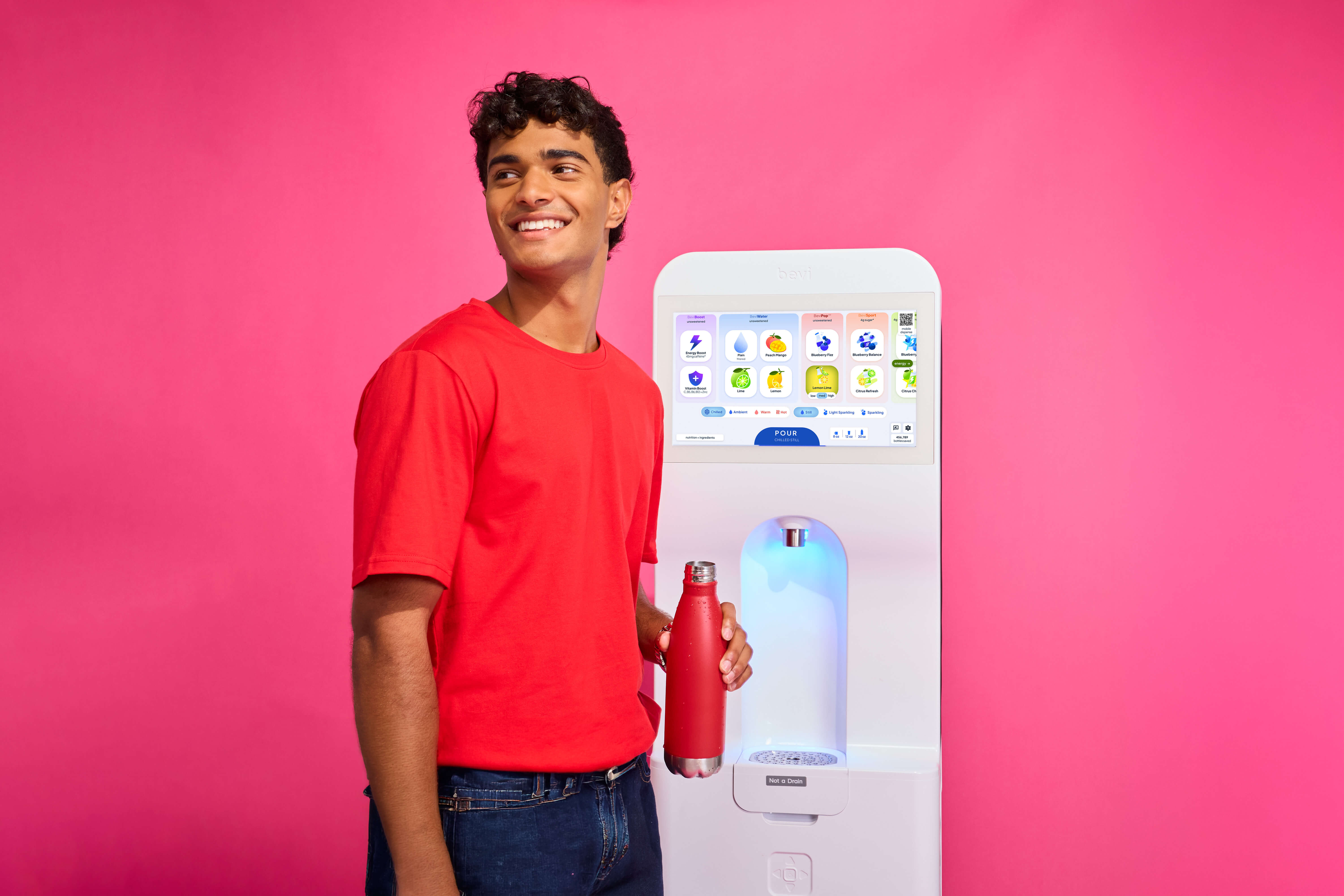
Today’s Signature Standup 2.0 offers still or sparkling drinks, hot, cold or ambient water, and eight slots for flavors and enhancements. A user can mix up to three flavors and two enhancements, adjusting strength and carbonation. The countertop family puts a dispenser above the worktop and supporting equipment below it. Exact capabilities depend on the generation. These are commercial appliances, installed by Bevi or qualified partners, rather than gadgets to unpack beside the toaster.
The distinctive engineering question is how to make repeated pours taste consistent. Early customer research found complaints about ordinary soda fountains: variable concentration and flavors crossing paths. Bevi’s original mixing system used digitally controlled peristaltic pumps, drawing on medical-device dosing. Precision had a second benefit. Measuring ingredients also helped the company know what needed replenishing. A pleasing drink and a sensible service route could come from the same information.
The internet connection therefore earns its keep behind the menu. Bevi and service partners monitor machines for ingredient refills, carbonation tanks and maintenance. According to the company’s FAQ, a Wi-Fi outage does not stop dispensing. This is connected hardware whose daily value depends on quite physical chores. Filters need changing. Ingredients run out. A touchscreen cannot charm an empty carbonation tank into producing bubbles.
The company buying the drinks is the customer
Bevi competes for the refreshment budget held by offices, hotels, gyms, apartment buildings and other shared spaces. Named corporate customers include Netflix, Lyft and Bank of America. Its current website invites more than 6,000 companies to join. The business spans the United States, Canada, the UK and Ireland. A tenant or employee chooses a drink; a facilities buyer chooses the equipment and the bill.
That distinction explains the business model: equipment sales or leases, plus recurring ingredients and service. It also explains why distribution matters. Canteen’s partnership, announced in 2017, took a company concentrated in Boston, New York and San Francisco into major metropolitan markets across the continental United States. Existing refreshment operators knew the buildings, customers and delivery routes. A better dispenser still needed someone who could reach it.
The alternatives are mundane and formidable: a stocked refrigerator, a jug cooler, a soda fountain or another commercial dispenser. Smartwell and MYX offer related dispensing options. Bevi’s proposition combines drink variety, customization and monitored service with less handling of individual packages. A basic filter may satisfy a workplace that wants only water. The broader menu matters when it replaces purchases people would otherwise make.
Count the pours before the savings
In May 2022, Grundy described all-in plans costing roughly $300 to $600 monthly, including the machine, drinks and maintenance. Those are historical figures. Current pricing is tailored, while Bevi’s FAQ estimates average beverage costs of 12 to 28 cents per 12-ounce pour, depending on concentrate and carbonation use. Buyers should ask which charges their quote includes, then compare the whole monthly bill with the drinks it replaces.
A busy machine earns its space.
Illustrative fixed-cost arithmetic. Enter the full monthly quote and expected 12-ounce servings; this is not a Bevi tariff.
PER SERVING AT THESE INPUTSInclude equipment, consumables, service and other contract charges in the monthly total.Attendance changes the arithmetic. A fixed monthly bill spread across many drinks looks different when the office empties. In March 2020, roughly 90% of Bevi’s customers closed their offices. The vulnerability was shared occupancy. By August 2022, the company had more than 4,000 commercial customers and secured $70 million from Cowen Sustainable Investments. The funding announcement targeted new commercial settings, product development and manufacturing capacity. Capital was buying infrastructure as well as beverages.
For a prospective buyer, the conditions are concrete: a suitable water supply, power, installation space and enough regular users. Connectivity enables monitoring. Service coverage must match the address. Count occupied days, rather than desks on a floor plan, and check whether employees will actually swap their cans for refills. The environmental case also depends on that substitution and on what vessel catches the pour.
Single-use plastic bottles avoided cumulatively by December 2025, according to Bevi.
Root beer, with a plain-water button
Bevi reported reaching one billion single-use plastic bottles avoided in December 2025. That is its cumulative estimate of displaced packaging, rather than a count of bottles retrieved from the sea. Its stated workplace values - humility, accountability and continuous improvement - sound most useful when applied to the same practical question: what gets someone to choose the next refill?
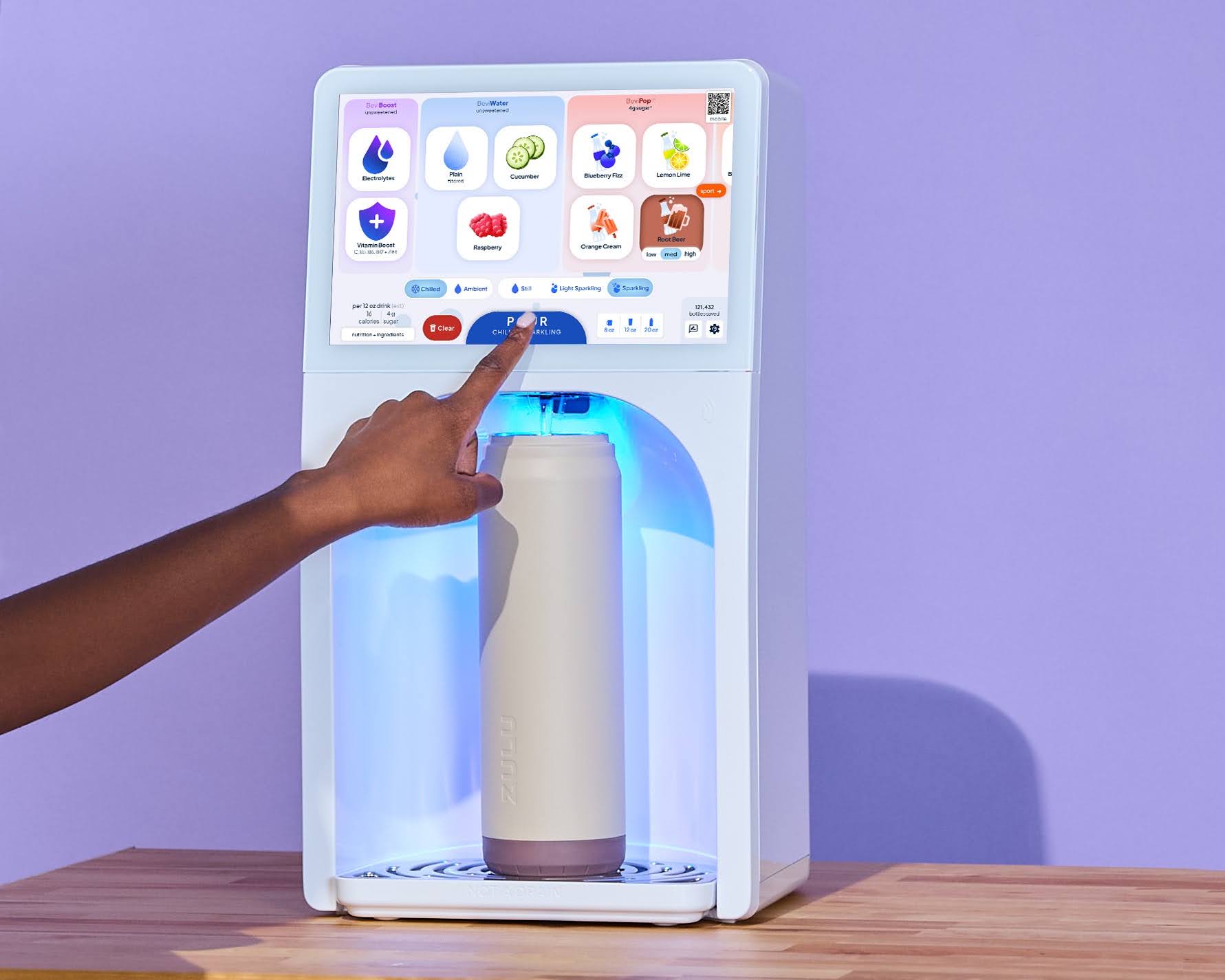
The 2026 answer includes soda. September’s BeviPop FAQ describes Root Beer, Orange Cream, Lemon Lime and Blueberry Fizz, available in the U.S. and Canada. At the published standard serving, each has 15 calories and four grams of sugar per 12 ounces. Enhancements can expand the recipe. The installed machine becomes a place to introduce another drink, without distributing an individual package for every serving.
Meanwhile, August’s interface update gave plain filtered water a dedicated button, added automatic volume pouring and made settings easier to clear. As the menu grows, the simplest order needs an obvious route. Bevi’s story keeps returning to that small act of subtraction: let people use the mug they own, the water already supplied and a button they can find. Even root beer needs somewhere sensible to begin.