An artery is a peculiar place to look for a business idea. It is narrow, difficult to inspect, and inclined to keep its troubles private. Yet the distinction that interests Elucid is smaller still: the difference between how much room blood has to pass and what, exactly, is accumulating inside the artery’s wall. Those questions are related. They are not identical.
The Boston medical technology company analyzes CT angiography with software called Plaque-IQ. Its wager is that a clearer account of plaque composition can help physicians decide how to treat the person attached to the scan. The unusual ingredient is histology: actual tissue, examined under a microscope, used to train and validate the algorithms interpreting an image.
- The product: CT-based plaque quantification for coronary and carotid arteries.
- The distinction: tissue-informed classification, including lipid-rich necrotic core.
- The business challenge: turn a useful measurement into a clinical habit that gets paid for.
The microscope behind the map
Founder Andrew Buckler was identified as president and chief technology officer in Elucid’s 2021 fundraising announcement. The earlier platform was called ElucidVivo. By 2024, Kelly Huang had become CEO, and PlaqueIQ was moving toward commercial release. The science had acquired a larger commercial assignment.
Think of the artery as a corridor. Measuring its width is sensible. But width alone does not describe the material behind the plaster. In atherosclerosis, plaque composition matters because some components are associated with greater vulnerability. Lipid-rich necrotic core, usually shortened to LRNC, is one such component. The name has little charm; the biological question has considerable consequence.
Elucid’s approach starts with a demanding comparison: what does the scan suggest, and what does the corresponding tissue contain? A published virtual-pathology study described 576 tissue samples paired with CTA. Pathologists annotated tissue components, while the software analysis was blinded to histology. Earlier work published in Radiology also examined agreement between software measurements and microscopic findings.
There is a practical reason this history matters. CT images contain blur and artifacts; a bright patch is not a tissue specimen. A 2023 review described Elucid’s work to compensate for scanner blur and explained that surgically collected carotid tissue helped supply its training and validation material. Turning an image into a biological estimate requires more than assigning attractive colors to pixels.
That is Elucid’s position in a market that includes HeartFlow and Cleerly: emphasize the biological reference behind the measurement. It is a distinction worth examining, rather than a reason to declare the competition settled. Different products, validation methods and clinical uses deserve comparison on their own terms.
A scan goes in. A decision still belongs to a doctor.
The operational detail is refreshingly concrete. A physician sends previously acquired CT images to Elucid. The company’s October 2024 launch announcement described image-restoration algorithms addressing motion and calcium-blooming artifacts, followed by trained analysts segmenting the data into a three-dimensional coronary model. Software then identifies and quantifies tissue structure and composition.
The FDA filing describes a cloud application with segmentation provided as a service. Human work is inside the workflow. The clinician receives an analysis to review and interrogate, rather than an autonomous instruction to perform a procedure. Its cleared purpose is to support assessment alongside symptoms, medical history, other tests and professional judgment.
“you can’t treat what you can’t see.”
Kelly Huang, Elucid CEO, October 2024
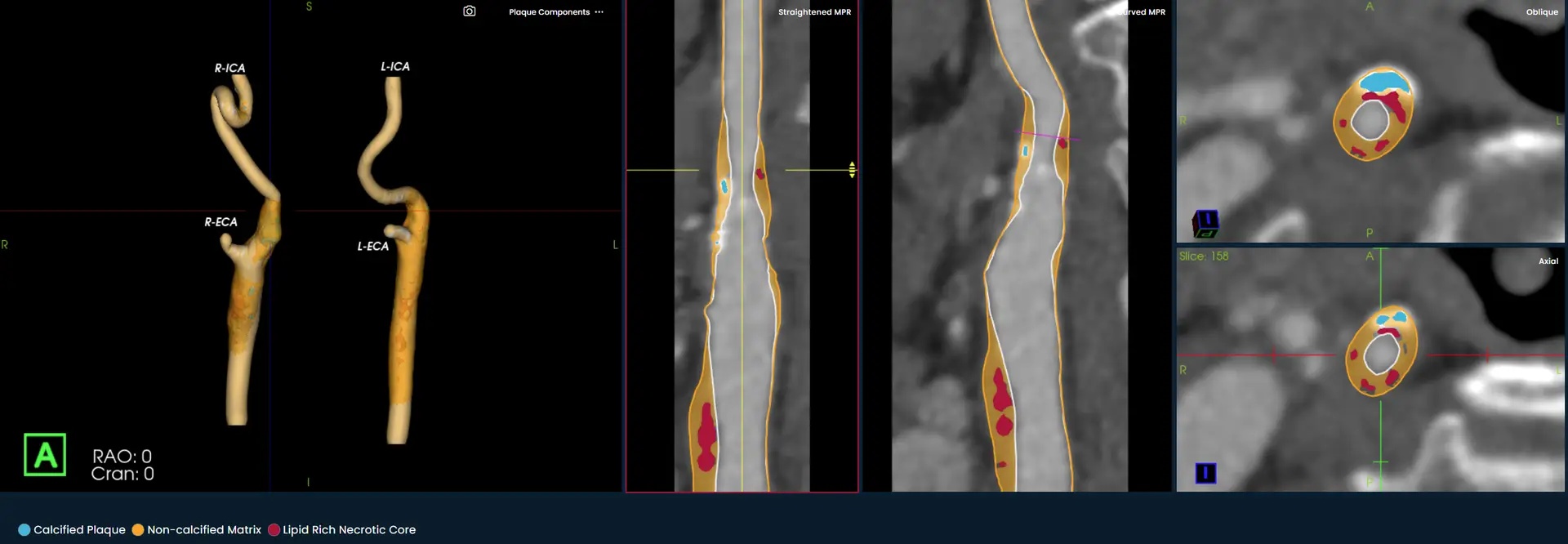
For cardiologists and radiologists, the resulting map can add information to discussions about prevention, medication and further investigation. Public testimonials include physicians at Ascension Saint Thomas Heart and Midwest Cardiovascular Institute. In October 2025, Elucid launched carotid analysis, extending the composition question to arteries relevant to ischemic stroke. The customer is a clinical service; the beneficiary is its patient.
The billing code joins the cast
Medical software has two audiences with very different reading habits. Doctors examine the report. Payers examine the claim. Elucid sells a cloud analysis service to providers, so adoption depends on whether a practice can order it, incorporate it into care and recover the expense. The elegant image must survive the inelegant paperwork.
In December 2025, Elucid reported that the new Category I CPT code 75577 and 2026 Medicare payment decisions supported coronary plaque analysis across care settings. Its published national-average figures were $1,021 for physician offices and imaging centers, and $951 for hospital outpatient settings. These are reimbursement amounts, not the company’s price or a patient’s bill. Eligibility and payer rules still matter.
Commercialization also consumes capital. An $8 million Series A in 2021 preceded a $27 million Series B in 2022 and an $80 million Series C led by Elevage Medical Technologies in 2023. In September 2026, Elucid announced a $55 million Series D and approximately $185 million raised in total. That is financing for development and expansion, not a disclosed development-cost ledger.
The latest proceeds support commercial growth, research and a planned BioIntegrated FFR-CT product. FFR concerns the physiological significance of a coronary blockage. Elucid proposes to derive that assessment from its plaque algorithm. As of its September announcement, the submission remained under FDA review. Cleared plaque analysis and an investigational physiology product occupy different regulatory positions.
The next question lives inside one lesion
In April 2026, Elucid introduced a Lesion Inspection Tool that lets physicians select a region and inspect its composition and plaque burden. The move makes its central argument tangible: a whole-patient total can conceal differences between individual lesions. A map becomes more useful when its reader can ask questions of particular streets.
July brought first enrollment in AI-PREDICT, a retrospective international study planning approximately 1,000 subjects across more than 20 sites. It compares patients who experienced myocardial infarction within 36 months of baseline CCTA with matched event-free controls. A central laboratory, blinded to outcomes, will analyze the scans. This is a study design, not a completed result.
Inside the company, the smaller rituals are pleasingly literal: a cross-functional “Plaqueathon,” peer-nominated “Heartbeat Awards,” and employee-led community activities. These are Elucid’s own descriptions of its culture. They suggest a workplace where the vocabulary follows the work, occasionally into the lunchroom.

The lesson other builders can borrow is specific: choose a credible truth standard, then build the route from measurement to action. The conditions are equally specific. Elucid needs usable CTA, trained interpretation and a workable payment pathway. Agreement with tissue does not itself prove fewer heart attacks. The next persuasive chapter will depend on what clinicians and studies can demonstrate after the map reaches the consulting room.