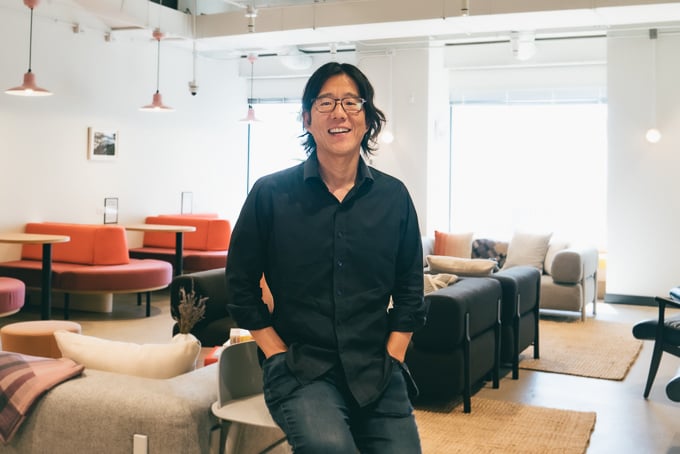
The doctor who decided heart attacks should be predictable
James K. Min runs Cleerly from Denver, where the company he founded in 2017 is trying to rewire how cardiology answers its oldest question. For most of a century, doctors have asked how narrow a coronary artery has become. Min's company asks something different: what is the plaque actually made of, and how much of it is there? His AI reads a coronary CT scan vessel by vessel, measures the different types of plaque in three dimensions, and turns that into a picture of risk that arrives faster than a radiologist could produce it by hand.
The pitch behind Cleerly is a blunt one, printed on the company's own materials: a world without heart attacks. It reads like marketing until you look at what sits behind it - an FDA clearance, a Medicare coverage decision, a dedicated billing code, and a randomized controlled trial called TRANSFORM that enrolls 7,500 patients across roughly 100 sites. Min is not selling a demo. He is running the kind of large-scale evidence machine he spent his academic career building, only now it is pointed at proving his own product.
Our goal here is to prove to the world that this approach of personalized cardiovascular evaluation and treatment is superior to the more population-based approaches that we've been using in the past.
James K. Min
Leaving the ivory tower
Before Cleerly, Min had the sort of resume that makes leaving look irrational. He was a professor of radiology and medicine at Weill Cornell Medical College and the founding director of the Dalio Institute of Cardiovascular Imaging at NewYork-Presbyterian, an institute seeded in part by a $20 million gift from Bridgewater founder Ray Dalio. He had served as president of the Society of Cardiovascular Computed Tomography and edited its flagship journal. He had run landmark studies - ACCURACY, CONFIRM, CONSERVE, CREDENCE, ICONIC, PARADIGM - names that read like a syllabus of modern cardiac CT.
So his exit surprised the field. As he has told it, the surprise was the point. His research at Cornell showed that analyzing soft coronary plaque could improve on the standard approach of counting calcium. But it was painstaking, manual work that lived and died within the walls of one academic center. The insight that pushed him out was less about the science and more about distribution.
The only way we're going to be able to do this very manual thing is to automate the whole thing and then deliver it at scale so that all medical centers could have access to that capability. And that's why we started Cleerly.
James K. Min, on founding the company
That is a founder's realization more than a physician's - the recognition that a good result stuck in a journal helps almost no one, and that the hard part is not proving something works once but making it work everywhere. Min belongs to a particular kind of health-tech founder: the ones who come from the problem itself, who treated the patients and ran the trials before they ever wrote a business plan.
What the technology actually does
Cleerly's software takes a coronary CT angiogram - a non-invasive scan - and uses machine learning trained on millions of images to characterize atherosclerosis. Rather than reducing a patient to a single number, it maps the plaque along each vessel, distinguishing the calcified deposits from the softer, more dangerous kinds, and estimates how much total burden a person is carrying. Min has described being able to calculate the 3D volumes of different plaque types to gauge heart-attack risk far more precisely than calcium scoring alone allows.
The clinical argument follows from that precision. If you can see disease earlier and grade it accurately, Min argues, you can act earlier too - and the toolbox for acting has never been fuller.
We're entering into an era where we're not only armed with better identification tools, more precision tools to really personalize somebody's heart evaluation, but we've got a huge heavy toolbox of medications and lifestyle modifications we can use to really prevent people from getting worse before they start to have their events.
James K. Min
Building the business case
Investors have followed the thesis with real money. Cleerly raised $43 million in 2021, closed a $223 million Series C led by T. Rowe Price and Fidelity in 2022, and then added a $106 million Series C extension in December 2024, this time led by the software investor Insight Partners with Battery Ventures joining. Total funding now runs past $400 million. Min has been clear about where the newer money goes: scaling commercially and generating clinical evidence, the two things that turn a promising scan into a routine one.
The less glamorous wins may matter most. In the run-up to the 2024 raise, Cleerly secured Medicare coverage and a CPT Category I code for advanced plaque analysis - the plumbing of American healthcare that decides whether a technology gets paid for and, therefore, whether it gets used. For a company whose founder spent years watching good ideas fail to scale, reimbursement is not a footnote. It is the whole game.
From Oklahoma to the operating theater of AI
Min was born in Norman, Oklahoma, in 1971. He earned a bachelor's degree from the University of Chicago in 1992, an MD from Temple University School of Medicine in 1999, then returned to Chicago for his internship, residency, and cardiovascular fellowship. His academic path ran through Weill Cornell, a stint as a senior investigator at the Harvard Clinical Research Institute, and a period at Cedars-Sinai before he landed back in New York to build the Dalio Institute. Along the way he authored more than 500 papers and four textbooks, and picked up the SCCT Gold Medal in 2017 - the same era he was starting the company that would consume the next chapter.
What ties the two chapters together is a stubborn preference for evidence over assertion. Min could have shipped a product and let the marketing do the work. Instead he built TRANSFORM, a trial designed to test whether personalized, plaque-based care genuinely beats the population-average approach that has governed cardiology for decades. If it does, the win is not just Cleerly's. If it does not, he will have run the study that says so. Either way, the plan is the same one he has followed his entire career: gather the data, then argue from it.
That is the quiet ambition underneath the tidy slogan. A world without heart attacks is a long way off, and Min knows the phrase invites eye-rolls. But he has spent thirty years moving toward it one scan, one trial, one reimbursement code at a time - which is a less romantic story than the tagline, and a more convincing one.