The most honest sentence on Betterworks’ website is not about artificial intelligence. It is an admission: “Conversations were essential to goal achievement.” That lesson took the company from a tidy piece of goal-setting software into a sprawling enterprise platform for OKRs, feedback, 1:1s, reviews, recognition, engagement surveys, calibration, skills and succession. In other words, Betterworks began by drawing the map and discovered that managers still had to drive the car.
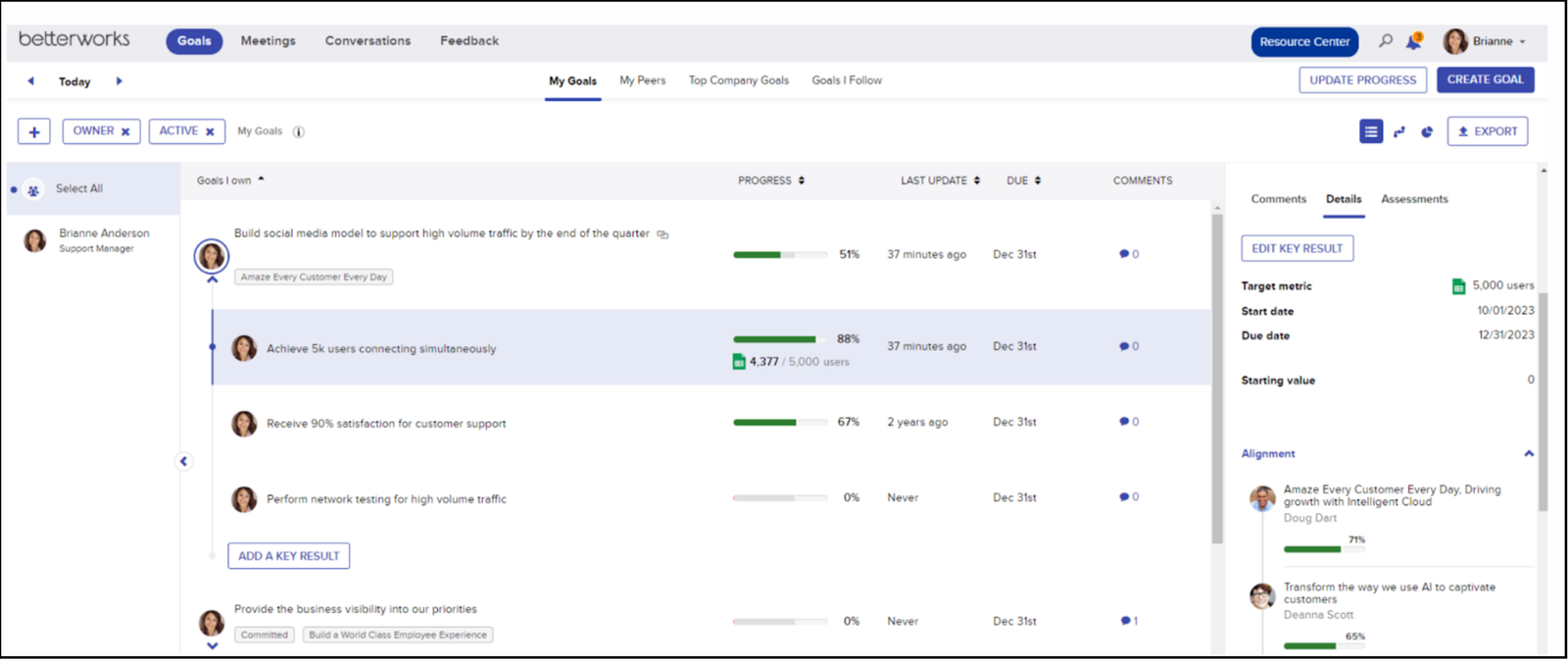
Founded in 2013 by Kris Duggan and Di Wu, the Menlo Park company arrived during the great Silicon Valley conversion to objectives and key results. Duggan’s own kickoff OKR was to explore the market for a better goal-setting system. The opening product let employees publish goals, connect them to company priorities and show progress. It was enterprise alignment rendered as software: who owns the work, what success means and whether the number is moving.
That pitch still sits at the center of Betterworks. But the company now sells something larger and more behavioral. Performance should be captured while it happens, the argument goes, instead of reconstructed months later from a manager’s inbox and selective memory. A goal update in Slack, a piece of peer feedback, notes from a 1:1 and a milestone pulled from Salesforce can become evidence for a later review. The annual form stops being the system. It becomes one output of the system.
The dashboard was right. The behavior was missing.
Betterworks did not abandon goals. It learned their limit. Years inside large organizations, including work with Intuit and Vertiv, showed that visibility alone did not produce better performance. A beautifully cascaded OKR could still sit untouched for a quarter. A red progress bar could identify trouble without causing the useful conversation. And a formal review could still reward the manager’s most recent recollection over an employee’s actual year.
So the product moved into the spaces around the goal: check-ins, continuous feedback, recognition and employee listening. Betterworks acquired survey platform Hyphen in 2020, folding it into Betterworks Engage. The idea was to close the distance between hearing a problem and assigning work to fix it. Calibration added a structured way to compare talent decisions using more than a fixed nine-box grid. Generative AI later arrived as a writing and summarization layer for goals, feedback, conversations and reviews.
“Performance doesn’t happen only during review cycles. It happens every day in the conversations, decisions, and coaching moments between managers and their teams.”Doug Dennerline, CEO and chairman
The customer list explains the expansion. Intuit, Kroger, Air Canada, Colgate-Palmolive, FedEx, Freddie Mac, Sony Pictures and other large organizations do not need a cute weekly goal app. They need permissions, integrations, repeatable review cycles, auditability, global program design and enough flexibility to survive a reorganization. Betterworks says its sweet spot begins above 500 employees. At that size, “set better goals” becomes an organizational plumbing job.
A performance loop, sold one employee at a time
The current platform has two broad halves. Performance Management covers goals and OKRs, feedback, conversations, formal reviews, 1:1s, recognition, engagement and analytics. Talent Intelligence uses that evidence for calibration, skills visibility, unified talent profiles, development plans, succession and mobility. AI sits across both: it can suggest goals, improve writing, aggregate feedback, summarize recurring 1:1s and assemble a performance narrative from the signals a user is allowed to see.
The useful detail is where those actions occur. Employees can update goals and request feedback from Microsoft Teams. Slack can deliver activity, cheers, nudges and mentions. Salesforce reports can move sales goals; Jira issues can move engineering goals; HRIS connectors can synchronize the organization chart. Betterworks also exposes an API for goals, employees, conversations, feedback, recognition and calibration. The product’s adoption theory is sensible: the less often a person must visit “the HR system,” the fresher the HR data might become.
That is also how Betterworks separates itself from a system of record. Workday, UKG and Cornerstone already store employee information and offer performance modules. Lattice, Culture Amp, 15Five and Leapsome compete in modern performance and engagement. WorkBoard, Quantive and Perdoo attack goals and strategy execution. Betterworks tries to sit across those categories as a performance layer tied tightly to business outcomes, then pass cleaner evidence back into talent decisions.
Its market position therefore comes with a useful tension. A broad HR suite can argue that one vendor and one database are simpler. A specialist can promise a sharper, lighter experience for a single job. Betterworks must prove that the connective tissue is valuable enough to justify another enterprise platform: that goal evidence improves a review, that feedback sharpens coaching, and that those signals produce a better promotion or succession decision. The case is strongest in complicated organizations where strategy changes faster than formal talent cycles and where managers span locations, functions and time zones. In a small company, people can often solve the same information problem by talking across a table.
03 / The billWhat it costs - and what the invoice misses
Betterworks’ public pricing page became unusually concrete in 2026. Its standard Performance package was listed at $8 per user per month. Performance plus Talent Intelligence was listed at $29. A temporary summer promotion displayed lower teaser prices, while the enterprise tier remained custom. The company says pricing varies with active users, selected products, complexity, integrations and support. Implementation is a separate one-time cost.
The visible price is the small number.
At the listed standard rate, 1,000 Performance seats imply $96,000 a year before implementation. The same population on Performance plus Talent Intelligence implies $348,000. Enterprise scope, service and negotiated terms can change the real figure.
The larger cost is managerial attention. Goals need owners. Feedback needs enough trust to be candid. Managers need to prepare for conversations and act on what they hear. HR needs governance so AI summaries, calibration data and skills inferences are understood rather than worshipped. A neglected performance platform does not fail loudly; it becomes another tab employees open when reminders grow threatening.
From HR program to manager moment
The 2026 acquisition of Rypple makes the evolution explicit. Rypple is an AI-native product meant to help managers prepare for 1:1s, give feedback, navigate team problems and make everyday decisions. Betterworks said the products would initially operate independently while the teams study adoption and identify useful connections. That restraint matters. Bolting an AI coach onto a performance database is easy; proving managers return to it in tense, specific moments is harder.
Rypple also fills the behavioral gap that the original goal product exposed. Betterworks can tell a manager that an objective is drifting, summarize months of input and show a skills pattern. Rypple aims at what happens next: the sentence the manager says, the question they ask and the follow-up they remember. The company has moved from measuring performance, to assembling evidence, to attempting to improve the human act that converts evidence into performance.
“Managers don’t need more theory - they need support in the moments where management actually happens.”Ian Gover, founder of Rypple05 / The copyable playbook
Steal the rhythm, not the feature list
A buyer should not begin by switching on every module. The more copyable Betterworks idea is a loop: connect one company priority to team goals, collect lightweight evidence where work already happens, train managers to use that evidence in a recurring conversation, and inspect whether behavior changes. Expansion should follow adoption, not the ambitions of the procurement document.
A pilot worth copying
- Choose one business unit with a real execution problem, not an abstract desire for “better culture.”
- Define three to five visible outcomes and connect team goals to them.
- Put weekly updates inside the collaboration tools people already open.
- Give managers one repeatable 1:1 format built around progress, blockers and support.
- After 90 days, measure update frequency, conversation quality, role clarity and decisions made faster.
It will not work everywhere. A 40-person company that needs only a lightweight OKR board may buy complexity it cannot use. A leadership team unwilling to reveal priorities will produce decorative alignment. A low-trust culture may turn continuous feedback into continuous surveillance. Poorly governed AI can make a polished summary look more certain than the underlying evidence deserves. And if managers are not given time, skill and permission to coach, no workflow can impersonate them.
Betterworks fits best where scale has made informal management unreliable, but the company still cares enough to repair it. Its achievement is not proving software can manage people. It cannot. The more defensible claim is narrower: software can preserve the evidence, surface the moment and make a useful conversation slightly harder to avoid. That is less magical than an AI manager. It is also much closer to how work improves.