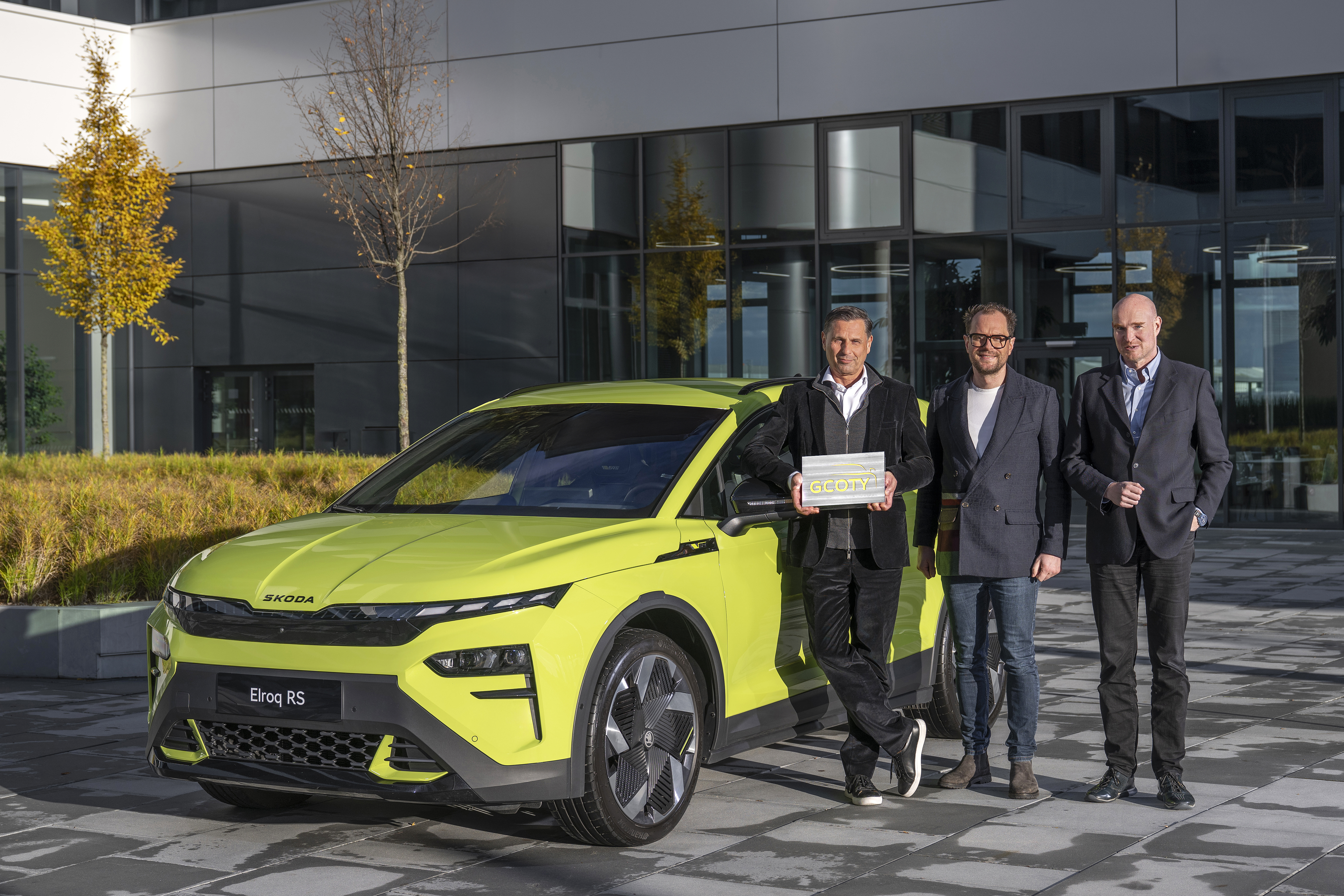
In the photograph, Bernd Hitzemann stands between a car-company chief executive and an automotive journalist. The occasion is the German Car of the Year award for the Škoda Elroq, presented at the manufacturer’s headquarters in Mladá Boleslav in November 2025. Hitzemann and Jens Meiners, the award’s initiators, are handing over the result of other people’s judgment. It is a useful place to begin a story about someone whose working life concerns how judgments are formed.
A trophy gives an opinion a pleasingly solid shape. Media research has a less photogenic assignment: discovering what an opinion consists of, where it travels, and whether it changes when it crosses a border. Hitzemann’s career connects those two activities. He has worked in automotive research, held senior roles at PRIME Research and Cision, and become a co-founder and CEO of AITASTIC. Alongside that work, he helps create the occasions on which journalists compare cars.
The connection is unusually concrete. A vehicle can be described as innovative in a presentation, experienced as awkward on a test drive, and discussed as desirable in a newspaper. Those are three different pieces of information. Put them in one undifferentiated heap and the heap gets bigger. Keep their differences intact and something useful may emerge. That distinction runs through the work surrounding Hitzemann, from early automotive trend reports to the company he helped establish in 2021.
A car becomes a computer, slowly and then everywhere
His academic background already brought several ways of looking at a business into the same room. His University of Mainz education, listed for 2006 to 2010, covers economics and international business, public relations and corporate communications, and research and statistics. It is an apt combination for a field in which a manufacturer’s commercial priorities, a journalist’s vocabulary and a researcher’s measurement choices all affect the answer.
By December 2014, Hitzemann was identified as chief operating officer of PRIME Research UK. The following year’s World Car Trends study, “Connected Mobility and Digital Lifestyle,” paired a panel of 75 World Car jurors with media analysis across 25 markets. Its scope included more than 100 million social documents from 2014 and 2015. The research placed smartphone integration, autonomous driving and new displays at the center of the connected-car conversation.
That combination of methods matters more than the impressive-looking pile of documents. An expert panel offers considered expectations; media analysis shows the conversation already happening. They can agree, diverge or notice different things. A carmaker planning an interior needs to know whether a screen is an engineering achievement, a talking point, a source of irritation, or all three. Counting the number of times the word “screen” appears will get the discussion only so far.
Read today, the 2015 report catches an industry in the middle of a vocabulary change. Connectivity was becoming part of what a car meant. The dashboard was acquiring responsibilities once left to the telephone. Technology companies were entering a conversation historically dominated by manufacturers. Hitzemann was working on that shift years before AITASTIC existed. The later company’s interest in artificial intelligence therefore sits within a longer career of studying how technology changes an industry’s conversation.
One scandal, several conversations
Later in 2015, Hitzemann contributed an analysis of the diesel emissions crisis to the World Car Awards publication The Road Ahead. His article compared reactions in markets with strong diesel traditions and markets more oriented toward petrol. The coverage did not move uniformly. In established diesel markets, the technology’s overall image was relatively resilient, even while its environmental reputation weakened. Elsewhere, the wider image took a much sharper hit.
The useful discovery was the difference. An international company could be facing one event and several reputational problems at once. A message designed around the average response might fit none of them particularly well. The report’s comparisons made geography part of the interpretation rather than a footnote beneath a global number. For communications work, that is a practical distinction: the audience brings its own history to the story.
This is where research can save a company from the seductive tidiness of a single chart. A global total is easy to put on a slide. A pattern that changes by market takes longer to explain, but gives the person using the slide more to work with. Hitzemann’s published analysis dealt with that untidy reality. The same engine technology carried different associations in different places; the event exposed those associations instead of creating an entirely uniform response.
“Passionate about cars & PR, media insights & innovation.”
Bernd Hitzemann · LinkedIn biography
The next business was built with familiar people
At Cision, his work continued across the territory where cars and technology meet. A January 2019 CES research report lists him as PRIME Research vice president. That study examined more than 475,000 articles and posts across 188 markets. Its remit extended from the prominence of technology brands to the audiences their coverage attracted. By the 2021 World Car trends report, his title was vice president, automotive, at Cision Insights.
The CES work adds another dimension to the career. Visibility and audience are related, but the largest volume of attention does not automatically tell a business who is listening. A show can generate a great deal of coverage while reaching a narrower audience than its organizers would like. For a researcher, the second question comes immediately after the first: once something has been noticed, what sort of attention has it received?
In 2021, Hitzemann co-founded AITASTIC with Rainer Mathes and Holger Oftring. They had worked in the same research world. The new venture brought their experience into a business organized around artificial intelligence, information analysis and consulting. Hitzemann took up his CEO role in August that year. The move joined a change in company scale to a continuing subject: how to extract useful understanding from the expanding supply of communication.
An October 2021 podcast appearance placed that transition in an international career. The episode’s introduction described three years in Oxford, work involving Shanghai and Tokyo, and two years in New York before the new venture in Germany. Its discussion ranged over the business’s beginnings, media and content analysis, trade fairs and the challenges of founding. These are the working coordinates of his story: research centers, industry events, clients and colleagues, rather than one uninterrupted climb through a single office building.
Harry reads. The client still needs an answer.
AITASTIC gives its analysis system a remarkably ordinary nickname: Harry. The formal name, Lasswell AI, refers to communication scientist Harold Lasswell. The system combines natural-language processing and knowledge graphs to organize material across text, images and audiovisual formats. The company describes coverage of more than 50 languages and 70 markets. Those are the business’s stated operating dimensions, rather than measurements of Hitzemann’s personal output.
The choice of name supplies a little relief from the industry’s taste for imposing acronyms. Harry sounds like someone who might already be in the office when you arrive. The company says the system scans news and social media around the clock. Its work supports analysis of topics, sentiment and share of voice, among other measures. Consultants then build measurement programs around client questions, while editorial workflows support briefings and media reviews.
There is an old managerial temptation to mistake more information for a better decision. AITASTIC’s proposition puts a second task after collection: arranging information so someone can use it. Hitzemann’s role belongs to that relationship between research and a client’s next action. The important moment comes when a finding helps a team choose what to investigate, how to interpret a developing topic, or which conversation deserves its limited time.
A dashboard can be wonderfully reassuring. So can a speedometer. Neither chooses the destination. The company’s combination of software, analysis and consulting recognizes the need for people to frame the question and act on the answer. That is also why an automotive background has relevance beyond automotive clients: industries differ, but businesses repeatedly need to distinguish a loud conversation from one with consequences.
- 01 / GatherNews, social and other media
- 02 / StructureLasswell AI, known as Harry
- 03 / InterpretMeasurement and analysis
- 04 / DeliverBriefings, reviews and consulting
Put the claim on the road
Hitzemann’s car-award work offers a physical counterpart to those analytical questions. At the July 2022 German Car of the Year summer test event in Alsfeld, he and Meiners welcomed participants. Around 25 automotive journalists had more than 30 vehicles available to drive on the surrounding roads. Some historic cars joined the newer arrivals. Research may live in documents and datasets; comparison also needs a stretch of road.
The setting makes an abstract word such as “evaluation” rather less abstract. A jury has products to examine and experiences to compare. Bringing those people and vehicles together is organizational work, with a visible result. Hitzemann occupies a position in that process alongside Meiners, rather than appearing only when a winning manufacturer poses for a photograph. The summer gathering is part of the less ceremonial machinery behind the ceremony.
The Hyundai IONIQ 5’s German Car of the Year 2022 win had already placed him in another award photograph, alongside Hyundai executives and Meiners. The electric model prevailed in a final that included the Audi e-tron GT and Porsche 911 GT3. Several years later, the Elroq award returned him to the same kind of encounter: a manufacturer receiving an assessment made by a group of automotive journalists.
For the 2026 award, announced in November 2025, 40 German and international journalists selected class winners from 80 new vehicles. Five class winners then faced a final test weekend. These figures describe that particular edition. They also show the successive narrowing required to turn a broad field into a single award. Plenty of products enter the conversation. A much smaller number get to leave with the sculpture.
A software question with a driver in it
A 2021 LinkedIn post sharing the 2022 Global Automotive Trends research returns to the theme of the connected car. The survey covered 102 journalists and experts in 34 markets. Hitzemann’s post highlighted Polestar’s position in assessments of in-car systems and its use of Android technology. It also recalled discussing the strategy with Alexander Lutz and Anna Wesolowski. Here, the research connects an industry-wide question to particular people and a particular product decision.
The issue had become more specific since the 2015 study. Once smartphone integration was on the agenda, someone still had to decide who would build the interface and whether drivers would like using it. Technology’s arrival creates further questions rather than settling the original one. Hitzemann’s public work keeps returning to that point of contact between an industry’s promises and the responses those promises receive.
Away from work, he plays bass, enjoys cars and is a father of two. These details make a modest, pleasingly human end to a professional story full of classifications and measurements. Bass is an instrument that asks its player to listen to the rest of the room. The analogy is irresistible, but the fact is sufficient: a research executive has another use for his ears.
The trophy photograph catches only one moment. The longer story passes through university study, automotive reports, international research work and a new company formed with experienced colleagues. It also keeps returning to a practical test. What have people actually said? What did they mean? What happens when the product reaches them? Hitzemann’s career has taken those questions into both the analysis room and the driver’s seat.