Pick up an object. Keep hold of it. Put it somewhere else. Bernard Casse built a company around the embarrassing distance between how easily a person performs that sequence and how much engineering a robot can require to do it reliably. A factory gives the problem a deadline. The next object is already coming.
The appeal of a robot is easy to understand when it moves. The difficulty often arrives when it touches something. A camera can help identify an object; contact introduces another set of questions. Has the grip slipped? Is the surface uneven? How should the machine adjust? The object, regrettably, has no interest in the elegance of the demonstration.
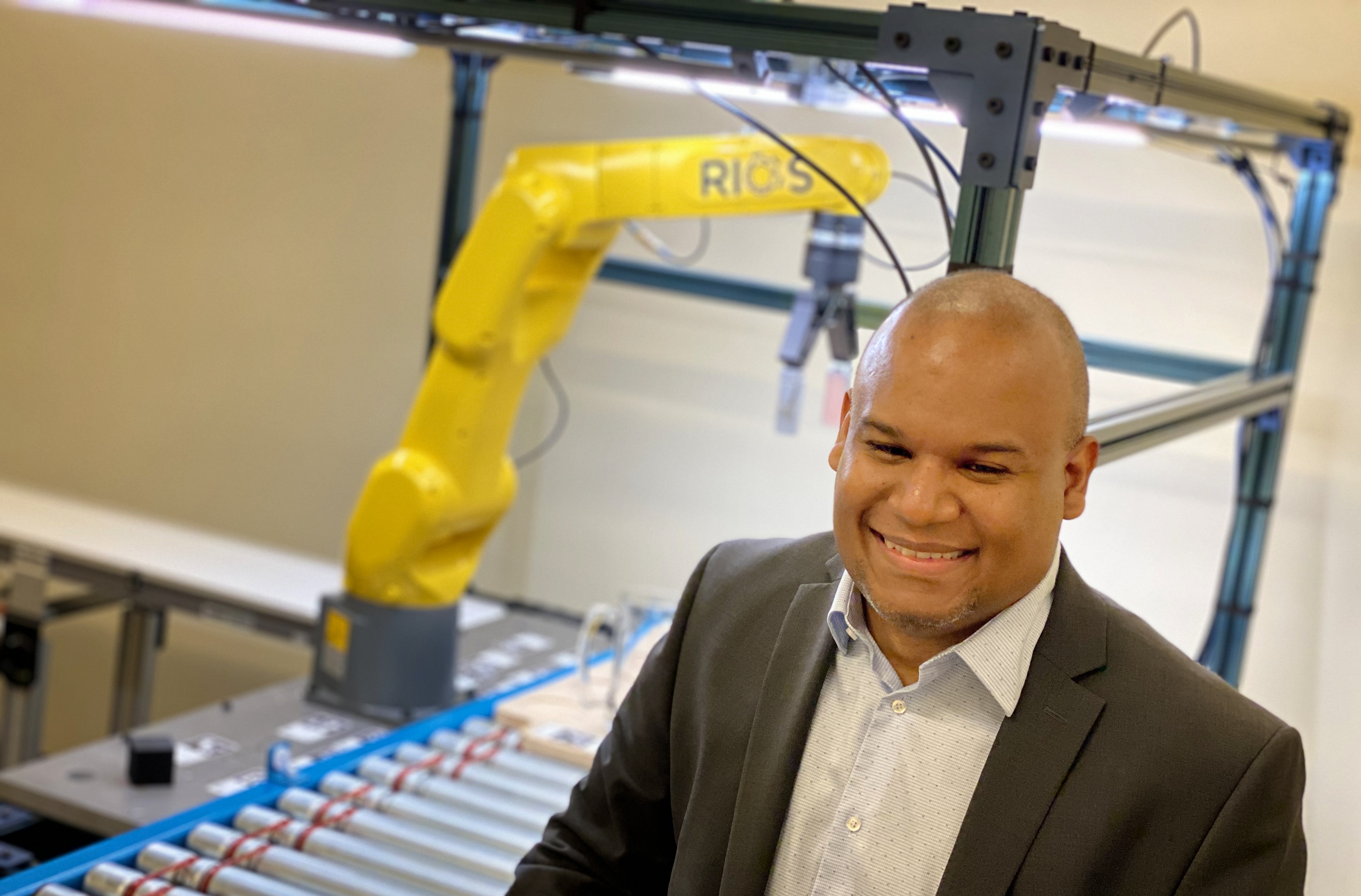
Casse co-founded RIOS in 2018 to tackle that physical uncertainty. His earlier work had dealt with light and engineered materials. At RIOS, the question became whether sensing, software and machinery could work together well enough to make automation useful beyond carefully arranged conditions. It was a physicist’s problem with a production manager attached.
The company’s story now has an ending: RIOS identifies 2026 as the year it was archived. Its intellectual property is available for licensing, alongside open-source releases. Read backward from that fact, Casse’s robotics chapter becomes more interesting than a fundraising announcement. It is an experiment in what happens when an ambitious technical idea has to earn its place on a factory floor.
Twelve micrometers, then a much larger world
Long before the factory workcells, there was a lens. In 2008, Casse was part of a Northeastern University physics team led by Srinivas Sridhar that developed a microlens for infrared light at telecommunications frequencies. It focused a beam just 12 micrometers from its surface. Casse was credited alongside Wentao Lu and Yongjiang Huang.
The work appeared in Applied Physics Letters. Its material was a nanostructured photonic crystal engineered into a semiconductor wafer. The scale is almost comically small beside the industrial equipment that would later fill RIOS photographs. Yet both projects concern a useful question: what can a machine perceive or accomplish when its physical interface is redesigned?
Casse holds a physics doctorate from the National University of Singapore, specializing in metamaterials. His research career included experimental nano-optics at Northeastern. A historical biography also records a less ceremonial pursuit: contributing code to open-source software and maintaining a Fedora Linux repository for the Enlightenment desktop shell. Evidently, very small lenses did not exhaust his appetite for fiddly systems. That detail gives the researcher a life beyond the laboratory’s formal credits. Maintaining a software repository means attending to a tool other people use, with all the small demands that entails. It sits comfortably beside a later career in which the component and the surrounding system would repeatedly have to meet.
His subsequent career moved through Physical Sciences Inc., where he managed defense programs, and Xerox PARC, where he created and led the Metamaterial Devices & Applications business area. Those jobs involved government and private-sector research contracts worth millions of dollars. Along the way, scientific work acquired budgets, teams and delivery obligations. An interesting result had to become something another organization could use.
Distance from lens surface to focused infrared light in the Northeastern team’s microlens experiment.
A research result, not a RIOS product specification.A radar detour with a theatrical vocabulary
In 2017, Casse co-founded Metawave, a company spun out of PARC. Maha Achour was CEO; Casse was CTO. The initial proposition combined engineered metamaterials with artificial intelligence for radar and wireless communications. A September announcement disclosed $7 million in seed funding, with investors including Khosla Ventures, Motus Ventures and Thyra Global Management.
The product vocabulary had a certain dramatic confidence. There was WARLORD, a radar name expanded into a lengthy technical acronym, and WRATH, its AI counterpart. You could be forgiven for expecting a cape. The actual work concerned perception: steering radar beams and improving the information available to vehicles and communications systems.
Metawave gives the later robotics venture a useful prehistory. Casse was already trying to move specialized science into a commercial system, with investors, customers and a team to recruit. RIOS changed the application. It also brought him into the chief executive’s chair, where the problem includes who will pay for the invention and how it will reach them.
Touch is information, too
RIOS’s founding group included Clinton Smith, Christopher Lalau-Keraly, Christopher Paulson and Matt Shaffer. Several came from Xerox PARC. They brought disciplines ranging from optics to machine learning into the same enterprise. Casse’s account of the team emphasized engineers focused on products, a revealing description for a company selling into places where a promising prototype is only the beginning.
“Human-level dexterity is still elusive,” he said in 2020. That admission is more useful than a promise of a robot that can do everything. Dexterity contains a multitude of small judgments. People often notice those judgments only when a task becomes awkward. For an engineer, each awkward moment is a question about feedback.
In July 2020, Fuji Corporation invested in RIOS, whose approach depended on detailed feedback from contact. Thousands of miniature sensors gathered information including pressure, texture and temperature. Embedded processors and the company’s algorithms interpreted those signals. The intended capabilities included recognizing slippage, distinguishing textures and adjusting a grasp. Touch became a stream of data that could influence an action.
Fuji also described a partnership to incorporate the technology into automation solutions for Japan. This was a practical connection for Casse’s team: an industrial equipment business interested in what a sensing system could add to its machines. The value of the hand would be tested in the work it enabled, well beyond the hand itself.
The second invention was the contract
RIOS offered factory automation as a service. Under the model offered in 2022, customers could deploy robotic workcells without an upfront capital commitment. The company reported agreements with more than a dozen customers in the United States and Japan. Its workcells were intended to fit into existing workflows.
That contract deserves a place beside the sensors in Casse’s story. A technical founder can spend years improving a machine and still meet a customer whose first concern is the purchase. The commercial arrangement changes the opening conversation. It asks a manufacturer to assess the service and its usefulness, rather than begin with a large equipment acquisition.
In Australia, Casse discussed establishing an applied research and development center through RIOS’s subsidiary. Main Sequence’s investment connected the company with a network of researchers and industrial expertise. The venture had to translate across national markets as well as across disciplines. There is a great deal of coordination concealed inside the reassuring phrase “factory automation.”
His public writing suggests he understood that tension. The titles of his 2021 essays included one about robotics companies failing and another about customers seeking automation. A founder interested only in the mechanism might have stopped at the gripper. Casse was also writing about the people who buy it, and the conditions under which the business survives.
“Human-level dexterity is still elusive.”
Bernard Casse, 2020
Series A equity funding and debt financing
Series B funding
Separate disclosed rounds. The 2022 amount includes debt; these figures are not a valuation or personal wealth estimate.From the gripper to the whole operation
By his 2023 Manufacturing Happy Hour appearance, Casse was discussing how automation could generate business intelligence. The vision extended to connected factories able to exchange information with suppliers and customers. The practical starting point remained smaller: choose a process that needs improvement and begin there. A whole-factory ambition still needs a first useful installation.
Away from work, there was Antonio’s Nut House, a Palo Alto dive bar Casse frequented earlier in his career. Mark Zuckerberg had also been a patron. The place gives this story a different sort of address from the laboratories and research centers. Silicon Valley’s mythology becomes rather more agreeable when it includes somewhere to sit down.
In March 2024, RIOS announced a $13 million Series B co-led by Yamaha Motor Corporation and IAG Capital Partners. Yamaha had invested since 2020. The stated expansion priorities were wood products, beverage distribution and packaged food. Those choices gave the company’s ambitions an unusually tangible vocabulary: lumber, plywood and goods moving through production.
The money marked a new stage of the effort, rather than a verdict on its outcome. A financing announcement tells us that investors agreed to back a plan. The plan still encounters real objects, shifting conditions and the requirements of customers. That distinction matters when looking at a founder whose work crosses between a research bench and a balance sheet.
What remains when the company becomes an archive
RIOS’s public code collection includes camera interfaces, robot software and a research implementation for modeling transparent objects. It preserves some of the less photogenic work required to connect perception with action. For another engineer, a working interface or a reusable component can be more valuable than a glossy account of the company that produced it.
The archive changes the reading of Casse’s earlier aspirations. He wanted automation to help businesses facing labor shortages, and described a future in which people could move toward more skilled work. Those were aims, not guarantees. The company’s ending keeps the profile honest about the distance between a founder’s intention and the life of the organization built around it.
His career nonetheless presents a consistent sequence of problems: focusing light, making radar more informative, giving robotic systems additional feedback, and making the resulting machinery accessible to a customer. Each step brings a different kind of constraint. Materials impose one. A factory workflow imposes another. A contract introduces a third.
It would be easy to end with a machine performing a flawless task. Casse’s story is better served by the task itself, still stubbornly simple to describe. Pick something up. Keep hold of it. Put it down where it belongs. Between those instructions lies a research career, a team of collaborators, a business model and an archive of attempts to make the ordinary dependable.
The work continues to be accessible through licensing and open-source releases.