Ben Kliger's company began with a problem that sounded almost impolite in 2021: what if the people building a company's software were no longer software engineers? Low-code tools had turned spreadsheets, forms and workflows into a shadow development shop. The work was useful. The oversight was patchy. Kliger and his co-founder, Michael Bargury, called their answer Zenity.
Five years later, the nouns have grown teeth. A workflow might now be an AI agent that reads company data, calls an API, edits code, places an order or talks to another agent. The old security question asked whether software contained a vulnerability. Kliger's newer question is closer to the one a parent asks while handing over the car keys: where are you going, what are you planning to do, and when should someone take the wheel?
That shift has carried Zenity from a $5 million seed round to a $125 million Series C announced in August 2026. The round, led by Norwest, brought publicly reported funding to $185 million. It also placed a large wager on a thesis Kliger has repeated with enviable consistency: visibility is useful, but arriving after the action is merely a well-documented failure.
A Friday-table education
The founder story starts in Ramat Gan, where Kliger was born and raised as the middle of three brothers. His father was a real-estate developer, so Friday dinners came with business talk. His mother worked in public relations and later with charities. Kliger remembers himself as the nerd at school, though not the quiet variety. He was opinionated, studied chemistry, physics, mathematics and computer science, and was pushed toward excellence at home.
The extracurricular list has the cheerful disorder of a child trying several possible lives. He played classical piano and particularly liked Chopin and Rachmaninoff. He played basketball, then moved to competitive swimming and water polo. The piano rewarded interpretation within strict boundaries. Water polo rewarded composure while people attempted to sink you. Neither is terrible preparation for enterprise software.
The long apprenticeship
At Unit 8200, Kliger started as a systems operator and shifted into cybersecurity after roughly two years. His team received the unit commander's prize, presented by Nadav Zafrir, who later became chief executive of Check Point. Kliger remembers the service as formative because young people were given consequential work and expected to challenge one another's thinking. Argument was not a crack in the culture. It was part of the machinery.
After leaving the military, he spent about a year at Israel's Prime Minister's Office while studying industrial engineering and management at Tel Aviv University. Deloitte followed, with work on data-security systems and penetration testing for Israeli and global organizations. In 2014 he joined Fortscale, a user-behavior analytics startup, as one of its first 20 employees. The hours were wild, the environment chaotic, and the education immediate.
“It's important in the cybersecurity industry to also think about what's coming next.”Ben Kliger, Category Visionaries
The Microsoft school
Kliger already knew he wanted to build a company. He also knew what he did not know: how a large American technology organization sets goals, ships products and serves customers at scale. Microsoft became the missing apprenticeship. He joined cloud-security product management in 2015, rose to manage a group of product managers, and led one of the company's early products in the area. At the same time, he completed an MBA focused on finance, accounting and technological entrepreneurship.
His managers included Assaf Rappaport and Yinon Costica, who went on to co-found Wiz. Kliger has described Microsoft as a school in focus: how to model an organization, choose a target and get a large machine to move toward it. He also cites Satya Nadella's cultural reset, especially its language of empathy and customer obsession. These ideas sound tidy in a management book. Their real test comes when a founder has little authority, fewer resources and a buyer who would prefer not to be the first.
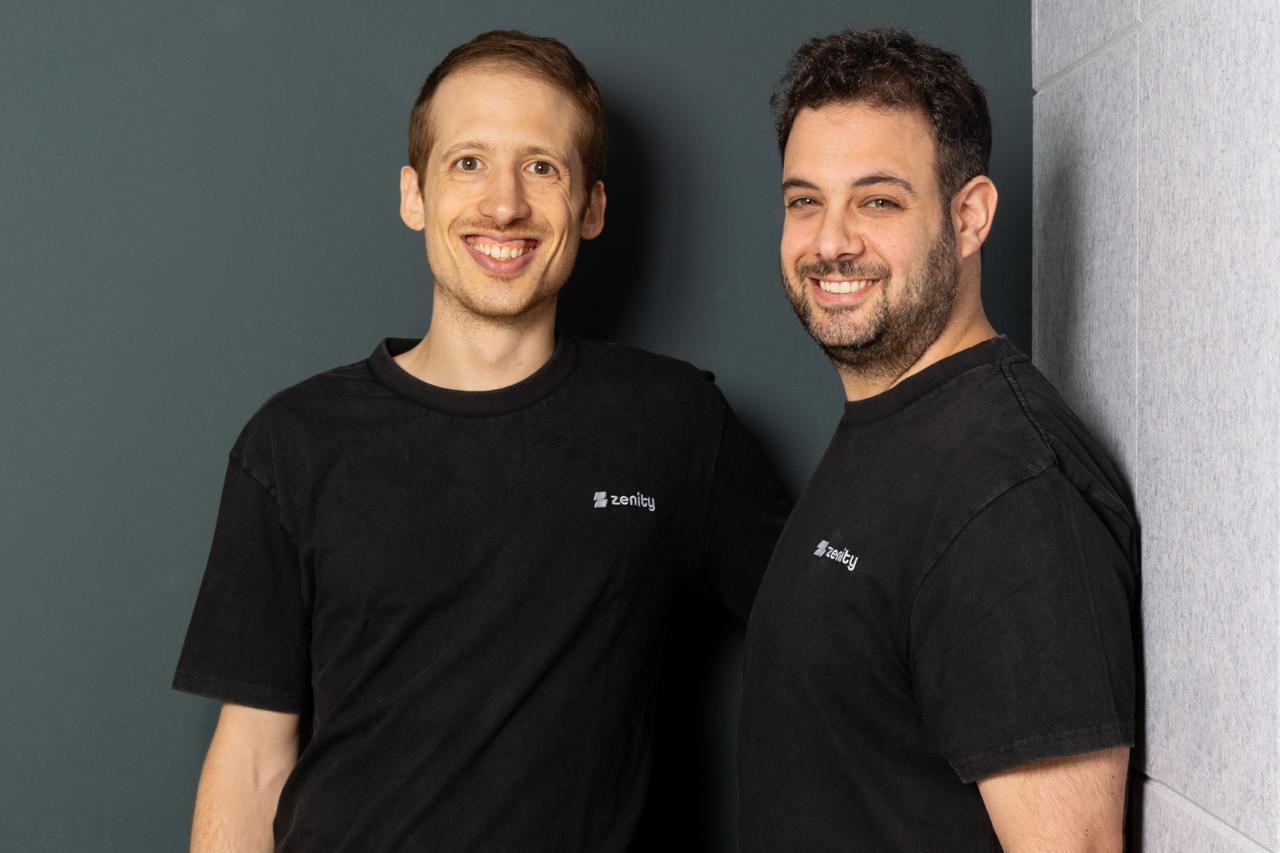
Michael Bargury worked in the same cloud-security division. They clicked, became friends and started comparing notes about a new kind of software. Business teams were building applications and automations for themselves. The people closest to the problem could finally make their own tools, but the traditional development lifecycle no longer wrapped around every creation. Kliger saw democratization. He also saw an unguarded door.
The category changed its name
Zenity launched in 2021 to secure low-code and no-code development. Then generative AI arrived in public. Copilots began appearing inside the same enterprise platforms. Soon the copilots acquired tools, memory and permission to act. The company's original concern had not disappeared. It had become autonomous.
This is the most useful thing to steal from Kliger's strategy. Zenity changed its vocabulary without discarding its question. The company began by asking how security teams could govern software created outside the conventional engineering pipeline. Today it asks how those teams can govern agents operating across SaaS products, employee devices, custom cloud stacks and enterprise data. The objects changed. The governance gap remained.
Where the old playbook runs out
email, prompt, page
reasons and chains tools
data, code, payment, API
Kliger's argument is that prompt filtering looks at the doorway while risk is already walking through the building. An agent can begin with an innocent instruction, combine tools in an unexpected way and reach sensitive systems through permissions inherited from its user. The important telemetry concerns identity, context, tool use, decisions and intent. Security must understand the whole task chain and enforce boundaries while it unfolds.
In one interview, he reduced the idea to a pair of questions: stop asking what the user said and start asking why the agent did that. It is both a product philosophy and an editorial correction. The output of an AI system may be awkward, wrong or offensive. The action of an AI system can alter a database before the awkward sentence has finished rendering.
“The next decade will not belong to whoever builds the most AI. It will belong to whoever builds the most trusted AI.”Ben Kliger, announcing Zenity's Series C
Teach first, sell later
There is a second lesson in how Kliger talks about security. He does not want it cast as the department of no. Zenity's pitch is enablement: give employees access to useful building tools while letting security teams see risks, enforce policy and respond when behavior slips its leash. It is less theatrical than selling catastrophe and more compatible with how large companies actually adopt technology.
That framing shaped the company's early go-to-market motion. Kliger has described a knowledge-first approach built around publications, research, respected security organizations and conversations that were not disguised demos. Enterprise feedback became part of product development. Analysts offered a view across many buyers. Trust formed before the purchase order.
The funding milestones arrived in sequence: seed capital in 2021, a $16.5 million Series A in 2023, a $38 million Series B in 2024, and the $125 million Series C in 2026. By then, Zenity reported more than 230 employees, with its research and development center in Tel Aviv and sales, marketing and operations managed from New York. Kliger had relocated to New York in 2023 to be closer to major East Coast customers.
A bell in the distance
Kliger's ambition is refreshingly specific. He wants to ring the Nasdaq bell. In five to ten years, when people name the Israeli cybersecurity companies that defined their era, he wants Zenity spoken alongside Check Point, Wiz and Cato Networks. The comparison is particularly close to home: two of the leaders who taught him at Microsoft went on to create Wiz.
He is not all agent telemetry. Kliger remains devoted to Manchester United, supports Hapoel Tel Aviv, catches Knicks games and plays FIFA with friends in Israel. His official biography keeps the proudest credential outside the title line: father of two daughters. In a public post about a family cruise, he wrote about briefly disconnecting, dressing for pirate night and watching one daughter emerge from a princess makeover glowing with confidence. A founder who spends his days defining machine autonomy appears unusually attentive to the human version.
The grand risk of AI agents is easy to dramatize. The quieter risk is administrative: thousands of useful actors accumulating permissions, dependencies and habits faster than a security team can understand them. Kliger's career has prepared him for that unglamorous middle ground. Unit 8200 supplied consequence. Deloitte supplied the enterprise. Fortscale supplied chaos. Microsoft supplied scale. The family dinner table supplied appetite.
Now the future he anticipated is arriving as ordinary office software. Agents are not waiting for a philosophical settlement. They are being deployed. Zenity's bet is that the companies moving fastest will eventually ask for brakes, mirrors and a dashboard. Ben Kliger would like to have them fitted before anyone discovers the wall.