Ben Jabbawy had spent three months working on a sale of Privy. A term sheet was signed. There was supposed to be a closing. Then, on the day the transaction was meant to finish, the buyer pulled out. The company had $1,000 left in the bank. A thousand dollars is a perfectly respectable sum for a weekend away. It is a rather less comfortable operating budget for a software company.
He picked up the phone. He asked customers why they used Privy, what they liked, and why they continued paying. Then came the practical question: would they pay for a year in advance, in exchange for a small discount? Several of the larger customers agreed. The business bought itself time through people who already knew its value. A customer conversation had become a financing conversation.
That episode makes a useful entrance into Jabbawy’s working life. The numbers eventually grew large enough to attract attention: in 2024, he put Privy’s 2021 sale price at $120 million. But the small transactions tell you more about how he operated. Again and again, he returned to someone using the product and asked a question. Sometimes the answer was a feature request. Once, it was enough cash to keep going.
A family business, then a very broad idea
Jabbawy grew up in a family of entrepreneurs. His father encouraged taking risks and becoming a leader. At Cornell, where he studied from 2004 to 2008, an Entrepreneurship for Engineers class helped him see a path that combined technical work with creativity and dealing with people. The usual campus recruiting opportunities had not especially excited him. Building something of his own did.
He founded Privy in 2011, drawing on the experience of helping his parents with their small business. He moved back home and initially worked from savings. The ambition was understandable: small businesses would increasingly use self-service technology to market themselves. The difficulty lay in the words “small businesses.” They covered an enormous range of customers whose routines, budgets, and buying habits had little in common.
Restaurants and other physical businesses were part of the early effort. Privy tried direct sales and required contracts before customers could experience the product. The founder later described that approach as a collection of mistakes. A broad market sounds reassuring in a pitch. On an ordinary working day, it can leave you wondering which person to call and what, exactly, to offer them.

A smaller company finds a clearer customer
After the failed acquisition, Jabbawy kept two developers and began rebuilding. The team called the new incarnation Privy Phoenix. Software companies are permitted a little drama in their internal naming, especially when there are only three people left to object. This version had a much clearer purpose: help ecommerce stores grow their email lists. It also had a free plan, making it possible to try the product without an elaborate buying process.
Finding those first users was painstaking work. Jabbawy searched merchant communities, platform forums, and Quora for discussions about popups, email marketing, and related problems. He read the responses and contributed detailed answers. When Privy could help, he mentioned the free plan and asked for feedback. He kept a Friday-morning routine of this work for at least two years. There was no glamorous distance between the founder and the questions.
Growth also came through integrations with ecommerce platforms and email providers. The logic was particularly useful when Privy focused on list building: an email provider could benefit when its customers collected more contacts. Connecting the products opened a route to app listings and joint marketing. Partners became a way to reach merchants who already understood why a larger email list mattered.
The change gave the business a more intelligible place in a merchant’s day. A shop owner could install a tool, collect addresses, and see a result. Privy no longer needed to explain an entire new philosophy of local marketing before demonstrating usefulness. The customer, the problem, and the route to that customer had begun to fit together.
The founder in the chat window
Jabbawy spent much of this rebuilding period inside Intercom, answering users through live chat. Free users were welcome too. After an earlier phase in which getting people to talk had been difficult, the steady stream of conversations was useful information. People could tell him where they were stuck while they were actually using the software. A product meeting could arrive disguised as a support ticket.
He wrote help guides and saved response templates as familiar questions repeated. He remained the only live-chat person until late 2016, when Privy had reached about $1 million in annual recurring revenue. Even after hiring support staff, he continued taking chats at night and on weekends. Over time, that habit developed into a broader model of support, onboarding, and customer success.
His shorthand for it was “Tools AND coaching.” The phrase has the bluntness of something repeated at enough company meetings to become a refrain. It explains a particular view of software: the feature matters, and so does whether a merchant knows how to put it to work. Installing a popup is one task. Choosing an offer worth showing in it is another.
In a 2021 conversation about leadership, he reduced the central ingredient to trust. Customers had to trust the company; investors had to trust him; employees had to trust where the business was going. In his telling, helping free users was one way to establish that relationship early. The support desk was part of the company’s reputation long before it could afford an extensive marketing operation.
“Tools AND coaching”Ben Jabbawy’s refrain at Privy
Nine dollars, and the education that followed
Pricing became another way Jabbawy listened to customers. Privy’s early paid “micro” plan cost $9 a month. The team built advanced features that several users requested, then tested whether those users would pay for them. This was an unusually direct way to judge engineering work: someone wanted the improvement enough to move off the free plan.
Later, the company learned that access to sophisticated features did not guarantee a small shop would get useful results. A store with little traffic could buy advanced testing tools and still have little to test. Privy moved through different approaches to packaging as it grew from a popup product into email and SMS marketing. The business model had to follow the value the customer could actually receive.
Jabbawy enjoys pricing enough to have written an entire account of those changes. His recollections include the less pleasant internal work, too: engineering complexity, coordination across teams, and preparing support staff before customers arrive with questions. A new price looks wonderfully simple when printed on a website. Behind it sits a surprising number of people hoping everyone else has read the plan.
Learning to speak outside the office
For several years, Jabbawy was more comfortable behind the scenes. Customer calls and internal conversations gave his enthusiasm somewhere to go. Broadcasting it publicly felt less natural. Dave Gerhardt, his cousin and Privy’s chief marketing officer, pushed him to share the practical knowledge he had accumulated. The founder who answered questions privately began answering them in public.
He started with short posts on Twitter and LinkedIn about ways merchants could grow lists and sell through email. His own description of the medium is admirably uncomplicated: “I hate video. I love writing.” He chose a format he could sustain, then developed the same idea into Ecommerce Marketing School, a tactical podcast with short, frequent episodes.
The response was not always visible in likes and comments. Business owners sent messages. Prospective customers mentioned the podcast on sales calls. Teaching made Jabbawy easier to approach and gave Privy a voice alongside its products. By the time he began Zero to Exit, his newsletter about building and selling, he had years of operating details to share, including the awkward parts.
Project Pheasant closes in flip-flops
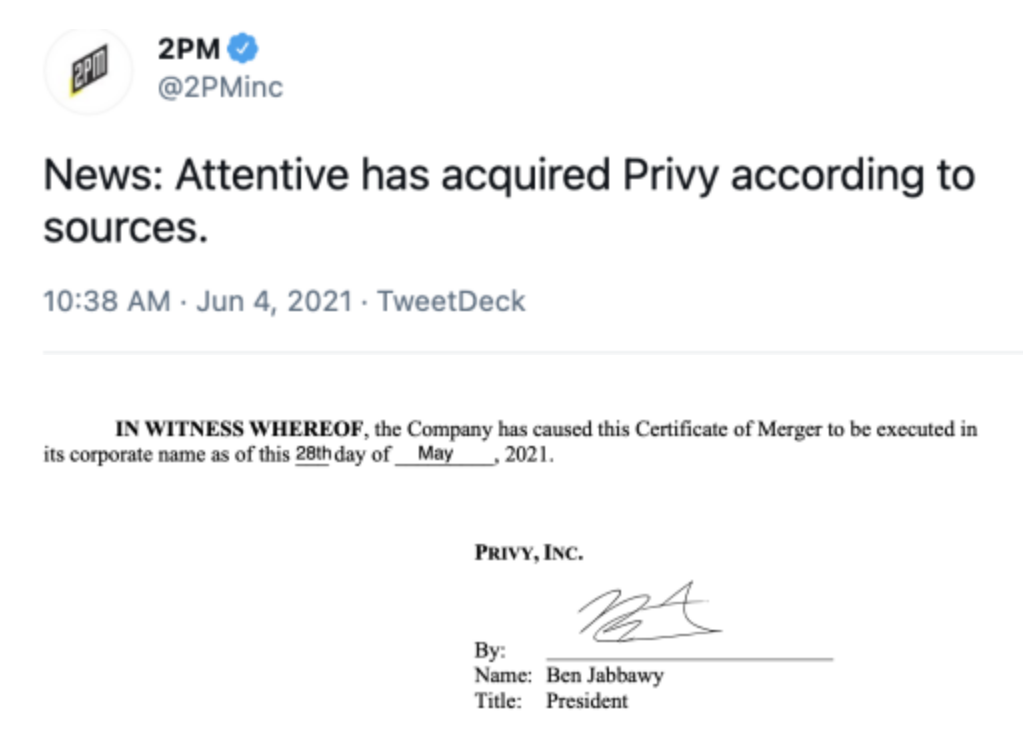
Attentive acquired Privy in June 2021. For Jabbawy, the fit included a shared emphasis on service and the chance to give growing merchants a path into a larger platform. Privy continued operating independently after the acquisition. A store could begin with Privy and, as its needs changed, move into Attentive’s offering with an established connection between the two.
The mechanics were less cinematic than a founder might imagine. The buyer used the code name “Project Pheasant.” The transaction combined cash and stock, with a distribution spreadsheet accounting for debts, expenses, employees, and more than 50 shareholders. Some older shareholders needed help signing electronically and navigating two-factor authentication. Jabbawy used FaceTime so they could point their phones at their screens.
He completed the deal from home in shorts, a T-shirt, and flip-flops. The imagined conference room full of lawyers never materialized. Instead, he found himself crying with happiness and telling his wife and brother, “we did it.” Years of customer explanations had led to one more round of patient explanations, this time so the people who backed the company could receive their proceeds.
The next customer is looking for dinner
After Privy, Jabbawy invested in commerce software and wrote about what he had learned. His published investment philosophy favors early commerce businesses with revenue, efficient use of cash, and attention to distribution. He has backed companies including Junip, Rebuy, and PostPilot. The experience of operating a product for small merchants gives him specific questions to ask the founders building their next tools.
Then he started again. In 2024, he publicly introduced Grocers List with a team that included former Privy colleagues. The idea came partly from cooking at home: discovering an appealing recipe on Instagram could be much easier than finding its ingredients and shopping for them. Food creators had audiences and repeatable workflows, but the available software often served creators generally.
The company, now presented as GRO, connects social engagement with direct messages, websites, and email lists. A follower can comment for a recipe and receive a linked message; an option to save it by email helps the creator develop a direct audience relationship. Its current offering also includes email marketing and paid memberships. The familiar concerns have returned in a different setting: reduce the steps, make the value clear, help an independent business keep in touch.
Jabbawy is based in Boston, where he lives with his wife and two daughters. He has carried a decade of merchant conversations into this new company, but the work still requires finding out what people need now. A recipe creator’s question can be as specific as a shop owner’s popup problem. Somewhere between a comment and a useful reply, there is another business to build.