For years, Southwest Airlines kept track of its contingent workforce in spreadsheets and databases. Recruiters entered sourcing activity and onboarding progress by hand. The records were inconsistent. Then federal training-reporting requirements gave those inconsistencies consequences: the airline could not supply the detailed information it needed. The audit problem arrived before anyone had a satisfactory ledger.
- Beeline manages the workers and service engagements outside a company’s payroll.
- Its software connects sourcing, approvals, time, invoices and offboarding.
- Separate products address global programs, smaller businesses, shift work and independent talent.
- The customer lesson: reliable records make both savings and accountability possible.
There was another uncomfortable question: who, exactly, had access to Southwest’s facilities and networks? Beeline’s published customer account describes the airline adopting its vendor management system, then expanding tracking beyond its initial contingent-worker program. Software acquired for a particular population became a way to see more of the organization.
This is a useful place to meet Beeline. A company may have a polished employee directory while the people beside those employees occupy a less orderly universe of agency contracts, purchase orders and local files. The organizational chart is beautifully dressed. The attendance list has arrived in slippers.
The spreadsheet meets the boarding gate
Beeline supplies a cloud-based vendor management system, or VMS, and an expanding collection of external-workforce services. Its customers are the businesses buying labor and services, along with the partners helping them run those programs. Procurement wants prices. HR wants talent information. Finance wants an invoice it can reconcile. Security wants an end date that means something.
Public customer material names companies including Airbus, Amazon, The Home Depot and Accenture. These are environments where a contractor record may have to travel between countries, departments and enterprise applications. Beeline’s territory is the space between those systems, where a worker can be essential to operations while absent from the employee payroll.
Annual spend under management, reported on Beeline’s Enterprise product page. The number describes the work its customers buy.
A worker record with consequences
The Enterprise product covers contingent staffing, services procurement, resource tracking and direct sourcing. In ordinary language, a manager requests help, the request receives budget approval, suppliers submit candidates, someone is engaged, and the work produces time entries or deliverables, invoices and an eventual departure.
A statement of work adds another wrinkle. The company is buying a defined service or project, so the relevant record must account for contractual scope and delivery rather than simply the presence of a person. Beeline gives these engagements their own procurement workflow. Resource tracking extends visibility to non-employees beyond the staffing transactions being managed.
- 01RequestNeed + budget
- 02EngageSource + onboard
- 03ManageTime + invoices
- 04CloseOffboard + report
The point is that the record carries decisions with it. An approved rate can be checked against billing. An assignment can be connected to onboarding requirements. An ending can trigger offboarding. A dashboard becomes useful when the underlying events are recorded consistently; a colorful chart cannot repair a missing departure date.
The shift refuses to fit the form
Beeline’s acquisitions explain why one workflow is insufficient. In May 2021 it bought JoinedUp, a specialist in high-volume shift labor. Filling tomorrow’s hotel or warehouse shifts involves availability, order fulfillment, time capture and complicated rate calculations. At the operating site, a beautifully governed request is of limited comfort if nobody turns up.
“High-volume, shift-based work is about one thing- fulfilling open shifts.”Doug Leeby, announcing the JoinedUp acquisition, 2021
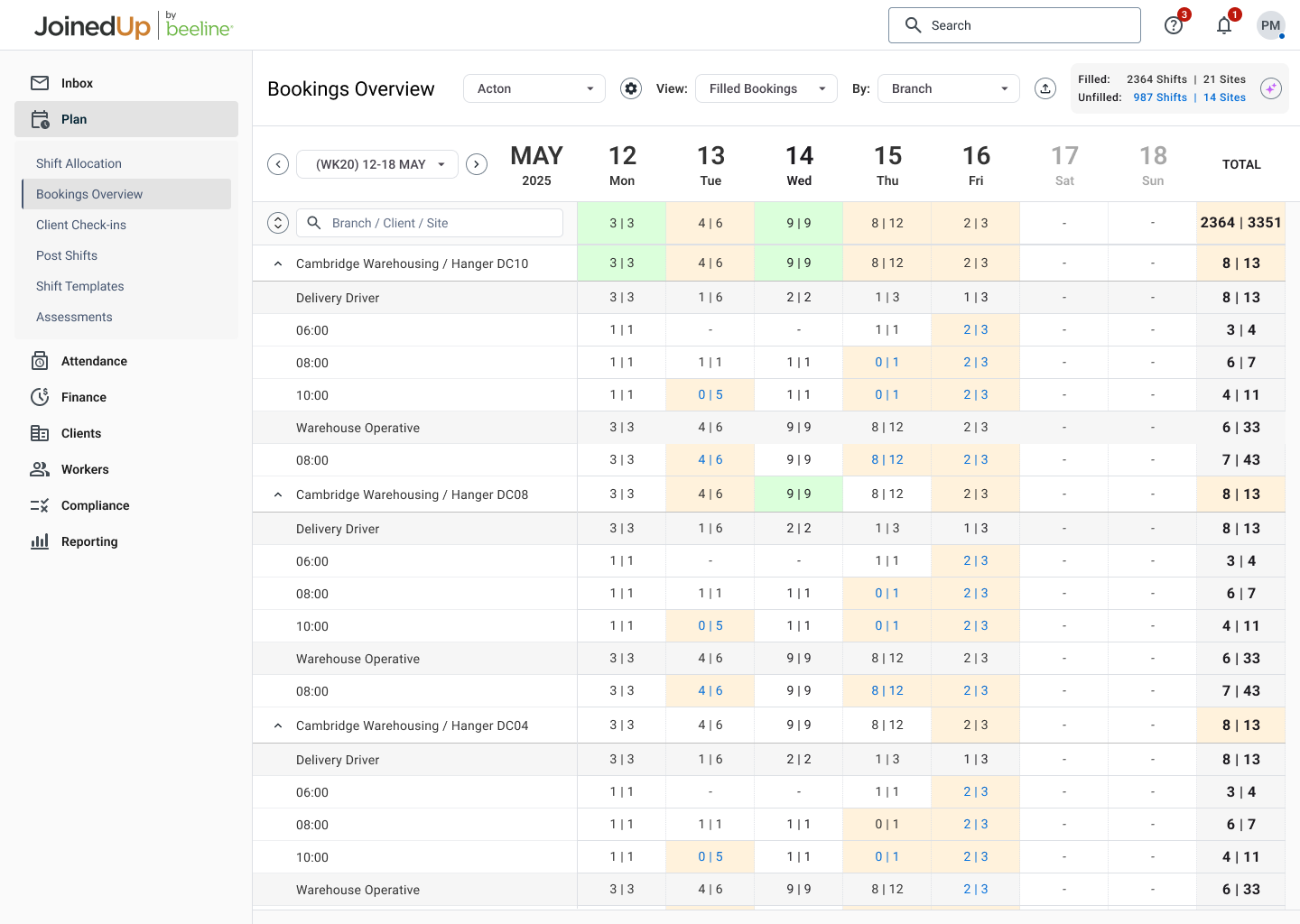
Utmost followed in 2022, adding workforce connectivity and capabilities for smaller programs. Beeline introduced Professional in 2023 with preconfigured workflows and reports. Its 2024 announcement described a target market spending $5 million to $35 million annually on non-employee labor. That matters because implementation effort can swallow the value of software built for a much larger operation.
In June 2025, Beeline acquired MBO Partners. The addition brought independent-contractor engagement and Agent of Record and Employer of Record services into the portfolio. MBO operates as its own business unit. The strategic logic is clear: an independent consultant brings different engagement questions from an agency worker filling Tuesday’s shift. The portfolio follows those differences.
The savings live in the rate card
One anonymous aerospace customer offers a concrete sequence. Its home-grown system had aged; replacing it meant migrating 8,000 ongoing assignments and interfacing with eight internal systems. Beeline proposed phases: US contingent staffing, services procurement, then broader international coverage.
The first staffing phase went live in September 2012. The customer reported $3 million in first-year savings from better vendor pricing. Services procurement followed in 2014. The useful lesson is the sequence: a bounded first deployment produced a result before more categories and countries joined it. A successful replacement does not require every ambition to arrive on opening day.
A utility case is smaller and equally revealing. In its first six months, the customer reported nearly $220,000 in negotiated savings and $167,000 from prompt-payment discounts. These mechanisms are specific enough to examine in another program: negotiated supplier terms and actual payment behavior, rather than a vague promise of efficiency.
A Beeline-commissioned Forrester study modeled 158% ROI for a composite organization. Net value is after modeled costs; the figures describe a scenario, not a quote for a buyer.
Beeline sells B2B cloud software; a published bank case documents license-fee pricing. MBO adds engagement services. For a buyer, the relevant cost includes the commercial agreement and the effort of getting a program into working order. The Forrester model supports an economic argument, but its assumptions need to resemble the buyer’s operation before its return means much.
JoinedUp’s hospitality case supplies a useful distinction. Analysis identified up to $1.4 million in potential annual savings associated with better break tracking and approvals. Potential is doing real work in that sentence. An identified opportunity becomes a realized saving only when the operating process changes and the result appears in the accounts.
A specialist in a room full of suites
Beeline competes with SAP Fieldglass, Workday VNDLY and other VMS providers, including Magnit. Its positioning rests on being a specialist that connects across enterprise systems. It advertises open APIs and prebuilt integrations with SAP, Workday, Oracle and proprietary applications.
The choice has a practical tradeoff. A company prioritizing one vendor relationship and a unified software ecosystem may prefer a suite-owned VMS. A company with complicated services procurement, several core systems or international workforce programs may give greater weight to specialist capabilities. Beeline’s integration argument is persuasive only if those connections work for the buyer’s particular data and processes.
A UK retailer’s implementation shows the partnership in miniature. Guidant Global, the managed service provider, worked with Beeline on a Workday-connected rollout. The program went live in October 2018 with roughly 736 assignments and 77 suppliers. The technology mattered; so did coordination between the customer, its program operator and the software company.
A business built by joining the pieces
Beeline began in 1999 within MPS Group. It later became part of Adecco and merged with IQNavigator in 2016. New Mountain Capital invested in 2018. In May 2022, Stone Point Capital-managed funds became the majority investor, with New Mountain retaining a minority stake. This is an enterprise software business shaped by consolidation and private equity.

Its stated culture puts customer focus and direct communication alongside assuming positive intent. On its careers page, the definition of a customer is “anyone who isn’t me.” It is an unusually expansive rule for a business whose product has to reconcile the interests of buyers, suppliers and workers.
That attention to the ecosystem also appears in partnerships. Beeline and The Mom Project reported more than $40 million in economic impact for moms in May 2023, following a relationship begun in 2018. The angle is different from invoice control: the supplier network influences who gets access to work as well as what the work costs.
Now the agent needs permission, too
Beeline announced general availability of Beeline AI in April 2025, emphasizing skills-based candidate evaluation, automation and human oversight. In September 2026, the company extended the agenda with Beeline MCP: a governed connection allowing approved AI agents and assistants to act on workforce data within existing permissions.
Later that month, it announced a partnership with Insygna to make agent identity, lifecycle governance and cost-accounting capabilities available to customers. These are product announcements, rather than evidence of a measured customer return. They extend a familiar administrative question to unfamiliar workers: what may this actor do, who owns the consequences, and how much does the activity cost?
Start with the record you can defend
The copyable approach is to begin with a defined population, reliable records and named responsibility for approvals and offboarding. Measure supplier prices, invoice errors and process time before changing them. Connect the systems that actually make decisions. Expand once the first category works.
This requires cooperation. Suppliers must submit usable data, managers must follow the process, and the program needs someone to own exceptions. A lightly governed organization can buy software and preserve its old habits inside it. A simple workforce may need less machinery; a complex one needs more than an attractive screen.
Southwest’s original difficulty was finding defensible answers in unreliable records. That gives Beeline’s business its plainest explanation. People arrive, work, get paid and leave. The company buying their work ought to be able to follow the whole sentence.