Consider the Tamagotchi. It is a plastic egg containing a needy digital creature and, for a certain generation, a tiny machine for manufacturing guilt. A child sees a pet. A millennial sees 1997. A parent sees a price. A retailer sees a square inch of shelf that must earn its keep. One object, four stories.
Beacon Media Group makes its living deciding which story to tell, to whom, and where. The agency plans and buys television and digital media, handles public relations, manages social channels, recruits influencers, produces creative work, runs events and measures what happened afterward. Its clients range across toys, games, entertainment, consumer products, lifestyle and technology. But its calling card is narrower: kids and family.
That specialty sounds cheerful. Operationally, it is difficult. Children’s attention moves among linear television, streaming video, games, creators and whatever app adults discover six months late. Parents control the purchase and worry about safety. Retailers care about conversion. Regulations constrain how children can be reached. Beacon’s product is the orchestration of those competing facts.
One product. Three different jobs.
Culture · play · belonging
Trust · price · availability
Demand · timing · conversion
The missing piece was television
The story began in 1992, when Sheldon “Shelly” Hirsch founded Summit Media. The company became Beacon Media in 2006 and built a reputation planning and buying media aimed at children and their parents. It was a specialist in a market where specialist knowledge compounds: viewing habits, seasonal windows, network relationships, pricing and the peculiar rhythm of toy retail.
A second company arrived in Toronto in 2013. Harold and Jennifer Chizick founded ChizComm as a marketing and communications agency spanning PR, digital, social and creative services. Six years later, ChizComm agreed to acquire Beacon. Harold Chizick’s explanation was wonderfully plain: television was “the last piece” of the marketing mix. Adding Beacon meant a client could take one brief from public conversation to paid screen time without asking two agencies to finish each other’s sentences.
A youth-media buying specialty takes shape.
Summit becomes Beacon Media.
PR, social, digital and creative join the plot.
ChizComm acquires Beacon and adds TV planning and buying.
An old specialist name is promoted to the front door.
The combination was sold again in February 2021. Genius Brands International, now Kartoon Studios, paid $8.5 million in cash and stock worth about $3.5 million for ChizComm’s Canadian and U.S. companies. The agreement allowed up to another $8 million in shares if performance targets were reached over four years. Public announcements attached a large operating number to the group: more than $100 million in annual media spend and more than 30 major toy-company clients.
The acquisition, in three bars
Upfront consideration was roughly $12 million. The additional shares depended on EBITDA and performance targets; this was a purchase of the wider ChizComm group, including its Beacon media operation.Then the shelves went empty
The first thing to fail was not the advertising. It was the supply chain. Genius Brands later reported revenue declines in markets served by ChizComm Beacon Media as pandemic shortages hit the toy industry. This is the dark joke of performance marketing: a campaign can create desire faster than a container ship can deliver inventory. A media plan is not a logistics plan.
The corporate integration proved harder still. In January 2022, the Chizicks left, saying that their vision for growth no longer aligned with Genius Brands and that organizational changes had reduced their roles. Litigation followed. Public filings later recorded a $4.8 million goodwill impairment and a $3.4 million write-down connected to discontinuing an acquired trade name. The deal did not unfold as its announcement had imagined.
The useful lesson is not that integration failed. It is that the operating idea survived the ownership drama: research the audience, then make every channel answer to the same brief.The Beacon logic
What changed was the sign. In April 2022, the former ChizComm companies were renamed Beacon Media Group. Beacon Communications in Toronto came under president Donna MacNeil; Beacon Media in the United States came under global CMO and general manager Kathleen Campisano. The media specialist bought in 2019 had lent its name to the whole operation.
A campaign is a chain, not a channel
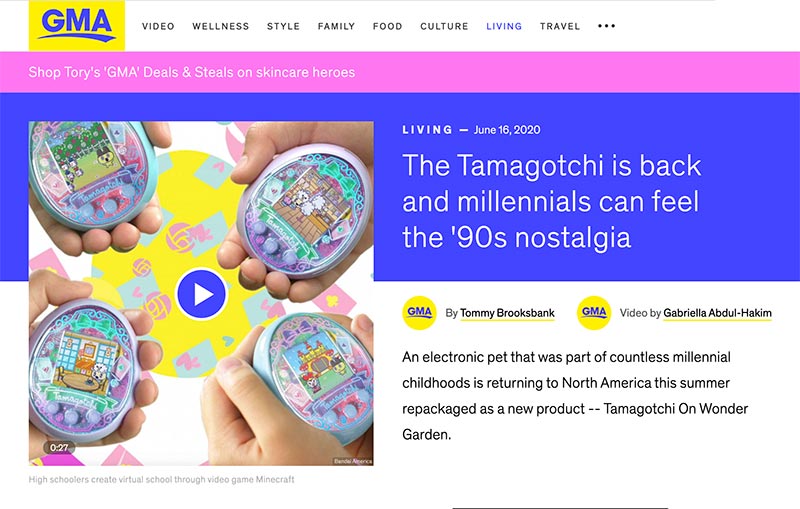
Beacon’s case work makes the proposition concrete. For Bandai’s Tamagotchi, the agency describes an always-on communications calendar that supported multiple product waves with PR, social amplification, paid media and events. For Netflix’s Karma’s World, it tested audience segments, including parents of children aged six to eleven, across premium streaming and OTT inventory. For Funko Games, daily creative tracking and search experiments were used to refine the launch of new Marvel Battleworld series and revive older ones at holiday time.
The more amusing campaigns begin with a behavioral observation. Goliath’s Mastermind needed fresh relevance, so Beacon borrowed the satisfaction loop of Wordle and aimed social and search at adults already enjoying word games. Bazooka wanted millennials to notice gum during tax season; ten financial influencers supplied tax tips, which were redrawn as personalized Bazooka Joe comics, framed and mailed back with gum. For a Disney trivia game, the agency found superfans through talent including Mickey Mouse voice actor Bret Iwan and Jodi Benson, the original voice of Ariel.
This is how Beacon differs from a conventional media buyer or a PR shop. It can follow the same audience from the earned story to the paid video, from the creator post to the retailer search box. It also competes with other specialist agencies - 360PR+, Coyne PR, Freeman PR and Blue Plate Media Services among them - and with the giant networks. Its advantage is not sheer scale. It is pattern recognition in a demanding niche.
The copyable part
A smaller brand cannot reproduce Beacon’s media relationships or decades of rate history. It can copy the thinking. Start with the people in the decision, not a demographic shorthand. Give each channel one job. Borrow a behavior that already exists instead of inventing “engagement” from scratch. Connect reporting to sales and availability, not just reach. And keep creative performance visible while the campaign is live, when it can still change the outcome.
A five-line brief worth stealing
- Name the user, payer and gatekeeper separately.
- Write one friction point for each of them.
- Assign every channel a single verb: discover, trust, try, buy or return.
- Choose the metric before choosing the format.
- Check inventory, regulation and brand safety before buying attention.
The method has limits. It works best where a household decision, cultural fandom and measurable retail action overlap. It is less distinctive for a commodity with no story, a business purchase with a tiny decision committee, or a brand unable to supply what demand creates. Children’s marketing also carries a higher burden of care: privacy, platform safety and parental trust are conditions of the work, not a compliance footnote.
Beacon’s history is messier than the smooth arrows in an agency presentation. There was a merger, an acquisition, a supply shock, a founder split, a write-down and a rebrand. Yet the oldest idea in the company remains the most useful one. A child watching, a parent paying and a buyer stocking may all look at the same toy. They are not seeing the same thing.
Follow the signal
Explore the agency’s current work, campaign archive and public channels.