BREAKING Barry's runs ~90 studios across 15+ countries
7M+ studio visits logged in 2024
Founded 1998 in West Hollywood
Princeton Equity Group invests, Jan 2026 era expansion
CEO Joey Gonzalez started as an instructor in 2003
Dropped "Bootcamp" from the name in 2019
RED ROOM Run. Lift. Repeat.
BREAKING Barry's runs ~90 studios across 15+ countries
7M+ studio visits logged in 2024
Founded 1998 in West Hollywood
Princeton Equity Group invests, Jan 2026 era expansion
CEO Joey Gonzalez started as an instructor in 2003
Dropped "Bootcamp" from the name in 2019
RED ROOM Run. Lift. Repeat.
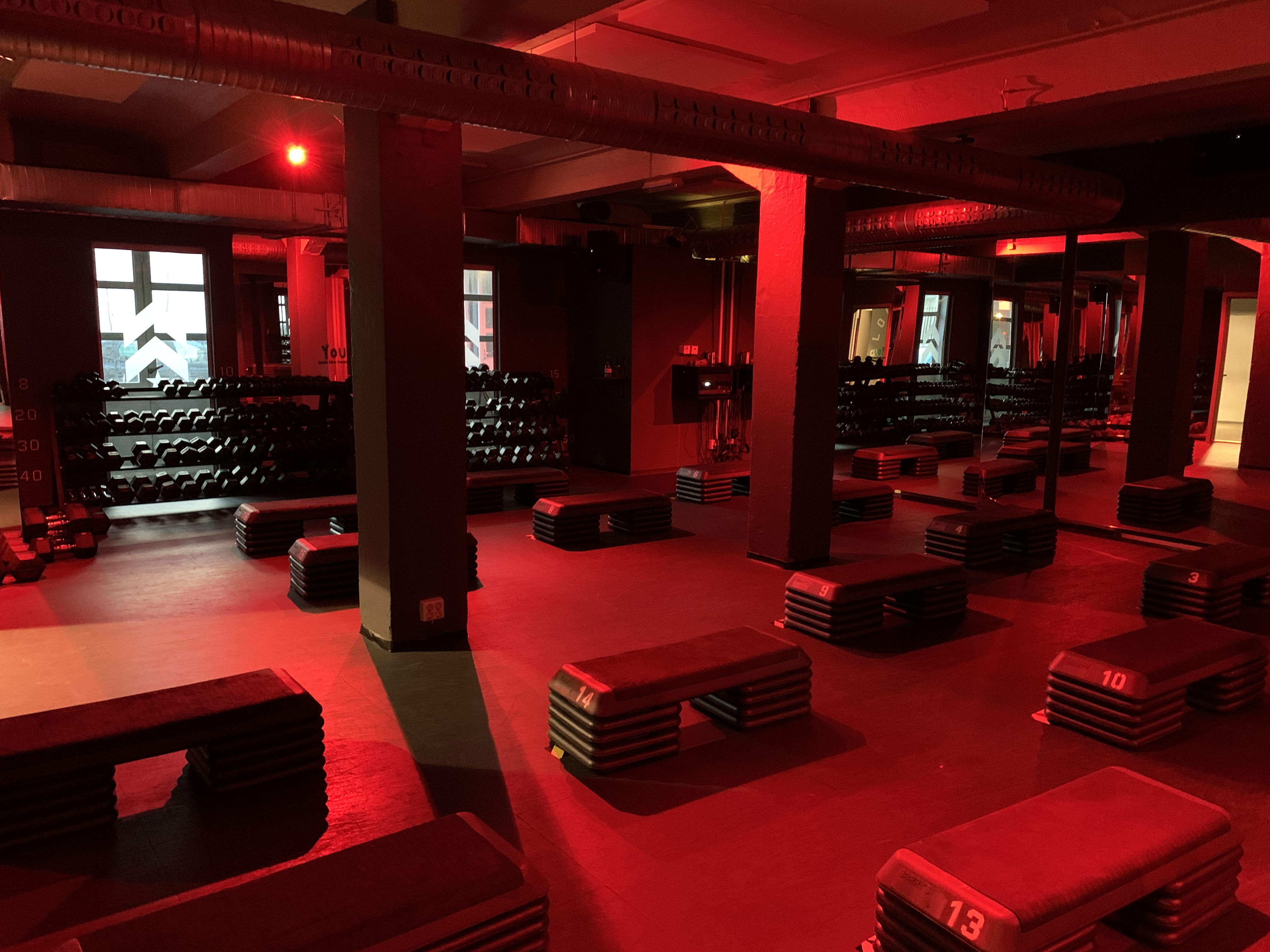
Above: the Red Room - where the lighting is flattering and the burpees are not. Photo: Wikimedia Commons (Oslo, 2021).
Who They Are Now
Somewhere right now, a red room is full.
It is 6:05 a.m. The lights are low and the color of a stoplight. A wall of treadmills hums. On the floor, a row of benches and dumbbells waits. A coach with a headset mic counts down, the bass drops, and forty strangers start running like they mean it. This is happening this morning in Los Angeles, in London, in Oslo, in Dubai - more or less simultaneously, more or less identically. That sameness is the whole trick.
Barry's is a boutique fitness company built around a single, stubbornly consistent product: a roughly hour-long class split between treadmill sprints and free-weight strength training, performed in a dark, mirrored, red-lit studio it calls the Red Room. Around 90 studios. More than 15 countries. Over seven million visits in 2024. And one idea that has barely changed in twenty-five years.
Barry's doesn't sell a gym membership. It sells the feeling that you showed up to something.
The Barry's premise, in one line
The Problem They Saw
Gyms were lonely. Classes were boring. Both were beige.
In the late 1990s, fitness mostly meant one of two things. There was the big-box gym - a fluorescent warehouse of machines where you wandered in alone, did your sets alone, and left without anyone noticing you'd come. Or there was the aerobics class, which had energy but not much edge, and tended to leave the serious lifters cold.
Nobody had really put the two together: the intensity of a hard, structured workout and the social charge of a room moving in time to music. Group fitness existed. So did high-intensity training. They simply hadn't been formally introduced. The market, in other words, had a gap shaped exactly like a loud, dark room.
The gym was a place you endured. Barry's bet there was a market for a place you'd actually want to be seen leaving.
On the white space in fitness, circa 1998
The Founders' Bet
One studio in West Hollywood. A wildly specific vibe.
In 1998, Barry Jay, along with John and Rachel Mumford, opened the first Barry's Bootcamp in West Hollywood. The pitch was almost comically literal: take the rigor of a boot camp and stage it with the atmosphere of a nightclub. Dim the lights. Crank the sound system. Put a charismatic instructor at the front with a microphone. Make the workout hard enough to feel like an accomplishment and theatrical enough to feel like a night out.
It could easily have read as a gimmick - fitness with a smoke machine. Most concept gyms of that vintage are now parking lots. What kept Barry's alive was that the workout underneath the lighting actually held up: treadmill intervals to spike the heart rate, free weights to build strength, a format structured tightly enough to repeat day after day without going stale.
1998First studio opens
2011First overseas: Bergen
2015Gonzalez named CEO
2019"Bootcamp" dropped
Barry Jay built the thing partly out of his own recovery story. The room was loud on purpose.
On the founder behind the brand
The Product
Run. Lift. Repeat. In that order, in red light.
The Barry's class is built on a deceptively simple split. Half the time goes to the treadmill - the "Run" - with a coach calling out walks, jogs, sprints and hill climbs to push your cardiovascular system. The other half goes to the floor - the "Lift" - with dumbbells, benches and bands for strength work. The two halves rotate, and the room never stops moving.
Around that core, Barry's has grown a small ecosystem. The Fuel Bar sells protein shakes you can order before class and grab the second you stumble out, sweat-soaked, into the lobby. Barry's X, launched in 2021, brought live and on-demand classes home for people who can't make it to a studio. RIDE extended the format to indoor cycling. There's branded apparel, an iOS and Android app, and a retail line. But make no mistake about what people are buying: the room.
What you can actually do with Barry's
- Walk in cold. Book a single class through the app - no long contract required to try the Red Room once.
- Train hybrid. Combine in-studio classes with Barry's X at-home workouts when travel or schedule gets in the way.
- Fuel up. Pre-order a Fuel Bar shake so recovery starts the moment class ends.
- Find a crowd. Use it as a community - the same faces, the same 6 a.m., the same instructor who remembers your name.
The genius isn't the treadmill or the weights. It's that the format is identical enough to repeat and theatrical enough to crave.
On why the class works
The Mission
Work hard, have fun, be your best.
Barry's states its purpose plainly: help people work hard, have fun, find their strength, and be their best. It's not a manifesto about disrupting anything. It's a description of what's supposed to happen in the room - and, by extension, a culture. The company leans on values it lists as diversity, ownership, support, trust, honesty, courage and innovation, and it has a habit of promoting from within. Gonzalez's path from instructor to CEO isn't a one-off; it's close to a brand value.
That matters more than it sounds. In a business where the product is, fundamentally, a person at the front of a dark room making you feel something, the instructors are the company. Treat them as interchangeable and the whole thing goes flat. Barry's bet, again, is on the room - and on the people who run it.
In fitness, you can copy the equipment overnight. You can't copy the coach who remembers your name.
On the moat that isn't a treadmill
Why It Matters Tomorrow
The room, scaled - or the room, diluted?
The tension that built Barry's is the same one that will test it. Its strength is consistency: a Red Room in Miami should feel like a Red Room in Manchester. Its risk is dilution: every new studio, every digital class, every licensing deal is a chance for that feeling to thin out. Growth and sameness are, in the long run, in quiet opposition.
So far Barry's has chosen to grow carefully rather than blanket the map. Backed by fresh capital and eyeing further international expansion, the company is wagering that the appetite for in-person, high-intensity, slightly theatrical sweat isn't going anywhere - even in an age of on-demand everything. The screens, it turns out, made the room more valuable, not less.
Which brings us back to 6:05 a.m. The bass drops. Forty strangers start running. Twenty-five years ago that room didn't exist; the gym was a quiet, fluorescent place you went alone. Barry's didn't invent the treadmill or the dumbbell. It invented the reason to want to be there - in the dark, in the red, with everyone else - before the sun is even up.
Barry's didn't make exercise easier. It made showing up the part you'd brag about.
Closing argument