Consider the life of a commercial loan after everyone has stopped congratulating one another. The agreement is signed. The money is available. Yet next month, and the month after that, somebody must ask for another set of financial documents. Somebody else must send them. A third person must decide whether they satisfy the agreement. BankStride has built a business around keeping those ordinary exchanges from getting lost.
- The job: collect borrower documents, track exceptions and monitor loan covenants.
- The detail: borrowers can submit files without creating an account.
- The fit: a monitoring workflow for banks, credit unions and commercial lenders.
The file that comes back every month
The company offers a useful example: a revolving line of credit. Each month, its bank customer requests accounts-receivable and accounts-payable lists, inventory analyses and borrowing-base certificates. These are recurring requests for fresh information. Having last month’s file is rather like having last month’s weather forecast. It tells you something, but it does not settle today’s question.
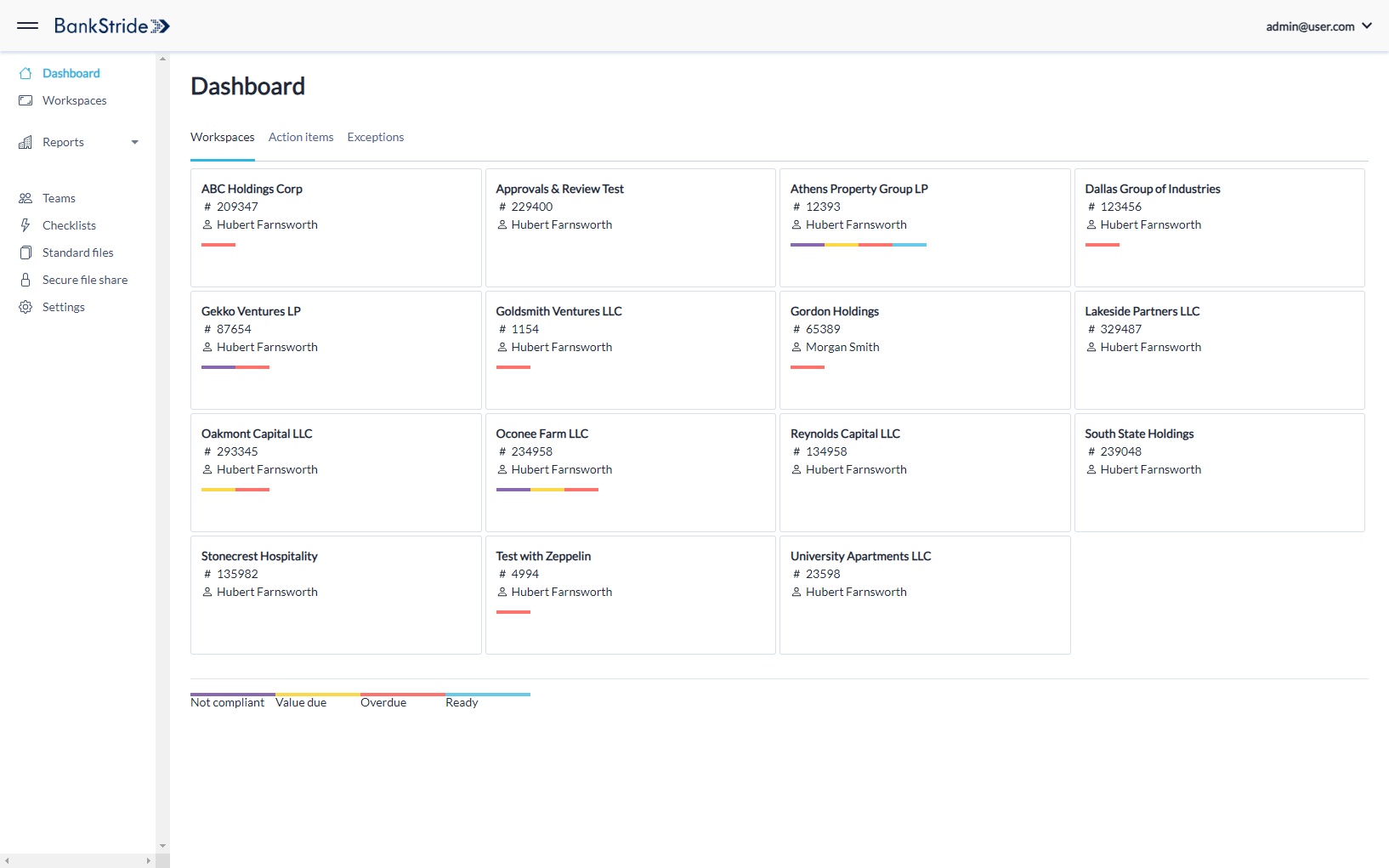
BankStride schedules those requests and reminders. It also reminds the banking team to test financial ratios, then brings the results into reports organized by banker or office. The appeal is easy to grasp: a recurring obligation becomes a recurring process, with a visible state, instead of another item someone hopes to remember.
That gives the company a particular place in lending software. Although it advertises underwriting and pipeline tools, its own account of what distinguishes it emphasizes monitoring after a loan has been booked. The closing meeting is a milestone. The continuing collection and review of information is the product’s center of gravity.
The password is optional
Now look at the borrower’s side. The bank wants a document. The borrower wants to finish the errand. BankStride allows the bank to send a tokenized link to a portal where the borrower can see the request and upload the file without establishing an account. Email submission is another route. The design recognizes that an occasional participant has little reason to love another password.
Once a file arrives, the lender receives a notification and reviews it. An unsatisfactory submission can go back with comments. That small loop matters. Receiving an attachment and satisfying a loan requirement are separate events; a useful workflow must allow for both.
For the advertised login-less submission route. Lender review still follows.
The lesson extends beyond banking. If a process depends on somebody outside your organization, design that person’s next action as carefully as your own dashboard. A reminder can be perfectly timed and still fail if completing the request is a nuisance.
A checklist with consequences
Not every open item means the same thing. An overdue financial statement creates a gap in information. A financial covenant compares the borrower’s position with an agreed condition. BankStride describes comparing actual covenant values with thresholds, including a minimum debt-service coverage ratio. Its exception records can show the issue, actions taken, timestamps and the people involved.
Those distinctions turn a checklist into something more useful for a credit team. Staff need to know what is missing, what needs review and which findings require attention. Managers need a view across the portfolio. BankStride’s tools organize that sequence; the credit judgment remains with the institution.
- 01RequestSet the item
and schedule. - 02SubmitBorrower sends
the document. - 03ReviewLender checks
the requirement. - 04MonitorTrack status.
Repeat when due.
Construction lending adds another version of the coordination problem. BankStride advertises draw requests, inspections and approvals in one workflow. The object being tracked changes, but the organizing question stays familiar: what must happen before the next action can proceed?
Borrowing an idea from access control
BankStride’s current origin story points to SecurEnds, an identity-governance and compliance company. It identifies Tippu Gagguturu as founder and CEO, and describes him as its founding backer. The connection is an analogy between two kinds of administrative work: reviewing access inside an enterprise and monitoring loan requirements inside a bank.
In the company’s telling, both suffer when evidence and responsibility are scattered. Its stated values emphasize innovation, trust and agility. The tangible expression of that philosophy is less abstract: collect the information, record the action and make the outstanding work visible.

Beside the system already there
There is a revealing phrase in a company-published testimonial from Doug LeBlanc of Encore Bank: the perfect complement to our loan operating system
. It places BankStride beside an existing system. The company says its software can integrate with core and other systems or operate independently.
The platform also lets institutions customize document checklists, financial requirements and approval workflows. Roles and permissions can govern who approves an item, performs a quality review or sees particular information. That configuration is part of the work: the same incoming file may need different treatment depending on the loan and the staff member responsible for it.
Its market includes community banks, credit unions and commercial lenders; it also presents use cases for private credit teams. Loan administrators, credit officers and operations staff are natural users. The business model is B2B software, with vendor discussions and demonstrations shaping the sale. For a prospective buyer, the useful comparison starts with the work that needs replacing: spreadsheets, inboxes, calendar ticklers or an existing monitoring module.
Make the next action obvious
In February 2026, BankStride described a redesigned experience bringing covenant dashboards, document collection and exception tracking into clearer view. Its launch message attributed the focus to customer requests for clarity, simpler workflows and reporting ready for audits. These are practical demands from people trying to keep many small obligations coordinated.
A sensible evaluation would therefore follow one recurring requirement all the way through: request, submission, correction, approval and reporting. The question is whether the institution can keep a coherent record when a borrower responds late or sends the wrong file. A tidy dashboard earns its keep when the underlying process survives those ordinary interruptions.
The operational lesson is copyable: give each recurring requirement a schedule, an owner and a review state. Let the person supplying information see exactly what is needed. Then preserve what happened. Software cannot rescue an incorrectly entered requirement or make an unreliable document true. It can give the people responsible a clearer place to begin. In BankStride’s corner of banking, progress looks like knowing whose turn it is.