Enterprise software has a peculiar relationship with glamour. Its least photogenic details are usually the ones holding the company together: an approval rule, an inventory exception, a ledger that reconciles, a permission that prevents the wrong person from seeing the right number. Baljeet Chhazal has spent a career near those details. Before he was the co-founder and chief executive of Calfus, before “agentic AI” became a phrase executives could say without stopping to define it, his work ran through Oracle practices, ERP programs, supply chains and cloud migrations.
That history makes his current bet more interesting. Calfus is repositioning itself around a platform-led model for enterprise AI, with Aetherion as the machinery. Chhazal talks about agents, but his vocabulary quickly returns to governance, isolation, audit trails, cost and business outcomes. It is the language of someone who knows that a prototype can charm a conference room while a production system has to answer to finance, security and the person carrying the pager.
The arc begins long before Calfus. Public professional records place Chhazal at the Indian Institute of Management Bangalore from 1993 to 1995. In May 2014, KPIT appointed him senior vice president and global head of its Oracle business unit, citing nearly 20 years of technology and industry experience. His assignment covered growth, major client relationships, the Oracle partnership and delivery capability across geographies. Four duties, each capable of swallowing a calendar whole.
An education in consequential software
The products around that job were rarely decorative. ERP decides how orders, materials and money move. Supply-chain systems turn a forecast into a purchase, then expose every mistaken assumption between the two. Chhazal's public comments from the period repeatedly joined technology to business value: agility, transformation, cloud adoption and customer outcomes. A recommendation on his professional profile puts the trait more plainly, describing an ability to see both the process and system view while keeping an eye on technical detail.
The awards accumulated around the teams he led. KPIT received Oracle recognition for JD Edwards work in 2015. In 2018, it won an Oracle SCM Cloud partner award in India for a third consecutive year. After KPIT's enterprise business became part of Birlasoft, Chhazal served as executive vice president and global head of enterprise solutions. In 2019, he stood with colleagues and Oracle executives at Oracle OpenWorld in San Francisco as Birlasoft received an APAC award for emerging technologies.
MBA studies at IIM Bangalore.
Takes charge of KPIT's global Oracle business.
Leads enterprise solutions at Birlasoft during an Oracle award run.
Co-founds Calfus and announces its public launch.
Pushes Calfus toward Aetherion and platform-led agentic AI.
Awards in the partner world can look like polished acrylic under flattering lights. Their practical meaning is more prosaic: certifications completed, customers delivered, alliances maintained and enough repeatable work to convince a large vendor that the relationship deserves a stage. Chhazal's career in that ecosystem offered a prolonged study of scale. It also offered a view of the compromises that appear when services businesses grow by adding projects and people.
“When you respect money, you build things that actually work.”Baljeet Chhazal, writing about Aetherion
The founder chooses a motto
Calfus was formed in 2021. Chhazal announced its launch in January 2022 with three Latin words and their modern Olympic translation: faster, higher, stronger - together. The last word was added to the Olympic motto in 2021, and it suited his pitch. Calfus, he wrote, had been founded by like-minded people to use technology disruption for customers, deliver result-oriented solutions and give employees a platform for growth and innovation.
The sporting language stayed. When Calfus opened a Bengaluru facility in September 2024, Chhazal closed his announcement with a promise that the team would “run together and run far.” The office, he said, created better access to talent and customers. The recruiting brief favored engineers with the curiosity to learn and the ability to solve complex problems at scale. There is a quiet consistency here: movement matters, though endurance and company matter too.
The corporate record gives the founding story firmer edges. A 2023 securities filing lists Chhazal as Calfus's president, executive officer, director and promoter, alongside co-founder Rohit Agarwal. Calfus's current leadership page names Chhazal chief executive and Agarwal managing director. This is not a lone-genius tableau. The company presents a bench spanning technology, data, delivery and business development.
From effort to engine
Calfus now describes its desired shift with a crisp pair of nouns: from effort to engine. The distinction reveals the business model ambition. Traditional consulting sells expertise applied to a customer's situation. A platform attempts to preserve that expertise as reusable machinery. One grows largely through the next engagement; the other tries to make each solution part of the next solution.
Aetherion is the vehicle for that attempt. Calfus publicly describes three ways to build agents: plain-language instructions, visual workflows and a software development kit. Underneath sits a governed runtime with connectors into enterprise systems. Chhazal's recent writing emphasizes the matters that arrive after a model produces an impressive answer: role-based access, data isolation, evaluation, auditability, cost metering and agents that can continue work over longer horizons.
The distance between an idea and an enterprise outcome
This is where Chhazal's ERP years stop being biography and become product strategy. An enterprise agent may use a newer interface, yet it enters an old maze. Who approved the purchase? Which customer record is authoritative? Can the action be reversed? What did the system know at the time? Who pays when the loop runs longer than expected? The questions are familiar to anyone who has implemented finance or supply-chain software. AI adds probability to a landscape that already had plenty of exceptions.
The company has begun adding pieces. In March 2026, Calfus announced the acquisition of DigitalMain, including its Vizerto product, to deepen generative and agentic AI capabilities inside Aetherion. Acquisition announcements are promises in formal clothing; integration supplies the proof. Still, the move makes the direction legible. Calfus wants more of its intelligence, orchestration and reusable software to live in a product layer.
A preference for composure
One of the more personal glimpses of Chhazal arrived at CalfusNXT, a 2026 company offsite in Colombo. He hosted Muttiah Muralitharan, the Sri Lankan cricketer, for a conversation with roughly 50 colleagues. Chhazal's recap dwelled on discipline, mental pressure and the usefulness of knowing one's strengths. His favorite counsel from the session was wonderfully compact: “Breathe. Don't freeze.”
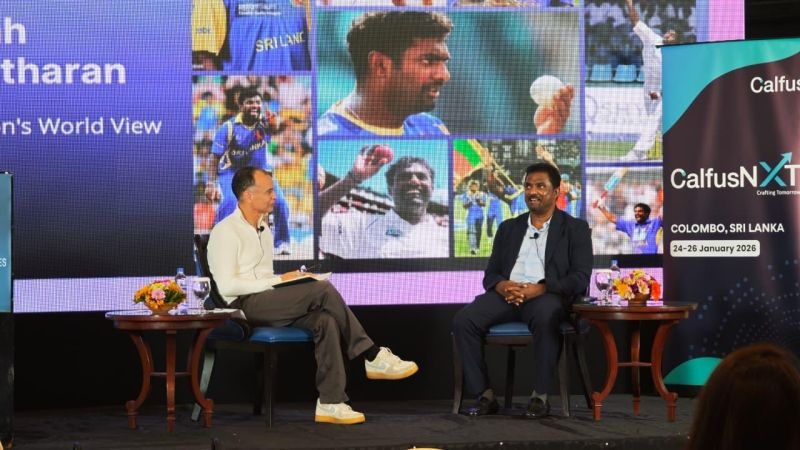
The moment also contained a miniature version of the Calfus thesis. Two young engineers had built an AI agent in three days for Muralitharan to try. The sporting hero supplied the theater; the engineers supplied the artifact. Chhazal celebrated both the speed and the grounding. For a leader fond of running metaphors, composure under pressure is a natural companion principle. Long races are usually lost by spending energy at the wrong time.
His public writing is most persuasive when it turns from category language to operational consequence. He has argued that an enterprise agent must respect permissions, survive a restart and leave a decision trail an auditor can reconstruct. He has also tied the work directly to money. That instinct separates a product budget from a science fair. Enterprises can enjoy novelty. They renew outcomes.
There is a gentle irony in the route. Chhazal left the world of enormous enterprise vendors to start a smaller company, then set about building a platform for the same difficult environments he already knew. Founders are often advised to escape their past. His approach is closer to distillation. Keep the useful constraints. Remove what became ceremony. Turn repeated labor into an engine.
The work after the applause
The open question is execution. Calfus must keep delivering services while making a platform sufficiently coherent to stand on its own. It must connect to the sprawling systems its customers already use, compete in a crowded agentic-AI market and demonstrate that governance features lead to business results. Chhazal knows the audience. He spent years serving buyers who can admire a roadmap and still demand a reconciliation report before lunch.
His advantage is not clairvoyance. It is familiarity with the scene after the demo ends: the room empties, the credentials expire, the sample data gives way to the live database, and someone asks who owns the outcome. Calfus is being built around an answer to that final question. Accountability, in its version of the future, belongs inside the product and alongside the people deploying it.
Faster, higher and stronger made a lively founding banner. “Together” turned it into an operating constraint. The agents may become more autonomous. The work remains social, financial and stubbornly real. Baljeet Chhazal's second act is a wager that enterprise AI will grow up when it learns those facts.