Fifty-four batteries. That was Bateriku.com’s first month of sales. A perfectly respectable number for a shelf, perhaps, but a modest beginning for a business that would eventually reach drivers across Malaysia. Azarol Faizi had spent years supplying companies with batteries. Now he was asking individual motorists to trust a different arrangement: stay where you are, and someone will bring the workshop to you.
There is a particular difficulty in selling something to a customer whose car will not start. The customer has already lost patience with one machine. Asking them to admire your technology is ambitious. They want to know who is coming, whether the person understands the problem, and when they can leave. Azarol’s career has increasingly revolved around making those questions easier to answer.
The early sales figure has a useful bluntness. It puts the subsequent talk of platforms, networks and regional expansion back on human ground. Before the conferences and institutional investors, there were customers who had never heard of the service. Each sale required somebody to make the idea work in an actual parking space.
A boy looking up, an engineer getting started
Azarol grew up in Kampung Seri Kaya, Bota Kiri, Perak, with four siblings. His schooling took him from Sekolah Kebangsaan Seri Kaya to Sekolah Sains Raja Tun Azlan Shah in Taiping. There was an interest in business early on, but there was also the Boeing 747. Watching the aircraft helped inspire a youthful ambition to become a pilot.
He eventually studied mechanical engineering with an aeronautical specialisation at Universiti Teknologi Malaysia, graduating in 1995. His working life began closer to the ground. Steel fabrication came first, followed by oil and gas. The jobs included estimating engineering at Cleveland Bridge UK-EON and project engineering at Unimasco. In 1999, he joined Hyundai Corporation, where his work involved heavy industry.
That background gives his later decisions a particular texture. Estimates, projects and industrial customers are an education in what a promise costs to deliver. The attractive idea has to survive procurement, installation and the practical habits of the people using it. A roadside service would eventually put the same test on a much shorter clock.
In September 2005, after roughly a decade of employment, he left to establish Astra Simfoni. The entrepreneurial ambition now had a company attached to it. Steve Jobs was an inspiration, although Azarol’s own route would run through automotive supply rather than consumer electronics. The ingredients were decidedly industrial: batteries, manufacturing relationships and customers with exact requirements.
The customer moves, the battery follows
Proton became an early customer in 2006. Mitsubishi and Perodua were also part of Astra’s automotive supply work. This mattered when Azarol began thinking about consumers. He already knew the product and had relationships in its supply chain. Bateriku would grow out of that experience, carrying existing knowledge into a different kind of transaction.
The visible change was simple. Instead of sending a driver to a battery shop, send a technician to the driver. Businesses were already doing versions of mobile battery replacement. Azarol has been quite clear about that. His interest lay in taking a service usually operated on a small scale and making it available across a country.
In March 2014, the consumer operation began with a small team and personal phones serving as its call centre. An app came later. Feedback arrived first. That order is revealing: the business had to discover what people needed while it was already answering them. There was little room for the comforting fiction that a finished interface meant a finished service.
“We didn’t have an app at the time”
Azarol Faizi, recalling Bateriku’s beginnings
The move also changed the less photogenic parts of the company. Industrial billing could happen monthly; consumer orders required transactions throughout the day. Growth meant adjusting the machinery behind the sale. A battery still had to arrive, but the information accompanying it had become much more demanding.
By the period covered in the 2017/18 SME annual report, monthly sales were around 8,000 batteries. The original Klang Valley operation had spread into other Malaysian states. The first month’s 54 was acquiring a different meaning: a starting point that could be measured against an increasingly busy dispatch operation.
- 2005Astra Simfoni begins
- 2014Bateriku reaches motorists directly
- 2019Endeavor selection in Madrid
- 2022Akademi Bateriku established
Somebody has to turn up
For a service like this, a nationwide ambition creates an awkward question. Who is close enough to help? Bateriku’s answer developed around several kinds of participant: mobile technicians called BHero, business partners called BPreneur, and workshop partners called BBuddy. The names have the cheerfulness of a company determined to make a breakdown less dreary.
For Azarol, these relationships became central to how the company would grow. In his message welcoming 2024, he put the technician and entrepreneur programmes at the centre of order fulfilment. He also described more than 160 physical Pitstops, including locations in Sabah and Sarawak. Coverage required people and places that a driver could actually reach.
Training followed the expanding responsibility. Akademi Bateriku was established in 2022, giving the network a place to develop and refresh its skills. A technician arriving under the Bateriku name carries the company’s reputation along with the tools. Azarol returned to that point in February 2026: inadequate training could damage a customer’s vehicle and the brand’s standing.
This is where the engineering instinct becomes visible again. A distributed service has many opportunities for variation. Training is one way to make the experience more dependable from one person to another. The academy gives the growth story an institutional shape: passing knowledge on becomes part of running the business.
Mobile skills at the customer’s location.
Local businesses within the wider network.
Partners for the work beyond a battery.
There is room for a little car limbo
A company concerned with reliable installation might sound rather solemn. Azarol’s automotive interests leave room for something noisier. MotorManiac, which he describes as Bateriku’s petrolhead department, makes content, participates in motoring events and builds project cars. Among the vehicles he has named are a Nissan Cefiro A31 and a Toyota Supra MK3.
At the October 2023 MotorManiac gathering at MyTown in Kuala Lumpur, the programme included 450 cars and competitions in car limbo and two-step. It also unveiled the Cefiro project, which had involved two years of stripping, re-engineering and rebuilding. BMX and breaking competitions widened the proceedings beyond a conventional car display.
It is a pleasingly specific detour in a founder’s story. Cars appear here as objects of affection as well as machines that occasionally need rescuing. There is an audience willing to spend a weekend looking at them, discussing them and finding new ways to get them under a limbo bar. Azarol’s company makes room for that audience too.
His enthusiasm for marketing has a practical outlet elsewhere. Bateriku has used its own people in promotional productions, with in-house work on scripts, storyboards and choreography. The business that began with an industrial supplier has learned to perform in public. Apparently, a battery can have a supporting cast.
The numbers get bigger, the question stays practical
In April 2019, Azarol was selected as an Endeavor Entrepreneur at the organisation’s 87th International Selection Panel in Madrid. The recognition placed him in a wider community of founders and mentors. It was another step away from running a battery supply operation alone and towards building a business with a larger set of relationships.
By 2023, Bateriku reported RM95 million in revenue. An April 2024 conversation about the business included an ambition to list in 2027. That date belongs to the category of plans: it describes what Azarol was aiming towards. The completed milestones are substantial enough without asking an intention to do the work of an outcome.
September 2024 brought a US$7.4 million Series B, equivalent to RM34.7 million at the announcement. Backers included KWAP, Gobi Partners and VentureTECH. The stated use of the money was to develop technology and connect battery services, breakdown assistance, workshops and an automotive marketplace. For a driver, those categories can follow one another quite naturally during a single troublesome week.
National recognition arrived in a particularly public setting the following month. Malaysia’s Budget 2025 speech named Azarol and cited Bateriku’s reach of 1.5 million customers, alongside 1,000 trained gig technicians and 100 entrepreneurs. A business that had started with 54 sales in a month was now an example in a national budget address.
The next country has its own roads
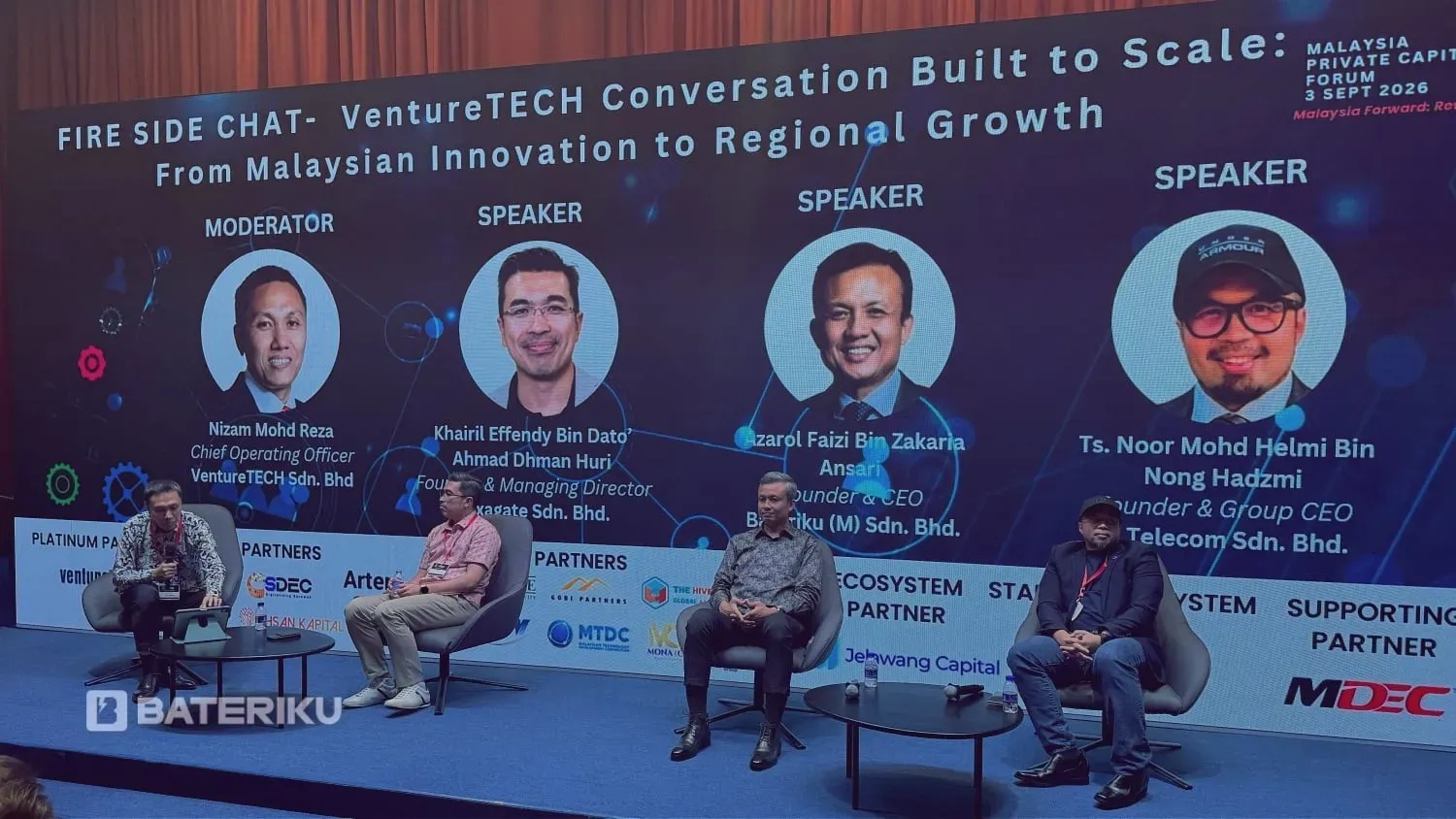
At the Malaysia Private Capital Forum in September 2026, Azarol’s discussion turned to expansion beyond Malaysia. Indonesia was the immediate focus, with Thailand, the Philippines and Vietnam among subsequent opportunities. The proposed approach relied on the digital network and fewer owned physical assets, recognising that Malaysia’s infrastructure could not simply be reproduced everywhere.
That qualification is useful. A map can make expansion look effortless; operating a service tends to restore the missing complications. Azarol’s original question remains waiting in each new market. A driver needs assistance. Someone must understand the problem, organise the response and make the encounter dependable.
The boy who watched a Boeing 747 became an engineer, then a supplier, then the founder of a business organised around other people’s interrupted journeys. The route is circuitous enough to be interesting. Its recurring concern is wonderfully concrete: helping somebody get moving again. A good deal can be built around that, provided somebody turns up.
Keep following the road
Read Azarol’s updates, hear him discuss the business, or take a detour through the cars.