A storage unit is an unromantic rectangle until life happens. A family moves. A shop outgrows its back room. A student leaves campus. A renovation eats the living room. The customer sees a temporary answer to a personal transition; the company sees demand, duration, price and a path through a digital funnel. Ayash Basu’s job is to hold both pictures at once.
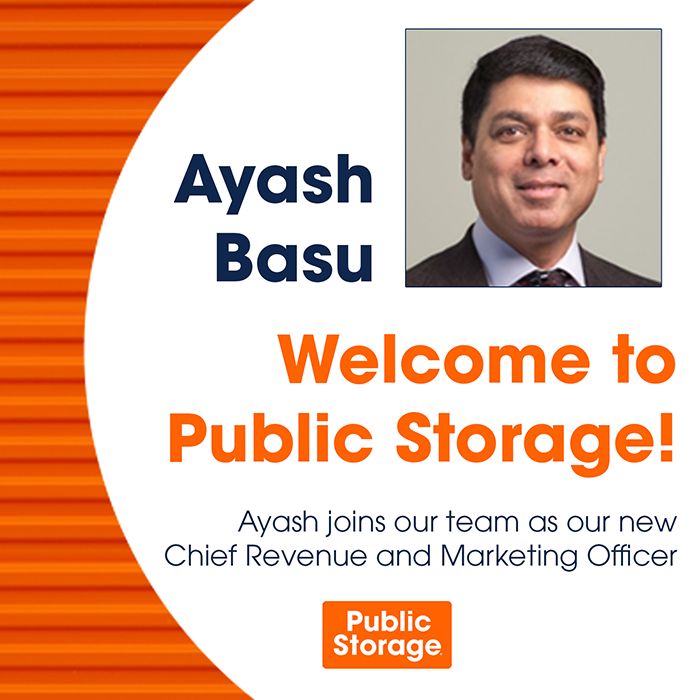
Basu joined Public Storage in January 2026 as Chief Revenue and Marketing Officer. The title bundles together functions that companies often scatter across an organization: revenue growth, pricing, go-to-market, brand, multichannel acquisition, digitally enabled customer experience and retention. At the time of his appointment, Public Storage described a portfolio of more than 3,500 facilities serving over two million customers. Small choices do not stay small at that scale.
His arrival also coincided with PS4.0, the company’s plan to connect a new operating model, data science, AI-enabled marketing and a more consistent customer experience. Basu described his part plainly in a public post: bring “marketing, pricing, channels, customer experience, and brand” together. The list is revealing. It treats growth less like a campaign and more like a sequence of connected decisions.
First, learn to frame the problem
Long before the C-suite, Basu studied architecture at the Indian Institute of Technology Roorkee. Architecture asks a person to work across scales: the joint, the room, the building, the street. The discipline is visible in the shape of his career, even if he rarely makes the connection explicit. He moved into creative and web work, earned an MBA with distinction at Columbia Business School, then entered strategy consulting at Deloitte and McKinsey.
At McKinsey, his public biographies place him in marketing effectiveness and digital work for consumer, retail, automotive and luxury companies. Those assignments taught the boardroom version of framing: decide which part of a sprawling problem deserves attention, then turn it into an operating choice. Yet Basu kept another school open after hours.
His photography began during undergraduate hikes in the Himalayas. He tinkered with old Russian manual cameras and developed black-and-white film in a rudimentary college darkroom. The machinery forced decisions. Film is finite. Focus is manual. The image cannot be rescued by taking 200 nearly identical frames and choosing later.
“Photographing people is as much about listening as it is about seeing.”Ayash Basu, on his people portfolio
That line is more than an artist statement. Listening changes where the photographer stands, when the shutter clicks and whether a stranger becomes a subject or remains a prop. Basu says he is drawn to small gestures and local context, the quiet evidence of how people relate to one another and their surroundings. In customer work, the parallel is direct: a data point becomes useful only after someone understands the situation that produced it.
The Basu frame
The founder enters the picture
In 2017, Basu left McKinsey and founded Loculars. The idea came from a gap familiar to serious travelers with cameras. A city’s working photographers possess local access, spare capacity and knowledge that no top-ten list can reproduce. Travelers want to make stronger pictures and find places beyond the standard route. Loculars turned that match into short, bookable experiences led by screened professionals.
The marketplace was an exercise in packaging context without flattening it. A guest was not booking a generic tour with fifteen strangers. Experiences were built for small private groups, usually around offbeat neighborhoods, communities or events. The professional on the other side was not simply carrying a camera; the professional was offering judgment, access and a way of seeing.
Leica Camera USA acquired Loculars, and the business was absorbed into Leica Akademie USA in 2021. The outcome gave Basu a founder’s education that consulting could not: build the supply, find the demand, earn trust on both sides and make the transaction feel personal. Marketplaces punish fuzzy value propositions. Either the match works or the booking does not happen.
After Loculars, Basu led e-commerce, direct-to-consumer and digital marketing at premium pet-food company Canidae. Then, in late 2021, he joined Boston Consulting Group, becoming a managing director and partner. His work there sat at the intersection of industrial goods and marketing, sales and pricing, with emphasis on automotive, mobility and infrastructure. He advised top management on profitable growth, operating models and large-scale digital, e-commerce, brand and performance-marketing transformations.
Two lenses, one operating system
The consultant and photographer are easy to treat as separate biographies. Basu’s own writing makes that division hard to sustain. He is interested in how places work. In Amsterdam, he wrote about a former shipyard becoming a creative and commercial district. In Ladakh and Turtuk, he placed landscape inside trade, border history and village life. Back in Kolkata, the city he disliked as a child, he found affection through a photographer’s eye and, as he jokes, a food lover’s appetite.
His images are similarly attentive to systems hiding inside scenes: a wholesale market’s chain of labor, ritual moving through a street, a repair shop preserving an old trade. He photographs people, but rarely strips away their surroundings. Context is not clutter. It is the thing that explains the frame.
There is humor, too. Writing about Austin during the 2020 lockdown, he compared Kodak Tri-X film to espresso and described taking many pictures through his car windshield. Empty Sixth Street became a stage for boarded storefronts, lone cyclists and murals. The exercise was slow by design. Film matched a city forced to pause.
A clean customer journey begins with noticing the moments an organization has learned to ignore.
This is the transferable part of Basu’s story. A camera does not automatically make an executive empathetic, and a strategy framework does not automatically make a photograph thoughtful. The overlap comes from practice: alternate between a wide view of the system and a close view of the person moving through it. Notice the edges. Remove what distracts. Preserve what matters.
A practice that survived the promotions
The photography did not disappear as Basu’s corporate responsibilities grew. His current portfolio moves among people, landscapes and travel stories, with captions that supply names, rituals, trades and relationships rather than treating a place as scenery. He lists both digital Leica bodies and Nikon film cameras in his kit, alongside Ilford and Kodak film. The equipment matters to him, but the writing keeps returning to patience, geometry, light and human context.
In late 2025, he joined the board of Leica Society International as an elected director in its Class of 2027. The appointment closed a neat circle without ending the story: the camera company that acquired his marketplace now sits beside a volunteer leadership role in the photographic community. It also gives his creative work an institutional home while his day job moves deeper into real estate and consumer operations.
His list of inspirations is revealingly physical. He names galleries in Wetzlar, Amsterdam, London, Havana, Stockholm and Paris. He talks about returning to the Himalayas decades after the hikes that first put a camera in his hands. He offers signed prints on heavy paper. In a career defined by digital transformation, he still values objects that carry grain, texture and edges.
- 2009 MBA completed at Columbia; strategy and operations consulting followed.
- 2011 Joined McKinsey, later leading marketing-effectiveness and digital engagements.
- 2017 Founded Loculars to make local photographic knowledge bookable.
- 2021 Loculars entered Leica Akademie USA; Basu moved from Canidae to BCG.
- 2025 Joined the board of Leica Society International.
- 2026 Became Public Storage’s Chief Revenue and Marketing Officer.
The new frame is bigger
Public Storage gives Basu a vast, measurable canvas. A customer can discover a location through search, compare unit sizes, reserve online, enter through a gate and manage payments without treating those steps as separate departments. The company, however, must price space by market, allocate marketing, maintain a recognizable brand, understand customer intent and decide where automation helps or irritates.
Basu’s remit puts those decisions in one frame. His executive biography emphasizes multichannel revenue generation, pricing excellence, data-driven customer insights, growth and retention. Public Storage’s strategy adds an operating context: more digital interaction, more AI-assisted decisioning and a drive for consistent experience across thousands of properties.
The consequences are practical. A better size guide can reduce hesitation. Clearer pricing can build trust. A smooth reservation can convert demand without making the customer feel processed. Good retention can begin with an entry system that simply works. These are not glamorous details, but neither is waiting on a street corner for the light to change. Attention makes both valuable.
In June, Basu shared Public Storage’s agreement to acquire Public Storage Canada as a landmark growth moment. A month later, Public Storage closed its acquisition of National Storage Affiliates, enlarging the platform that PS4.0 is meant to serve. Those corporate moves make his central challenge sharper: scale the system without losing the context.
His public ambition is compact: bring the commercial pieces together and build what comes next. His career supplies a useful translation. Growth is not only a matter of looking farther. Sometimes it begins by standing still long enough to see the person already in the frame.