Avi Bhagtani has the sort of résumé that makes a tidy argument against tidy résumés. He started by writing software. Then he worked on networks, led engineering teams, managed products, marketed those products across continents and eventually became Chief Marketing Officer at Digitate. The progression looks obvious only after it happened. At each turn, he kept one foot in the machine room and put the other a little closer to the customer.
That matters because Bhagtani now works in a corner of technology where language can become airborne. Autonomous IT. Cognitive automation. Agentic AI. Each phrase points to real engineering, but each also risks floating away from the blunt concerns of the people asked to buy it. Will service outages fall? Can a system spot trouble before customers do? What happens when software is permitted to act? Who remains accountable?
Bhagtani's public work keeps returning these abstractions to earth. He talks about AI moving from an operational utility to a strategic capability. He talks about guardrails, measurable return and human judgment. Most revealingly, he talks about experiments that fail. This is not the usual polished victory lap of enterprise marketing. It is closer to a lab notebook with a budget attached.
The useful mess of becoming
A technical career learns to speak buyer
The formal education came in three distinct languages. Bhagtani earned a bachelor's degree in electronics and telecommunications through the University of Mumbai, a master's in computer networks from North Carolina State University and, later, an MBA in marketing from UNC Kenan-Flagler. The sequence could double as a diagram of his career: understand the system, understand the product, understand the decision.
His professional life began at Wipro Technologies in 1999 as a software development engineer. By 2002 he was a senior networking specialist at LVL7 Systems. At Broadcom, he spent more than five years managing engineering services for data-center and cloud software before moving into product management and marketing. The technical apprenticeship was not decorative. It lasted long enough to leave marks.
In 2014, while leading product management at Meru Networks, Bhagtani appeared in public demonstrations of software-defined networking and Wi-Fi applications. His name also appears among the inventors on a patent application for extending Wi-Fi service multicast across subnets with an SDN controller. Long before he was paid to define the story around AI operations, he was explaining network behavior in rooms where an imprecise answer could be tested against a working demo.
1999
Software development at Wipro Technologies
2002-2013
Networking and cloud engineering, then product management
2013-2018
Global product leadership and product marketing at Meru Networks and Broadcom
2018-2021
AI and cognitive-automation marketing at Automation Anywhere
2021-NOW
Chief Marketing Officer at Digitate
The shift into marketing did not require him to abandon engineering. It required translation. At Automation Anywhere, where he became senior director of product and solution marketing, his remit centered on artificial intelligence, robotic process automation and cognitive automation. He wrote about intelligent document processing and discussed why RPA programs fail to deliver expected returns. The recurring problem was not whether technology could perform a clever task. It was whether an organization could turn that capability into dependable work.
The small-bet doctrine
Failure, but make it affordable
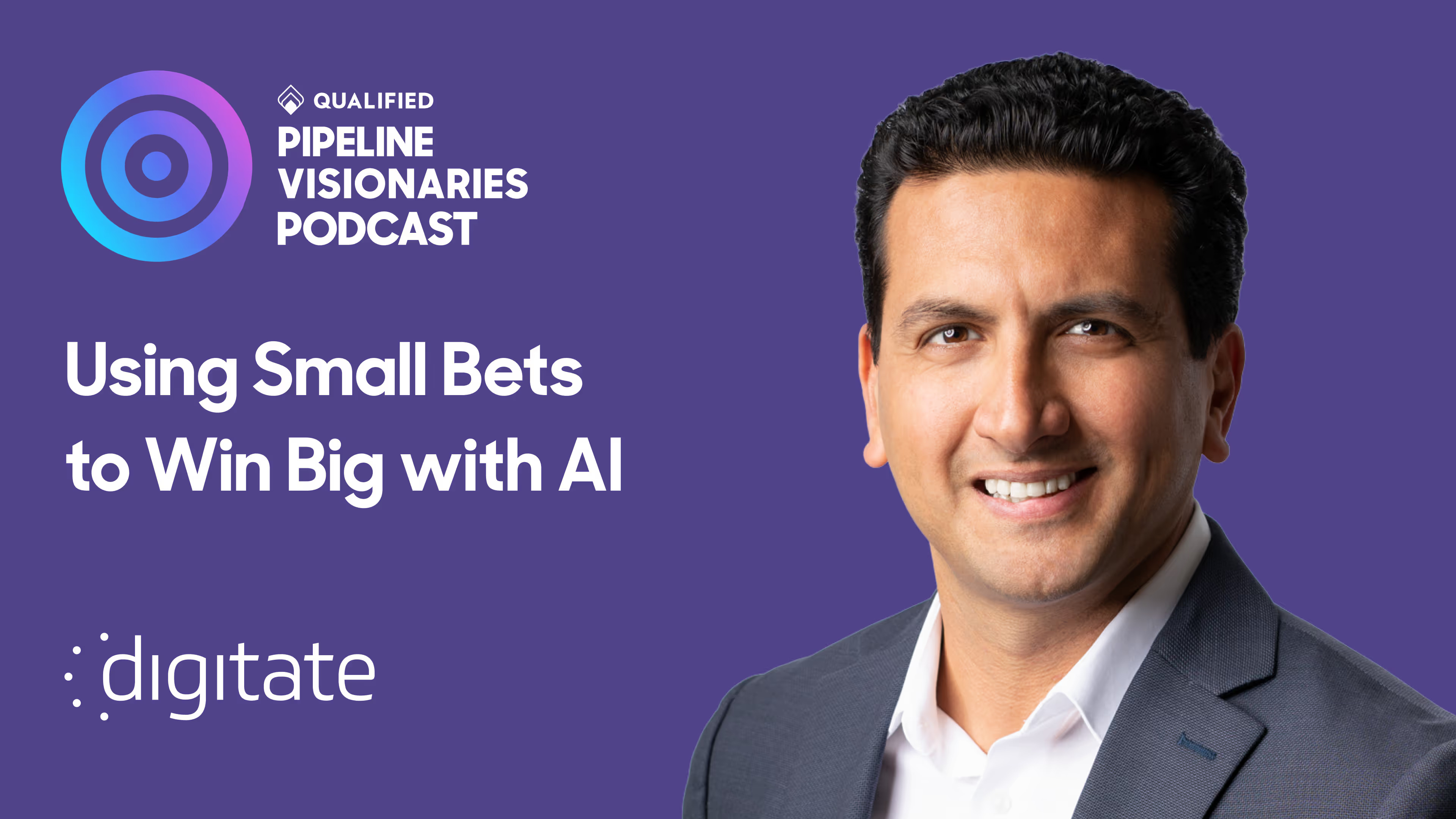
In a 2025 podcast conversation, Bhagtani offered a number that cuts through the ceremonial language of AI adoption: his team had experimented with at least 12 to 15 new tools in the previous year. They used them to find prospects, distill signals and improve productivity. Some worked. Some, he said, “failed miserably.”
“Some of them have worked. Some of them have failed miserably, just the nature of the business today.”Avi Bhagtani, Pipeline Visionaries
The phrase is funny because it is rarely admitted by somebody with “chief” in the title. It is useful because it describes the only sane way to approach a fast-changing tool market. If every experiment must succeed, nobody runs an experiment. They stage a coronation. Bhagtani's version leaves room for evidence to embarrass the original thesis.
Small bets are not timidity. They are a way of buying information at a tolerable price. A team can test whether a tool improves signal quality or campaign speed without rearranging the company around it. The promising experiments receive a longer runway. The failures become tuition. The approach is an engineer's feedback loop applied to a marketer's stack.
There is another discipline underneath the experimentation: consistency. Bhagtani has argued that message consistency over time still matters even when the tools move at astonishing speed. This is a useful tension. Execution can accelerate while the central promise remains steady. A website can change faster. An account-based campaign can launch faster. The reason a customer should care cannot molt every Tuesday.
A buyer with the map
The funnel has lost custody of the journey
Bhagtani's view of B2B buying is equally unsentimental. The traditional funnel, he has said, is gone. Buyers have more agency, and their journeys move much faster. They research independently, form preferences before a sales conversation and take routes that refuse to fit the neat geometry on a marketing slide.
His response contains a charmingly analog move: smaller, curated, regional events. The value of a gathering is not the acreage of its expo hall. It is the probability that one useful person will meet another. A well-built room creates the peer conversations enterprise buyers seek and cannot download as a white paper. Scale, in this context, can be the enemy of density.
This preference also reveals something about Bhagtani's operating style. Across customer-first writing, public presentations and interviews, the emphasis lands on specific utility: a business problem, a relevant conversation, a measurable improvement. The buyer is not an entry moving obediently down a funnel. The buyer is a person with a map, a search bar and limited patience.
From alerts to action
Autonomy still has a human job description
At Digitate, which he joined as CMO in April 2021, Bhagtani markets software designed to make complex IT operations more predictive and increasingly autonomous. The company's ignio platform combines observability and AIOps. Its stated work includes detecting anomalies, correlating events, predicting service-level problems and automating remediation across enterprise environments.
Bhagtani frames the industry shift in three stages. Traditional automation executes rules. Predictive intelligence anticipates trouble and recommends action. Autonomous operations can perceive context, act within boundaries and learn. The meaningful jump is from producing another insight to changing an operational outcome. A dashboard may diagnose the rain; an autonomous system is expected to close the window.
His messaging is careful about the person standing near that window. In discussions of agentic AI, Bhagtani and his colleagues emphasize governance and oversight. Human experts supply business context, ethical judgment and strategic priorities. Systems take on high-volume operational work. The aspiration is not the disappearance of the IT team. It is the disappearance of some firefighting.
“What began as a cost-saving exercise is maturing into a profit-driving strategy.”Avi Bhagtani, on enterprise AI research
That evolution is the larger story he is trying to tell. Enterprise AI spent years earning attention through novelty and efficiency. Now it is being asked to earn trust through governed action and measurable value. Digitate's public research describes the technology moving from cost-saving utility toward strategic capability. Bhagtani's own career makes him an apt translator for that moment: the former engineer knows what a system must do, the former product manager knows how it fits, and the CMO knows why a buyer might care.
The compounding career
Keep the old vocabulary
A conventional career story treats each promotion as an escape from the work below it. Bhagtani's is more interesting when read as accumulation. Software gave him a respect for behavior. Networks gave him a respect for interdependence. Product management gave him a respect for trade-offs. Marketing gave him a respect for perception. Leadership requires holding all four at once, preferably before the meeting ends.
The practical lesson is not that every marketer should become an engineer or every engineer should collect an MBA. It is that changing functions need not erase the craft that came before. In complex industries, the valuable person is often the one who can cross a border without flattening either side. Translation is not simplification at any cost. It is fidelity made legible.
Bhagtani's public philosophy offers the same courtesy to AI itself. Do not worship the complexity. Do not hide it. Put it inside a small, measurable experiment. Ask what changed. Keep people close enough to judge the answer. Then decide whether the next bet has been earned.
There are grander ways to describe the autonomous enterprise. Few are more reassuring. Somewhere behind the orchestration, the predictions and the agents, an old engineering habit survives: run the test.