When Avak Kahvejian’s family left Lebanon, they took their education with them. He was an infant. Civil war had made staying untenable; London was a stop along the way, and Montreal became home. Years later, speaking to students in Boston, he would credit his father’s engineering training with helping the family start again. A qualification could cross a border even when a household could not.
There is a useful place to begin a story about someone whose work involves starting companies. Before the board seats and the founding CEO titles came a family confronting a much more fundamental question: how do you begin again with what you know? Kahvejian’s answer has taken him through a Canadian university, an American startup and a firm devoted to inventing new businesses. Education keeps appearing in the story, sometimes wearing the respectable clothes of a doctorate, sometimes arriving as homework due after midnight.
The luggage that survived the journey
Kahvejian was born in Beirut in 1975, to parents also born there. His Armenian family’s earlier journey had passed through Syria after fleeing Urfa during the Armenian genocide. His own departure from Lebanon belonged to another generation of displacement. He grew up in Montreal and later moved to the Boston area by choice.
Those are different kinds of journeys, and he treats them differently. Leaving a war as a child was a decision made for him. Moving for work as an adult came with opportunities and a community ready to receive him. His account gives considerable space to that welcome. It is a refreshing complication in a business biography: the protagonist insists on making room for other people.
In 2022, he received the Barry M. Portnoy Immigrant Entrepreneur Award for Life Science Business. His acceptance turned the attention toward his parents. “I feel like the award goes to my parents,” he said. His mother was there. He also credited Boston’s Armenian, business and philanthropic communities, which had helped him and his wife feel comfortable after arriving from Canada.
An award normally comes with an invitation to describe your own accomplishments. Kahvejian used his to describe the conditions that had made accomplishment possible. The distinction matters throughout his public life. He can talk about building an institution and then talk about the people who need access to it, without treating the second subject as a ceremonial afterthought.
- BeirutBorn, 1975
- LondonFamily stopover
- MontrealChildhood & McGill
- Boston areaCareer & community
A doctorate, then forty-eight hours
As a child, Kahvejian was drawn to science and technology and wanted to go into space. When he chose a university subject, computer science competed with biotechnology. He chose biochemistry, earning his bachelor’s degree at McGill in 1997 and his doctorate there in 2004. Nahum Sonenberg supervised his doctoral work.
His university record was serious: he was selected for the Dean’s Honour List, and his research training led to published papers. A 2004 thesis sits in McGill’s catalogue under his name. The credentials supplied a foundation. They did not supply a complete map of what to do next.
Then a meeting with Helicos CEO Stan Lapidus produced a deadline. Lapidus offered him a business development job and gave him forty-eight hours to decide. Kahvejian accepted. For someone exploring the boundary between science and business, the boundary suddenly had an address and a start date.
Helicos became his working education in commercial life. He joined in 2004 and held roles in business development, product management, marketing and sales, eventually becoming vice president of business development. The work meant establishing partnerships and helping turn a complicated technical project into something other people could use. A university can teach you a discipline. A young company has a way of introducing you to all the disciplines you had hoped someone else would handle.
In 2008, he co-authored a paper called What would you do if you could sequence everything? The question in the title captures an enduring professional habit: begin by widening the possible uses of a capability. Ask what becomes feasible when the tool changes. A research question can also contain the beginnings of a business question, provided someone is prepared to follow it far enough.
Making a company before investing in it
Kahvejian joined Flagship in 2011. In a later reflection on that arrival, he described being among the first few people dedicated full-time to the venture creation work that became Flagship Labs. That detail helps explain the otherwise unwieldy list of companies attached to his name. His profession involves helping businesses come into existence, repeatedly.
Today he is President of Flagship Labs and a General Partner at Flagship Pioneering. His career includes founding CEO roles at Ring, Cellarity, Laronde, ProFound, Ampersand, Abiologics and Etiome, along with leadership at Rubius and Generate. Ring belongs in that history as a company he helped establish; its current leadership page lists him among its directors.
Ring launched in 2017 after exploratory work at Flagship. Its founding team included Kahvejian, Erica Weinstein and Noubar Afeyan. The sequence is worth noticing: a team explored a question, conducted experiments and then launched a company. The company was an outcome of the work, rather than simply a name waiting for work to justify it.
That puts an unusual burden on a founder. There must be enough imagination to begin and enough discipline to test what imagination proposes. A company name, a presentation and an agreeable meeting can all arrive before the evidence. Kahvejian’s public description of venture creation keeps returning to questions, experiments and the capabilities needed to answer them.
The year Kahvejian joined Flagship.
A career spent helping new companies take shape.
The student who kept his homework
Computer science eventually returned. Kahvejian took Andrew Ng’s machine learning course remotely, expecting an overview. Instead, he found programming assignments and spent evenings coding and debugging, sometimes until midnight. This is a rather effective antidote to the executive photograph: imagine the person in the photograph trying to get his homework to run.
The detail gives his interest in computation some texture. It also makes continued education look properly inconvenient. The pleasant version is a speech about staying curious. The practical version includes assignments. There is a reason “lifelong learner” looks better on a biography than “still doing the problem set.”
His public work now includes explaining that process to other people. In June 2026, he and Justine Levin-Allerhand introduced The Labs Report podcast. Its opening episode explored their routes into Flagship Labs and the uncertainty involved in creating new scientific fields. Unexpected results and moments of doubt were part of the stated subject matter.
For listeners accustomed to hearing about companies only when they announce something, that offers a different vantage point. There is a stretch before an announcement when the result is uncertain and the vocabulary has not settled. Putting that stretch into a conversation gives a public audience something more useful than another polished description of success.
Armenia, with the horizon widened
Kahvejian’s connections extend to the Foundation for Armenian Science and Technology, known as FAST, where he serves on the advisory board. In 2019, he spoke in Armenia about commercializing scientific work and described plans for young Armenian experts to join a twelve-week Flagship fellowship in Boston.
His argument was practical. Scientists needed connections to colleagues in the diaspora, collaboration across institutions and an ambition broad enough to address international markets. He also emphasized sustained effort. A short visit could introduce a method; building the institutions around it would take longer.
He compared the different participants needed to build a scientific ecosystem to an orchestra. The metaphor makes room for government, researchers, entrepreneurs and education. An orchestra has individual talent, of course. It also needs people to agree on when to come in.
His own institutional commitments span those borders. Genome Canada announced his appointment to its board in October 2023, bringing his company creation and commercialization experience into a Canadian organization. His connection to McGill continues through its US regional advisory board. The places where he studied and the communities from which his family came remain present in his professional life.
“They must unite and act in unison, like an orchestra.”
Avak Kahvejian, on building a scientific ecosystem in Armenia
What a welcome requires
In New England, Kahvejian chairs the board of the International Institute of New England. Its work includes helping refugees and immigrants settle, learn English, advance in their careers and find pathways to citizenship. Here, the support that he once received becomes a responsibility he helps oversee.
The scale belongs to the organization and its staff. In its 2024 annual report, a leadership letter signed by Kahvejian and CEO Jeff Thielman reported serving more than 21,000 refugees and immigrants from 82 countries. The organization added shelter services and more English classes as it responded to demand. Those are concrete forms of welcome: housing assistance, instruction and the work of helping people navigate a new place.
In April 2026, IINE reported raising more than $1.7 million at its Golden Door Award gala. Kahvejian appeared there as board chair. The public event is one visible moment in a less visible institutional task: keeping an organization able to respond when people arrive with urgent needs and complicated histories.
A short walk from the familiar
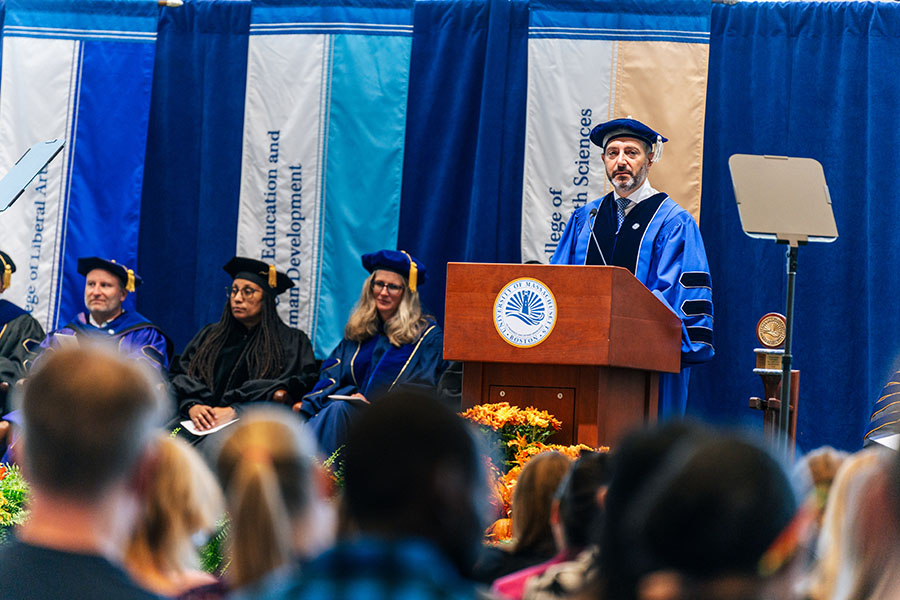
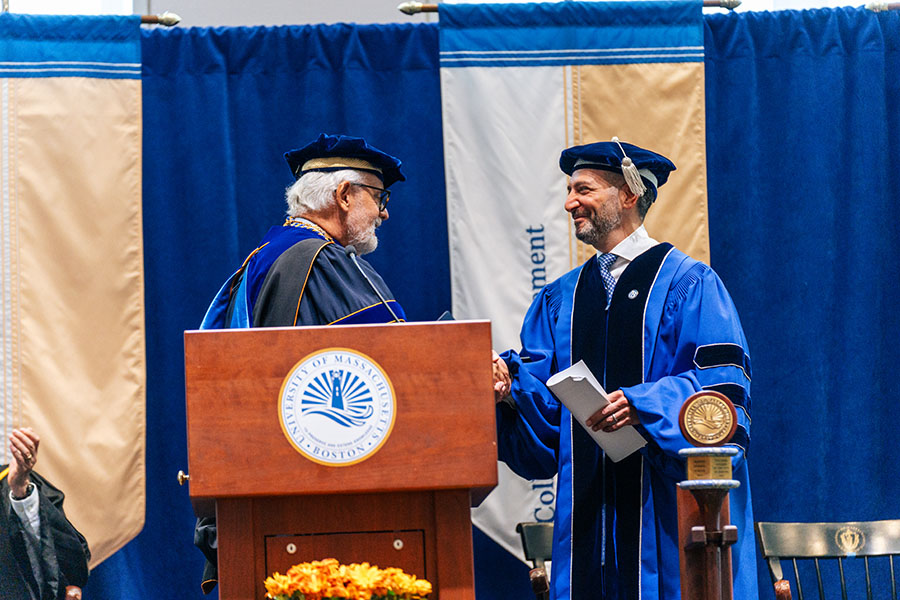
At UMass Boston’s 2024 convocation, Kahvejian asked students to explore beyond their familiar disciplines. He also pointed to a literal neighborhood: South Line, where companies he had helped establish were operating close to the university. UMass Boston and Abiologics were sharing specialized equipment and expertise. Collaboration had a walking distance.
There is something appealingly ordinary about that invitation. After the international moves, the doctorate, the companies and the boardrooms, a next step might be as modest as meeting someone nearby. The pattern of his career suggests the value of such crossings: between countries, between disciplines, between an idea and the institution that can test it.
His family carried education out of Lebanon. In Montreal, he acquired more of it. In Boston, he found ways to put it to work and communities willing to help. Now his public commitments include extending those opportunities to other people. The luggage has grown. He is still making room.