Ten paying customers can be a beginning. For Augustus Franklin, they were also a warning. By 2013, the time he had allowed himself to turn Gaglers Chat into a business had run out. His family lent him enough money for another six months. A software engineer with years at Sun Microsystems and Yahoo behind him now had a rather less abstract problem than scalability: finding something people needed enough to pay for.
Early in 2014, while looking for consulting work, he wrote an integration between CallHub and NationBuilder, software used by political and advocacy organizations. That modest connection helped him find his market. An integration is an unglamorous thing to put at the center of a founder story. It has none of the theatrical possibilities of a garage. It does, however, have customers on the other end.
Before the campaign, the conversation
Franklin’s first idea was already about bringing people together. After moving from the San Francisco Bay Area to Bangalore in 2010, he developed Gaglers, a messaging service for online marketplaces. A seller could respond to a prospective buyer from a cellphone. The marketplace could keep the exchange within its own system.
There was a practical difficulty behind the proposition. Individual sellers had other things to do; unlike a conventional online shop, they could not necessarily employ someone to answer questions all day. Franklin wanted to make them easier to reach without asking the marketplace to surrender the transaction.
Gaglers joined the Morpheus startup network, and business adviser Jessie Paul helped with strategy. The product was looking for a place in the growing world of sharing, renting and trading online. In retrospect, the continuity is striking. The audience would change considerably. The question of how to get two people talking would remain.
An engineer who enjoyed the difficult bits
Long before campaigns became his customers, Franklin wrote about algorithms. His personal blog, Blogarithm, offers a view of a working engineer thinking aloud: graphs, models, difficult programming puzzles and the trade-offs between possible solutions.
In a 2009 post, he considered how a problem described in the language of chemical manufacturing could be recast as a familiar computer-science problem. Choose the right model and the available techniques become clearer. Choose poorly and considerable effort can go into solving the wrong thing.
The attraction was intellectual as well as practical. He wrote warmly about conversations with visiting colleagues and the difficult problems in Solaris Cluster. When he left Sun, by then part of Oracle, on April 9, 2010, his farewell was brief and affectionate. He had spent about a decade there. The people and the engineering had mattered to him. There was no grand declaration of disruption, just a departure and the intention to keep writing.
The product evolved; connecting people remained the thread.
The job description had a clue
In May 2013, Franklin posted a recruiting message to a Bangalore Python mailing list. Gaglers needed a developer who could work across a stack that included Python, Django, Erlang, Redis and RabbitMQ. The technical ambition was substantial: a real-time platform capable of handling millions of concurrent users.
The more revealing requirement concerned temperament. He wanted someone who would look beyond programming, understand the business and notice ways to improve things for customers. The founder was recruiting an engineer and, at the same time, asking that engineer to care about the person using the software.
Even the application exercise was concrete. Build a small web application that accepts a line of text, detects a URL and displays the first image from that page. Applicants could also submit code they had already written. There was a pleasing lack of ceremony about it: here is a problem; show what you can make.
A support ticket with code attached
Franklin has described a customer who could not delete call lists in another piece of software connected to CallHub. The problem belonged to the integration’s wider world rather than neatly inside his own product. He knew how to fix it, so he wrote a script and sent it over.
Two years later, that customer was among his larger accounts. Franklin resisted awarding himself a tidy causal victory: perhaps the customer would have stayed anyway. That qualification makes the anecdote better. Customer loyalty rarely arrives with an explanatory note attached.
His accompanying story involved a very old family torch, no longer working, which he kept partly because his mother still asked about it. Neglecting the batteries had consequences. He used the torch to discuss a business that stops attending to its customers. An entrepreneur may be able to explain away a missed opportunity. Explaining the torch to his mother sounded considerably harder.
The product grows around its users
CallHub’s own account dates the original webpage chat experiment to 2011 and traces its evolution through marketplace engagement into campaigning. That history helps explain why the company’s beginnings carry several dates: there was an early venture, a changing product and a later focus on campaign outreach.
Today, the business Franklin leads brings together calling, texting, integrations and organizing tools. A campaign’s contacts may live in one system while volunteers work in another. Connecting those activities is part of the product’s purpose. The software has to fit around people who are trying to organize other people, often with limited time to learn a new tool.
It is a different environment from a marketplace seller answering a buyer, but the family resemblance survives. Someone wants a response. Someone else needs a manageable way to give one. Franklin’s business has grown around the machinery between them.
Putting a boundary around growth
In May 2023, Franklin made CallHub’s values public. He described a company that had initially understood itself as a technology tool, then developed a closer identification with the political world using it. Serving that world brought responsibilities.
The statement identified CallHub as progressive. It set out commitments including truthfulness, transparency, diversity, inclusion and fairness, and reserved the right to decline organizations whose activities conflicted with those commitments. Franklin acknowledged that a public position could cost the company customers.
That was a meaningful development from the early promise of making campaign technology available across affiliations. A business built around access was now explaining the conditions of that access. He argued that a narrower focus would also give the product a clearer direction. The policy made his judgment part of what customers were buying into, alongside the software.
“Be willing to be flexible on the product and business but never on the values.”
Augustus Franklin, 2023
The son of two teachers
Franklin grew up in India with a brother and parents who were schoolteachers. He has connected that upbringing to his desire to make a wider contribution. He was the first in his family to move to the United States and later returned to India to build his own business.
His account of leadership includes uncomfortable decisions. He has recalled ending a customer relationship after initially overlooking the organization’s treatment of the support team because of its revenue potential. The lesson he drew concerned the need to take early behavior seriously.
He wants CallHub to be a company that organizers think of when they need to mobilize people. The aspiration extends to equal opportunity: helping more people exercise agency, regardless of background. It is an expansive ambition for a business whose everyday work includes lists, messages and call routing. Those ordinary operations are where the ambition has to earn its keep.
Twenty languages, one awkward question
One common operational language. A policy Franklin explained in May 2024.
In 2024, Franklin addressed a challenge inside his own organization. CallHub’s team collectively spoke twenty languages. He favored English as the common language for operational work, and colleagues asked whether that rule sat comfortably with a commitment to diversity.
His answer focused on the person left outside a conversation. Shared native languages can create easy bonds, he argued, but they can also produce cliques or exclude colleagues who cannot follow. He wanted a common working language to give everyone a way into the discussion.
There was room for context: if everyone present understood another shared language, they could use it. Employees still developing English proficiency needed support. The interesting part is the friction he chose to discuss publicly. Inclusion sounds agreeable until a team must decide how a meeting actually works. Here, the founder put his reasoning on the table for others to question.
The person on the other end
Away from the company, his public biographies describe someone who makes toys with his children and trains for marathons. Making things appears to travel home with him. His working life has included product development, business development and engineering teams dealing with systems that need to keep running.
There is something useful about placing those details together without turning them into a formula for entrepreneurship. A toy can be made for the pleasure of making it. A commercial product has to survive a less indulgent audience. Franklin has spent years working on both.
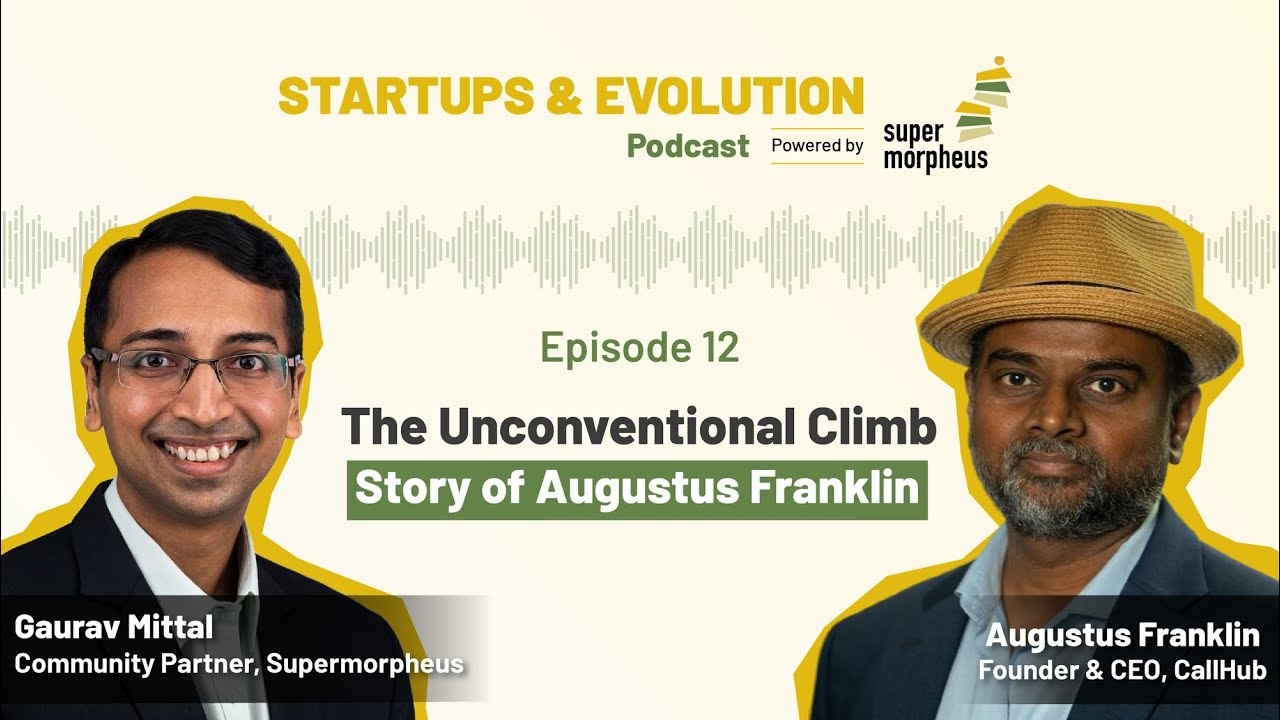
When he discussed his founder journey with Gaurav Mittal in 2025, he framed it as a messy progression from working alone to building a team. Content, search traffic and customer demand were part of the conversation. The small integration at the beginning still offers a useful way into the story: build a connection, see who uses it, and pay attention to what they ask for next.