Ken Rosenfeld had already been a chief executive when he became employee number two. In August 2019, the co-founder and former president and CEO of eHealth Technologies joined Casana. The change makes a useful opening to his story: a person who had helped build an organization was prepared to return to a company small enough for its headcount to fit on a bicycle.
Titles usually make careers look tidier than they felt. Engineer becomes manager; manager becomes executive; executive becomes founder. Put the jobs in a column and the route appears to be one continuous ascent. Rosenfeld's route has involved returning to the beginning, carrying experience into places where much of the organization still had to be invented.
Today he is chief operating officer at Ognomy Sleep. Between that role, Casana and eHealth Technologies sits a recurring question: how do you turn the work of a few capable people into something a much larger team can keep doing well? His career offers several answers. One of the more revealing involves a management book, an admission of limited success, and the willingness to try again.
The engineer inside the executive
Rosenfeld studied at the University of Pennsylvania, graduating in 1985 with an engineering degree in bioengineering and a minor in computer science. His early career took him to California and ADAC Laboratories as a software engineer. Later came Cemax-Icon, Imation and Kodak. The organizations changed around him as his responsibilities expanded.
At Kodak, his work included running an $80 million imaging systems business and leading a global research and development organization. Those are two different vantage points on technology. A business manager has to think about customers, resources and commercial performance. An R&D leader has to think about what can be made and how a team can make it.
Read across those assignments and the later combination of founder and operator becomes easier to understand. He had worked on the product and on the organization surrounding it. A technical idea needs both kinds of attention. Someone has to solve the engineering problem; someone also has to make sure the people solving it can work together tomorrow.
The scale of that Kodak responsibility gives the next move its weight. In 2006 he co-founded eHealth Technologies with Michael Margiotta. A corporate organization comes with established departments and procedures. A new business has to earn the right to have departments. Even its procedures can begin as promises someone has made to a customer.
Penn graduate.
Software engineer.
Co-founds
eHealth Technologies.
Joins Casana as
employee number two.
First, find room for the people
By June 2013, eHealth Technologies was preparing to break ground on a new headquarters. The announcement described an employee base that had quadrupled. Rosenfeld was then president and chief technology officer; Margiotta was chairman and CEO. Both were named in the plans for the groundbreaking in West Henrietta.
Office space is a pleasantly unromantic measure of a startup's progress. Growth eventually requires somewhere to put the chairs. A headquarters announcement says something a slogan cannot: enough people are doing the work that the physical arrangements need to change.
It also makes the division of responsibility visible. Rosenfeld's title joined company leadership to technical leadership. He was working across the boundary between an organization's direction and the machinery needed to carry it out. That boundary would remain a recurring feature of his career.
In July 2014, the board appointed him president and CEO. The company had also added Colin Rhodes as chief technology officer and Chad Malone as chief strategy officer. The leadership structure was becoming more specialized as the business grew.
Delegation can sound effortless when it is reduced to a diagram. In practice, a founder moving out of a technical leadership role has to rely on other people's judgment about work he understands himself. The appointment marked a change in Rosenfeld's formal responsibilities. It also placed his attention on a larger organization than the one he and Margiotta had started.
A governor visits. The team gets the credit.
In July 2017, Governor Andrew Cuomo visited the company. Rosenfeld's account of the occasion put the team at more than 225 people. He singled out both recent arrivals and colleagues who had been there since the beginning, and acknowledged the customers who had trusted the business early.
That distribution of credit is worth lingering over. The early employee and the new recruit have different relationships with a growing company. One remembers how everything used to work; the other may see why it needs to change. Rosenfeld's account made room for both.
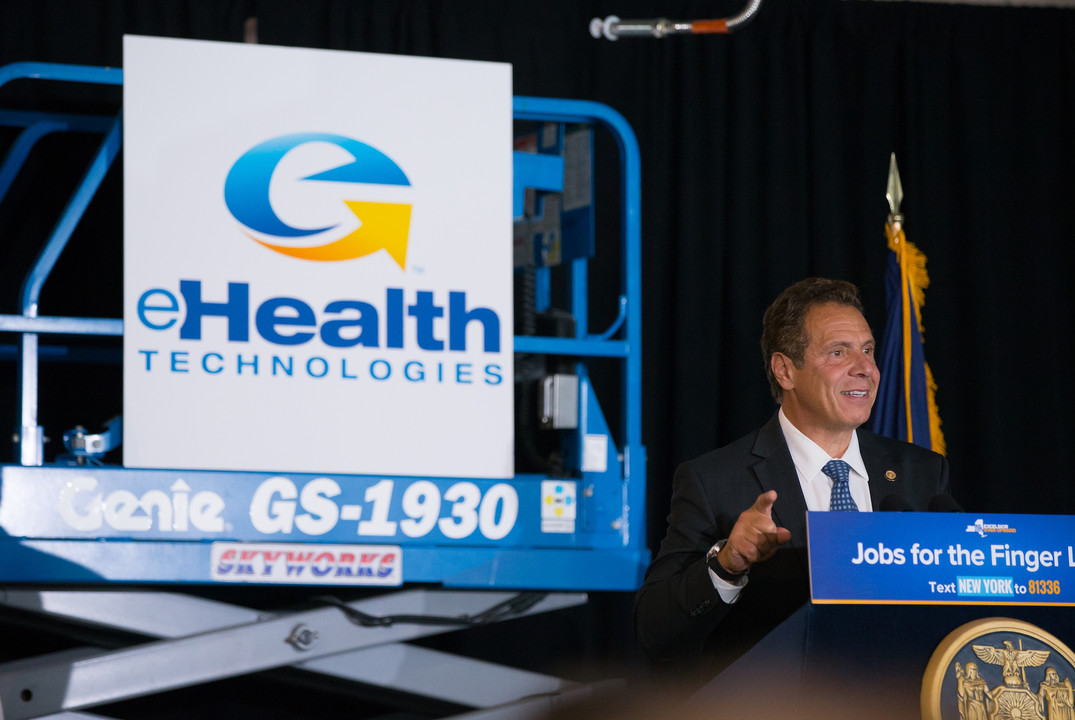
The expansion announced that month involved 12,000 additional square feet and plans for up to 160 new full-time positions. New York's support was tied to job creation and retention commitments. Those figures described an expansion plan, with obligations attached, rather than a completed hiring tally.
For Rosenfeld, the region's appeal included access to technical and customer service talent. That is an operator's description of a place: who can we hire, and can they do the work? The answer matters long after a visiting official has left and the podium has been carried away.
The dashboard deserves a second look
There is another side to an executive associated with growth figures. In October 2018, Rosenfeld wrote about Goodhart's law after listening to the Reply All podcast's discussion of New York City's COMPSTAT system. He was interested in what happens when a measure becomes a target and people begin changing their behavior to improve the number.
His essay raised the problem of incentives producing unintended consequences. It is a useful complication in a career full of organizational milestones. Counting is necessary. Understanding what the count encourages is another job, and a busy organization can easily confuse the two.
A dashboard is wonderfully agreeable company. It answers the questions it has been asked, in the format it has been given. The troublesome question is whether those are still the right questions. Rosenfeld's writing suggests an executive willing to inspect that arrangement rather than accept the display at face value.
This is also where his engineering background and management work appear to meet. A system includes the people responding to it. Give them a target and their response becomes part of the system's behavior. Designing the measurement takes judgment about human beings as well as arithmetic.
A book review with an admission inside
Three months later, in January 2019, Rosenfeld published his thoughts on John Doerr's Measure What Matters. He had tried introducing objectives and key results, or OKRs, at his company. The attempt had achieved limited success. Reading the book led him to reconsider the effort involved in making the method work.
The revealing detail is the admission. A former CEO could have written a comfortable endorsement of a familiar management tool. Rosenfeld instead included his own imperfect attempt. A framework can look simple on paper while asking much more of the people expected to use it.
“ideas can come from anywhere”
Ken Rosenfeld, January 2019
He emphasized consistent application, shared participation and transparency. He also described using personal objectives and key results while looking for his next role. The management method had followed him out of the company and into his own calendar.
There is a modest charm to that image: an experienced executive organizing a job search with the same discipline he wanted an organization to adopt. Experience had given him methods, but he was still testing how to use them. The experimentation continued before the next title arrived.
Back to two
That August, he joined Casana as its second employee. He would serve as chief operating officer. The sequence is striking enough without decoration: co-founder, CEO, job seeker, early employee, COO. A career can advance by changing the kind of responsibility a person is willing to take.
The second employee joins a particularly small conversation. There are fewer established relationships to navigate, fewer routines to inherit, and more decisions whose consequences will become the routines everyone else inherits later. Rosenfeld brought experience of larger organizations into that early stage.
His later move to Ognomy continued the operating thread. Its leadership roster names him chief operating officer, alongside founder and CEO Daniel Rifkin. In June 2026, the company announced a $20 million Series A financing led by Catalyst Investors, with Blue Heron Capital participating.
Rosenfeld's comment on the financing emphasized the incoming investors' operational experience and strategic perspective. Money matters to an expanding company. So does the experience arriving with it. For an executive whose work repeatedly involves building the organization around a product, that emphasis fits.
The next conversation is in Rochester
Rosenfeld's career has also become part of the region's entrepreneurial conversation. He belongs to Upstate Venture Connect's UNY50 Leadership Network. The Venture NY agenda for April 2026 listed him with investor David Brown and moderator Chris Rodi for a discussion of company building, capital and performance.
In 2017, RocGrowth had featured him in a public interview led by Diana Palotas at Rochester's Downstairs Cabaret Theatre. The event reached capacity. The setting seems appropriate: entrepreneurship has plenty of performance in it, but an interview allows room for the awkward parts between the polished announcements.
Those parts make Rosenfeld interesting. The technical manager became a founder. The CEO reconsidered a management method that had disappointed him. The experienced executive became employee number two. His story leaves room for revision, and for the work of other people. The next organization still needs building, however many titles came before it.
Keep the conversation going
Writing, interviews & company pages
- Ken Rosenfeld on LinkedIn
- Ognomy leadership
- eHealth Technologies
- His thoughts on Measure What Matters
- His essay on measurement and incentives
- His account of the 2017 company visit
- RocGrowth interview page
- Venture NY 2026
- 2014 CEO appointment
- 2013 headquarters announcement
- 2017 expansion announcement
- Casana career biography
- 2015 career interview
- June 2026 financing announcement