The first audibene office had no desks and one telephone line. In 2012, co-founders Marco Vietor and Paul Crusius took early customer calls from Vietor's Berlin living room. The furniture improved quickly. The basic question has barely changed: how do you help someone cross the awkward distance between noticing a hearing problem and wearing a hearing aid?
That distance is not measured in meters. It is made of denial, stigma, confusing technology, uncertain prices and the suspicion that a hearing aid announces old age before it restores a conversation. A device can be physically tiny and psychologically enormous. audibene's answer was to redesign the approach to care before redesigning the hardware.
The company finds prospective customers where they already look for answers - online. A hearing expert calls, explains hearing loss and device choices, discusses price and insurance, and prepares the customer for a trial. A nearby partner audiologist then tests hearing, fits the selected devices and makes the fine physical adjustments. The remote expert stays involved. audibene calls this a two-sided consultation. In less polished language, it is a very carefully managed handoff.
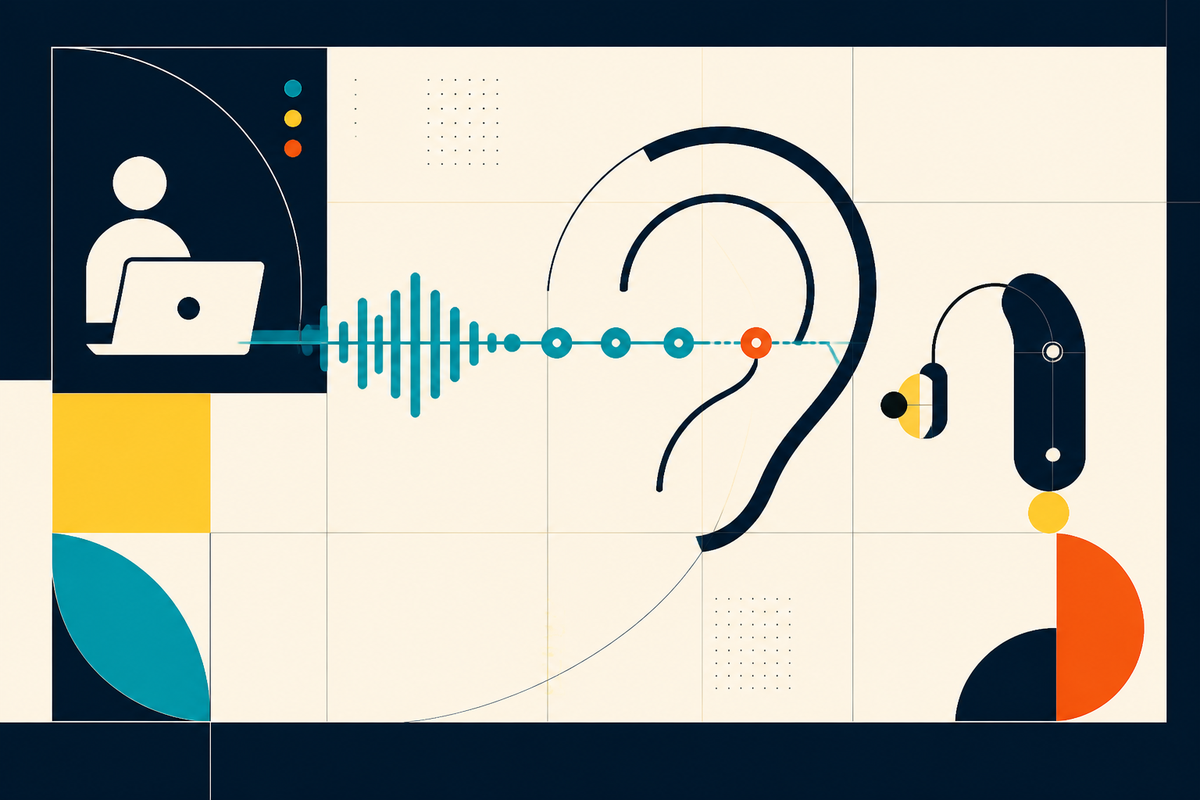
The browser is the lobby, not the clinic
Many digital-health companies talk about removing the middleman. audibene made a more practical choice: keep the professional, remove the wandering. Its website and marketing generate attention. Its advisers turn curiosity into a case. Its partner network supplies the local clinical craft. The model accepts that hearing aids are not ordinary electronics. They need selection, fitting, adaptation and often several rounds of adjustment.
Discover
Education, search and a low-pressure first step.
Consult
A remote expert turns symptoms into options.
Try locally
An audiologist tests, selects and tunes.
Adjust
Follow-up continues in person and remotely.
For the independent audiologist, audibene behaves like a source of qualified demand and a case-management layer. The practice receives a customer who has already been educated and is ready to try a device. For the customer, audibene is a navigator through products, appointments and, in Germany, some insurer administration. The service is presented as free to the consumer. The business earns money when the journey results in a hearing-aid sale; the exact commercial split with partners is not public.
The clever part is not putting hearing aids online. It is knowing what must remain human.
This is why calling audibene an e-commerce company is both correct and incomplete. It is also a consumer-health brand, a lead-generation engine, a marketplace of local specialists, a remote support service and an owner of branded hardware. The seams between those roles are the product. If the appointment arrives late, the adviser overpromises or the fitter lacks context, the experience collapses.
A gadget for people who do not want one
The founders aimed first at younger, active and technology-comfortable first-time users - not necessarily young people, but people who did not recognize themselves in the old visual language of beige prosthetics and decline. Modern hearing systems gave audibene useful material: discreet in-ear shells, slim receivers, rechargeable batteries, Bluetooth streaming and apps that can emphasize speech or alter listening modes.
Its current own-brand range is led by audibene IX. The go IX is a receiver-in-canal model with rechargeable batteries, Bluetooth, app controls and what the company calls MultiBeam processing for following several speakers. The lite IX is a smaller in-ear option. Older AX models remain in the range. audibene also compares and supplies products from established manufacturers, which gives advisers more than one device story to tell.
Numbers around audibene require labels. Its corporate LinkedIn says more than one million people have been put on a path to better hearing. German consumer pages cite hundreds of thousands of satisfied customers. A French page says nearly 500,000 people have been fitted worldwide. The company also refers to roughly three million consultation conversations and more than a million consultations in a year. Those measures overlap, but they are not interchangeable. The safest conclusion is that audibene has operated the model at international scale, not that every large number describes a completed device sale.
Health commerce has a counting problem: a visitor, a consultation, a fitting and a satisfied customer are four different events. Good profiles keep the labels attached.
The acquisition that preserved the experiment
Venture investors including Acton Capital and Sunstone Capital backed audibene early. In March 2015, Sivantos - the company built from Siemens' former hearing-aid business - agreed to acquire all its shares for an undisclosed sum. The founders reinvested in Sivantos and continued to lead the digital business. At the time, audibene had about 180 employees, operated in Germany, Switzerland and the Netherlands, and drew roughly 15,000 website visits a day.
The pairing was strategically tidy. audibene understood the hesitant consumer and online acquisition; Sivantos understood devices, audiology and global distribution. In 2019, Sivantos combined with Widex to form WS Audiology, placing audibene inside one of the industry's large manufacturer groups. That ownership supplies reach and technical proximity, while audibene continues to present itself as a comparison and care platform rather than a single-manufacturer storefront.
International expansion followed quickly. The company entered the United States, Canada, India and South Korea in 2016, using hear.com in several markets. It opened a training campus in Mainz in 2018 and launched a portal for partner audiologists in 2019. Its careers pages describe offices from Berlin and Paris to Miami, Kuala Lumpur and Seoul. Public headcount figures vary by page and period; the corporate LinkedIn and careers material say more than 1,200 employees.
hybrid
The market lives between clinic and checkout
audibene competes with traditional clinics and chains such as Amplifon, manufacturer-linked retail networks, other hybrid providers, and direct online or over-the-counter sellers. The pure clinic owns trust and the physical relationship but may struggle to reach a customer who has not decided to walk in. The pure online seller offers speed and apparent simplicity but has less room for acoustic nuance. audibene occupies the upper-right middle: digital convenience with a guided, local fitting.
Its defensibility lies less in a single algorithm than in accumulated coordination. Search demand, millions of conversations, trained remote advisers, insurer workflows, a recognizable consumer brand, product feedback and thousands of partner relationships all reinforce the route. Competitors can copy a questionnaire. Reproducing the handoff, market by market, is slower.
The tension is equally clear. A platform owned within a large hearing-aid group must persuade customers that its recommendations serve them. Heavy digital marketing can make a medical decision feel like a sales funnel. Partner quality has to remain consistent across independent practices. Remote care can improve access, but it must know when a screen is not enough. audibene's model works only while convenience and clinical judgment keep each other honest.
From remote advice to remote adjustment
Teleaudiology is the logical extension. audibene says it tested the idea as early as 2014 and introduced it in the United States in 2020. The latest service connects initial consultation, device use and remote adjustment. In 2026, the company announced two iF Design Awards for the service's user experience and service design, following an iF award for the broader care model in 2024.
The awards do not prove clinical superiority, but they point to the problem audibene has chosen to own: making a complicated sequence legible. A remote adjustment can save a journey. An app can give a wearer control in a restaurant. A named adviser can answer the question a product page cannot. None eliminates the audiologist. Together, they reduce the chances that a costly device ends up in a drawer.
In 2025, audibene's television campaign, “So hören, wie Sie wollen,” won a Bronze Effie Germany. The campaign put active life and autonomy ahead of decline. That is not merely advertising decoration. It addresses the adoption barrier on which the business was founded. The hardest competitor may be no device at all.
A hearing aid is a piece of hardware. Accepting one is a change in identity.
Fourteen years after the living-room calls, audibene's most useful lesson travels beyond audiology. Hybrid care is not a compromise between digital and physical channels. Done well, it assigns each task to the place where it works best. The internet can make a private concern easier to voice. A specialist can make complex technology fit a human body. Software can keep the relationship alive after the appointment.
The company put the internet in the waiting room, but it did not ask the waiting room to perform the fitting. That boundary - drawn, measured and repeatedly adjusted - is audibene's real invention.