A customer clicks “buy” and a merchant has every reason to smile. The product worked. The price worked. The page persuaded someone to part with money. Then the parcel has to leave. For Atul Mehta, that apparently minor continuation is a substantial part of the business. The customer’s verdict is still being written, and the courier has been handed a pen.
Mehta is the chief executive of Domestic Shipping at Shiprocket. His career has taken him through Unilever’s consumer brands and Amazon’s online grocery programme, into the operations of independent ecommerce sellers. Across those moves, the question has become increasingly practical: how does a business carry its promise all the way to the customer?
There is an appealing continuity here. A brand manager thinks about why someone wants a product. A shipping operator thinks about how it reaches them. Mehta has worked on both sides of that relationship. His story is best followed through the changes in what he was responsible for, rather than through the grandeur of the names on his résumé.
A chemical engineer in the consumer aisle
His academic route began at IIT Kharagpur, where he studied chemical engineering, and continued at IIM Calcutta, where he completed a management diploma. The two qualifications suggest a tidy progression from technical training to business. His later account of his career makes the progression sound rather less prearranged.
At Unilever, he spent 11 years working across sales and brand marketing. His experience included leading the Pepsodent brand. These were consumer businesses, with the everyday demands of selling familiar products and making them matter to buyers. Before the shipping platform and the software vocabulary came the commercial work of understanding what people would choose.
It is tempting to turn an engineering degree into an explanation for everything that follows. Mehta’s actual career offers a more useful detail: he moved beyond the subject he had studied. Chemical engineering became part of his preparation, while sales, marketing and management became the work. Education supplied a starting point; it did not dictate every destination.
Years later, speaking to students at Altera Institute, he described his career turns as less deliberate than they might appear on paper. He also recalled becoming tearful in his Unilever interview and wondered whether that openness had helped him receive the offer. It is a rather human footnote to a corporate career. Even an accomplished résumé can begin with an interview that refuses to behave.
A bigger grocery map
Amazon brought a different operating challenge. Mehta spent more than four years there, with responsibilities that included strategic partnerships and new business initiatives. He helped take Amazon Pantry from a single-city programme to a pan-India operation. Grocery added a national delivery problem to his experience of consumer demand.
The significance of that change is easy to overlook if one reads it as another employer on a list. A brand can be discussed in terms of positioning and preference. A grocery programme must also work in particular places, through particular arrangements. Expanding its geography gives the word “scale” a physical meaning. More customers need a functioning service where they live.
This experience helps explain the relevance of his next move. Shiprocket’s merchants would also need access to delivery operations beyond their immediate surroundings. The organisation was different, and the merchants had their own brands to build. But the distance between attracting a customer and serving that customer remained central to the job.
- UnileverSales & brand marketing
- AmazonPantry’s national expansion
- ShiprocketDomestic shipping
The July 2021 change of pace
Mehta joined Shiprocket as chief operating officer on July 12, 2021. His remit covered sales, account management, supply chain operations, customer operations and seller excellence. He would also work with the founding team on innovation and longer-term strategy. It was a broad assignment, stretching from attracting merchants to helping their orders move.
The appointment arrived at an already busy operation. In September 2021, Shiprocket reported more than five million monthly shipments, over 17 courier partners and coverage of more than 29,000 pin codes. Those figures describe the company around the time he joined. They are a useful sense of the workload he entered, rather than a personal scorecard.
He has since discussed moving from established employers to a startup in a Let Us Talk conversation. In his own description of the interview, pace, ownership, ambiguity and accountability were the themes. He had been having versions of that conversation with friends who were considering the same kind of move.
“The shift from process to pace”
Atul Mehta, describing his corporate-to-startup conversation
That short phrase carries a recognisable adjustment. A new employer can change the rhythm of decisions as much as their subject. Experience remains useful, but the person bringing it has to learn how the next organisation works. Mehta’s account gives that adaptation some weight, instead of treating a change of company as a change of stationery.
The merchant’s unfinished promise
By 2022, his public advice to growing direct-to-consumer brands had a clear emphasis. At D2C Carwaan in Indore, he urged founders to stay close to the customer problem they were solving, use the available ecommerce ecosystem and demand useful support from partners. Once brands reached roughly 3,000 to 4,000 monthly orders, he argued, they should invest in the experience after checkout.
His advice also allowed room for marketplaces. Smaller brands still testing their fit with customers could use platforms such as Amazon and Flipkart for initial scale with limited investment. That is a practical position for someone working with direct commerce: a young business needs ways to learn and sell, including channels beyond its own website.
The attraction of the shipping platform, in Mehta’s explanation, was to give merchants a consolidated view of operations. In a March 2022 interview, he described a business built around three connected pieces: logistics, the software workflows that organise it, and data that helps improve decisions. Bringing those pieces together could help a seller keep its own operation lean.
The logic is straightforward. A merchant may be very good at creating a product without wanting to assemble a separate apparatus for every courier, tracking update and delivery exception. Shared infrastructure offers a way to handle those tasks. The promise is attractive precisely because the tasks themselves can be so unglamorous. Few founders launch a brand out of a passionate devotion to shipment reconciliation.
A delivery date worth believing
Mehta became CEO of Domestic Shipping on April 1, 2024. The title has a specific scope: he manages the domestic shipping business, including growth, expansion and operations. Saahil Goel leads Shiprocket as MD and CEO. Within that wider leadership team, Mehta’s responsibilities remain close to the core movement of orders.
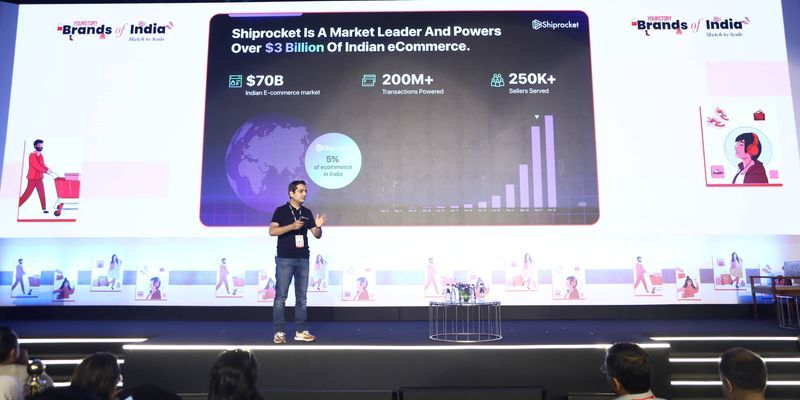
At Brands of India that year, he discussed Shiprocket Promise, which communicates an expected delivery date to shoppers. He also addressed customer engagement and easier checkout. Read together, these concerns bring delivery into the purchase experience itself. The buyer is deciding what to order while also deciding whether the transaction feels dependable.
A delivery date is a small piece of information with a large place in that decision. It tells the customer what to expect and gives the business something concrete to fulfil. The same talk encouraged brands to improve conversion from the traffic they already had. Attention is expensive; making an existing customer’s next step clearer is a practical use of it.
In his discussion of courier recommendations, Mehta has described factors such as pickup performance, delivery commitment, return-to-origin rates and the time taken to remit cash-on-delivery payments. These details make his interest in technology fairly specific. A courier recommendation has to account for how the service performs, including consequences the merchant will feel after the parcel leaves.
The work travels through partners
In June 2025, Shiprocket announced a partnership with Fynd. Courier selection, price comparison and tracking were integrated into Fynd’s order management system, with the service already live for more than 300 direct-to-consumer brands. The stated aim included improving delivery in Tier II and Tier III markets.
For Mehta, the announcement was another expression of merchant enablement: shipping functions made available where brands were already managing orders. An integration rarely supplies a stirring photograph, but it can remove work from someone’s day. In an operating business, that is a respectable form of progress.
His public agenda continues to place him among founders and operators. The SHIVIR Mumbai programme for July 2026 listed him on discussions about enduring consumer brands and emerging brands using AI. A leadership profile published in April 2026 described his focus on expanding the domestic network, service reliability and relationships with logistics partners.
A career that leaves room for curiosity
There is room in this story for a person beyond the operating title. Mehta represented his college in multiple racquet sports. His wife, Charulatha, is an ISB alumna and the author of the Beaming Child children’s book series. His own teaching includes a D2C launch masterclass through Shiprocket Growth Academy.
His career advice gives curiosity a place alongside responsibility. In the Altera conversation, he described major moves as beginning with an interest in understanding what another business was doing. That is a less theatrical account than the carefully plotted ascent usually attached to senior executives. A conversation can precede a decision. A new question can precede a new job.
For Mehta, those questions have led from consumer brands to groceries to the merchant waiting for an order to arrive. The work has become more operational, but the customer remains in view. The sale deserves its moment of celebration. Then someone has to see the parcel through.