A campsite is a patch of ground with unusually complicated paperwork. Someone must decide when it opens, who may book it, how long they may stay, what their vehicle can fit, and what happens when they cancel. The trees contribute very little to this discussion. Aspira has made a business of the discussion.
Its most recognizable face is ReserveAmerica, the website people use to find and book outdoor stays. Behind that storefront sits a collection of reservation, licensing and operating systems for public agencies and private campgrounds. A camper wants confirmation. A park needs a transaction that obeys its rules and appears correctly in its accounts. Aspira works where those two wishes meet.
- For visitors: find campsites, reserve outdoor stays and use agency tools for licenses and permits.
- For operators: manage inventory, bookings, payments and guest communication; Firefly serves local and private campgrounds.
- For buyers: examine the rules, migration work and total fees. A pleasant booking screen is only the entrance.
Aspira says its technology facilitates more than 50 million bookings and purchases annually. Purchases matter in that sentence. This is a company selling the machinery of access across several activities, rather than counting only nights under canvas. Its stated mission is to connect people through outdoor experiences. Much of the job involves making the administrative parts behave.
01 The woods, by telephone
The corporate family traces its beginnings to Kitchener, Ontario, in 1984, developing municipal recreation software. Aspira’s Canadian history dates its first reservation website to 1997. On the same history page is a photograph of the opening day of its first call centre: rows of cubicles, bulky monitors and people arranging other people’s escapes.
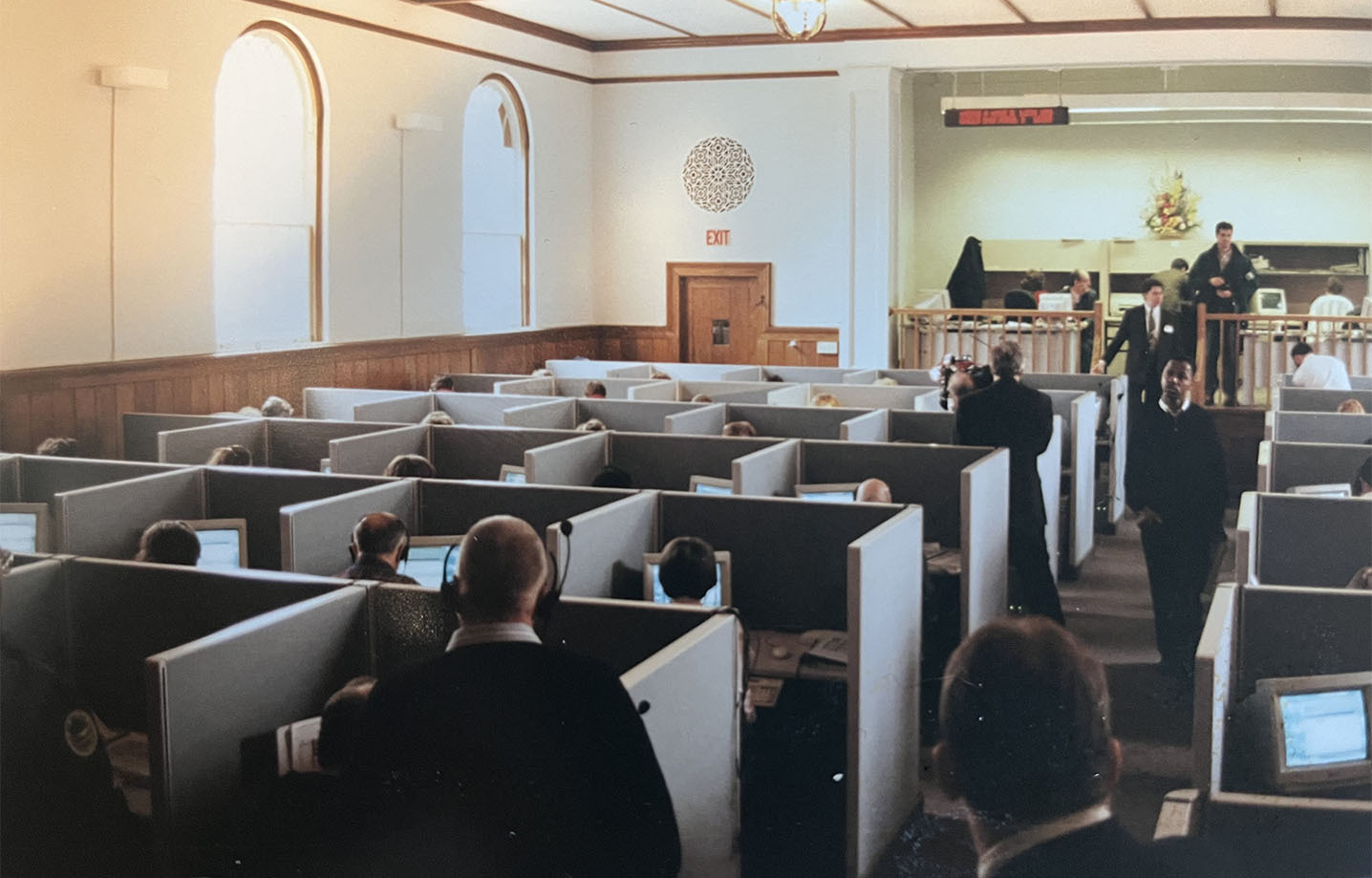
The photograph is a useful corrective to the romance of the business. Outdoor recreation has always required indoor coordination. Putting a reservation online changes how the request arrives; it leaves plenty of work around it. Someone still has to explain a policy, resolve an account problem or help a visitor whose plans refuse to fit neatly into a form.
The present legal entity, RA Outdoors, LLC, was organized in 2017. The 1984 date belongs to the predecessor business. Aspira expanded its private-campground portfolio by buying Mission Management in 2018. Alpine Investors then acquired Aspira from Vista Equity Partners in April 2021, promising investment in growth and further acquisitions.
“Our first objective is to listen to our team and customers”
Fraser Cameron, incoming CEO, April 2021 acquisition announcement
That is an appropriately unglamorous opening ambition for this industry. A campground owner’s irritation can be a product specification. A wildlife agency’s exception can become a substantial development project. Listening is useful when the customer knows exactly which apparently minor detail will cause trouble on opening day.
02 Every park has its exceptions
The customer list spans state and provincial parks, wildlife agencies, municipal operators and private campgrounds. Their common need is controlled access. Their actual jobs differ. A picnic pavilion requires a time slot. A hunting license may require eligibility checks. A limited-quota draw requires rules for distributing opportunities. The software must know which kind of promise it is making.
- 01The requestDates, destination, activity
- 02The rulesAvailability, eligibility, fees
- 03The promiseBooking, license or permit
- 04The recordsPayment, reporting, support
Massachusetts offers a particularly plain example. Aspira describes a system that applies minimum stays and resident versus nonresident charges during booking. Kansas helped drive its branded Campit KS application. New Mexico added the ability to reserve accessible Trackchairs at Manzano Mountains State Park in 2024. A booking platform can administer a piece of equipment as well as a place to sleep.
For wildlife departments, Aspira offers licenses, lotteries and harvest reports. It reports processing more than two million fish and wildlife lottery applications each year. For provincial partners, the company says their data is processed and stored in Canadian data centres. Those are different requirements from the ones a private RV park brings to a sales demonstration.
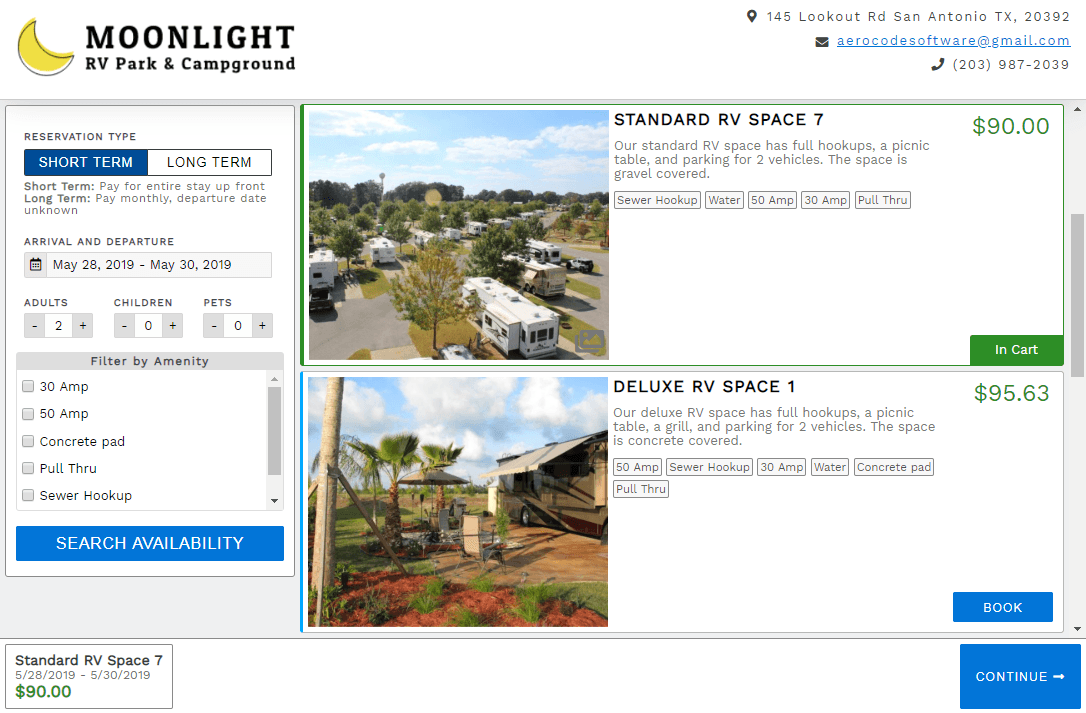
Firefly Reservations addresses that operator with online reservations, guest portals, recurring payments, point of sale and self-service tools. ReserveAmerica supplies a consumer discovery channel; RV Parky adds an RV directory and trip planning. The portfolio reaches from choosing a destination to administering the stay.
03 The fee follows the camper
Software has to be paid for, even when its buyer prefers that the payment happen elsewhere. Firefly publishes a US$3.50 service fee for each newly booked unit. Operators can absorb it or pass it to the guest. Qualifying long-term reservations carry a separate US$3.50 monthly maintenance charge. Credit-card processing costs depend on the processor, and optional services add charges.
Illustrative service-fee total, in US dollars. Excludes processing, long-term maintenance and add-ons. Passing it to guests changes who pays.
Public agencies also use transaction funding. In an April 2025 Saskatchewan committee hearing, officials described the campground system as fully covered by user fees, without taxpayer subsidy. In Utah, a 2023 FOX 13 investigation reported that US$5.75 per state-park camping reservation went to Aspira. Those are dated examples of particular arrangements, not a universal Aspira price list.
The attraction is clear: an operator can obtain a booking service without carrying its entire cost in a conventional software budget. The tension is equally clear: visitors see another charge on their receipt. Calling the service affordable requires specifying for whom. A procurement decision and a camper’s verdict can both be reasonable and still disagree.
Seasonal campsites filled in minutes, according to provincial officials. About 94% of the available sites. Better software can process demand; it cannot add lakeshore.
04 The check that was skipped
The most instructive failure in the public record occurred away from a checkout screen. On January 7, 2021, Aspira sent Saskatchewan hunting, angling and trapping customers survey emails containing other people’s names and account numbers. The privacy commissioner’s investigation covered 33,501 individuals.
The report identified errors while adding personalized fields, followed by a skipped test communication. Aspira halted the mailing after detecting the problem. Its revised procedures added another manager’s review, more matching checks and a test email with written ministry approval before sending consumer communications. The commissioner found the response and preventive steps appropriate and recommended no further action by the ministry.
The lesson is specific enough to borrow: test the relationship between a recipient and the personalized information they receive, and make approval an actual step in the process. Operational quality can hinge on an ordinary check performed every time. A company handling outdoor access is also handling information about people.
05 Long relationships still face a tender
Aspira’s careers page reports average client tenure exceeding 17 years and average full-time employee tenure of 8.5 years. It lists customer obsession, transparency and integrity among its values. These are the company’s own descriptions, but the long relationships help explain its position: agencies need people who understand their accumulated rules.
Competitors can understand those rules too. Campspot offers campground software and a booking marketplace. Brandt competes in agency systems. In August 2026, Brandt announced that Colorado Parks and Wildlife had signed a contract for a modernized IPAWS platform, with launch planned for 2027. Aspira’s longstanding Colorado relationship therefore comes with a successor in view.
A Colorado procurement presentation makes the reasoning concrete. It lists current-system complexity, speed and difficulty making quick changes among the challenges. It says Brandt could accommodate 90% of requirements with its existing platform. This illustrates a limit of extensive specialization: if changing rules repeatedly demands coding, buyers may prefer a system they can configure more readily.
Meanwhile, Maryland selected Aspira for an upgrade announced for February 24, 2026, covering amenities at 37 state parks. The state described improved mobile and desktop performance, text notifications and simpler checkout, with transaction fees funding the service. Its transition required a reservation blackout and new user accounts. Even modernization has a moving day.
For a buyer, the useful demonstration begins with the awkward cases: a cancellation, a long stay, a changing fee, an eligibility rule, a busy launch. Ask what happens after confirmation and what migration requires. For a software builder, the transferable idea is to learn the chores closely enough to remove them. This approach works when the system fits the operator’s rules and the fee arrangement is acceptable to its users.
It becomes harder when requirements change faster than the platform, when checks depend on someone remembering them, or when easier booking merely creates a faster race for scarce spaces. Aspira’s business rests on doing the surrounding work well. The camper, quite reasonably, would rather think about the trees.
Follow the booking trail
Explore Aspira, book through ReserveAmerica, or inspect Firefly’s features and published pricing.
Follow Aspira on LinkedIn and X. Firefly posts on Instagram, Facebook and YouTube, and maintains a product blog.
Watch Firefly’s extended product demo ↗ (2021 interface walkthrough)
For the latest procurement developments, read Maryland’s reservation upgrade announcement and Colorado’s planned successor system.