Aris Saxena has found a use for the office hallway. In September 2026, the Solstice co-founder described a workplace so full that its rooms had acquired second jobs. The kitchen hosted sales calls. New colleagues worked at improvised desks. A photograph showed three people sitting on the wooden floor, laptops open, apparently prepared to conduct business without the assistance of chairs.
Saxena was pleased. He and his co-founder, Yiwen Li, were adding people to a company that had recently announced a $21 million Series A. A larger office was coming. Meanwhile, the hallway would do. Commercial ambition has many visual expressions; this one came with a fire alarm on the wall.
For Saxena, shared space has been consequential before. He met Li as a freshman hallmate at the University of Pennsylvania. Years earlier, he had shared the work of winning a debate final with another partner. His career is easy to reduce to a sequence of ventures and financing rounds. Follow the people beside him, though, and a more interesting sequence appears.
Five judges, one decision
In March 2015, Saxena and Connor Duncan were a young debate team at Sonoma Academy. They reached the final round of a state qualifying tournament and finished as alternates. Their coach, Brandon Spars, singled them out in his account of the competition. It was a promising result, with further work plainly left to do.
By the 2016 Stanford Invitational, that partnership had become formidable. Sonoma Academy sent two undefeated teams into the elimination bracket as the first and second seeds. Duncan and Saxena eventually reached the final. The resolution concerned economics and how best to help disadvantaged people. Five judges voted for them. Five votes, no dissent: they were the varsity parliamentary debate champions.
Connor Duncan + Aris Saxena
Varsity parliamentary debate final
The result also helped qualify the pair for the Parliamentary Debate Tournament of Champions. There is a temptation to treat an early trophy as a prediction. A tournament win establishes something more modest and more useful: on that occasion, against that opposition, the partnership worked.
Debate continued into Saxena’s Penn years, with a change in responsibility. The 2019 university tournament invitation lists him as a junior tournament director alongside Nick Yang. Penn for Youth Debate organized free tournaments and supplied volunteer coaches to Philadelphia schools. The job involved making a competition possible for other people, with all the scheduling and coordination that implies.
The tournament invitation described a program working with 20 schools and running three free tournaments a year. Its volunteers coached Public Forum debate at public high schools and middle schools. That puts the director’s title in context. Organizing meant supporting a wider network of students and coaches, alongside the visiting competitors. The experience sits comfortably beside his later interest in how teams work, without requiring a claim that a student tournament supplied a ready-made instruction manual for running a company.
A persuasive speech is visible. The work that gets students into the room tends to be less so. Saxena’s record includes both sides of that equation: competing and organizing. By his senior year, he had also served as the student organization’s co-president.
The hallmate who stayed
Penn gave Saxena another collaborator. He and Li met in the Research, Innovation and Entrepreneurship residential program. Their first venture together, Mobility, grew out of their undergraduate years. In 2021, they received the university’s President’s Innovation Prize, which provided $100,000 for their project and a $50,000 living stipend for each team member.
The award gave the partnership a practical runway beyond graduation. Saxena completed Wharton in 2021. Tyler Wry, a Wharton management professor, mentored the founders. The university residence had supplied an introduction; the project, mentorship and funding helped turn it into a working relationship.
“finding a problem you care deeply about”
Aris Saxena, on entrepreneurship, 2021
That fragment of Saxena’s description of entrepreneurship is a useful starting point. The harder part comes after choosing the problem: deciding what to build, putting it in front of people and returning to the work when the first answer proves incomplete. Mobility preceded Solstice. Li remained his co-founder.
There is no requirement that a business partnership begin with a carefully arranged introduction. Sometimes the relevant person lives down the hall. What gives this origin its weight is the years of joint work that followed.
An argument meets a workflow
At Solstice, Saxena and Li chose marketing operations as the setting for their next business. The company’s public launch in February 2025 centered on an AI assistant for reviewing marketing content. It announced $3.5 million in seed funding from investors including Twelve Below and Virtue. The founders described an ambition to provide a broader system for teams creating and revising campaigns.
By May 2026, the description had widened to an AI-native marketing agency. Software and in-house expertise would sit together, covering content creation, review and performance insights. The distinction has practical consequences. Selling a tool leaves customers to organize the surrounding work. Operating an agency brings more of that work inside the business.
- 01CreateDevelop campaign content
- 02ReviewCheck work before release
- 03LearnUse performance insights
The company said its Series A capital would support product development, commercial expansion and hiring. Transformation Capital led the $21 million round, with Twelve Below and Virtue Ventures participating. Solstice put its total funding at approximately $25 million. These are company financing figures, rather than a measure of Saxena’s personal wealth.
A founder can win agreement about a product and still have a large operating problem ahead. Each new promise brings work: hiring the people who can deliver it, building the tools they need and deciding how their responsibilities fit together. Solstice’s changing scope makes the composition of its team part of the business model.
Hiring people who know the work
Saxena’s accounts of colleagues are unusually useful here. Discussing creative Robert Lee, he described interviewing dozens of candidates before finding the combination he wanted: someone who had done the work, understood its details and remained interested in changing how it was done. Experience mattered. So did a willingness to learn.
His praise of another colleague, Chandhru, included the detail that he reads while walking through Flatiron. It is an affectionate observation, and a rather demanding way to use a pavement. Across those accounts, Saxena gives attention to curiosity, professional knowledge and reliability toward teammates. These are the qualities he chooses to celebrate publicly.
Arindam Sharma’s account supplies the employee’s perspective. After five months at Solstice, he described joining client meetings, contributing beyond engineering and interviewing candidates. His thinking had shifted toward how an end user would experience the product: what would feel intuitive, what would frustrate them and how the work would actually be used.
Those responsibilities put an engineer closer to the commercial and human consequences of a technical decision. A feature can work as designed and still be awkward to use. Hearing a customer explain the difficulty makes the problem harder to dismiss. Sharma’s account describes a team where that exposure was part of his early experience.
Recruiting, too, appears in the ordinary details. In a testimonial for Honed Partners, Saxena described hiring a product manager through the firm and sourcing candidates across applied AI, backend engineering, quality assurance and data engineering. He valued screening, responsiveness and the ability to adjust as priorities changed. The vocabulary is practical: finding people who fit the work currently needing to be done.
The room gets bigger
Investor Jonathan Hirsch met Saxena and Li through Byron Ling. After the Series A announcement, Hirsch praised their clarity of thought, intensity, recruiting and closeness to customers. His account is an investor’s endorsement, with the perspective that entails. It also identifies a relationship behind the round: an introduction followed by time watching the founders work.
In a founder video filmed around Madison Square Park, Saxena was asked what made Solstice distinctive. His answer began with the people. He also described a five-year ambition for the company to become an everyday assistant for marketers. A future product vision and a present team were occupying the same conversation.

That gives the office photograph a little more meaning. It captures the unceremonious part of expansion. More people have arrived, and the building has yet to catch up. Li sits on the floor with colleagues. The image belongs to Saxena’s own account of the crowded office, offered with pride and a sense of humor.
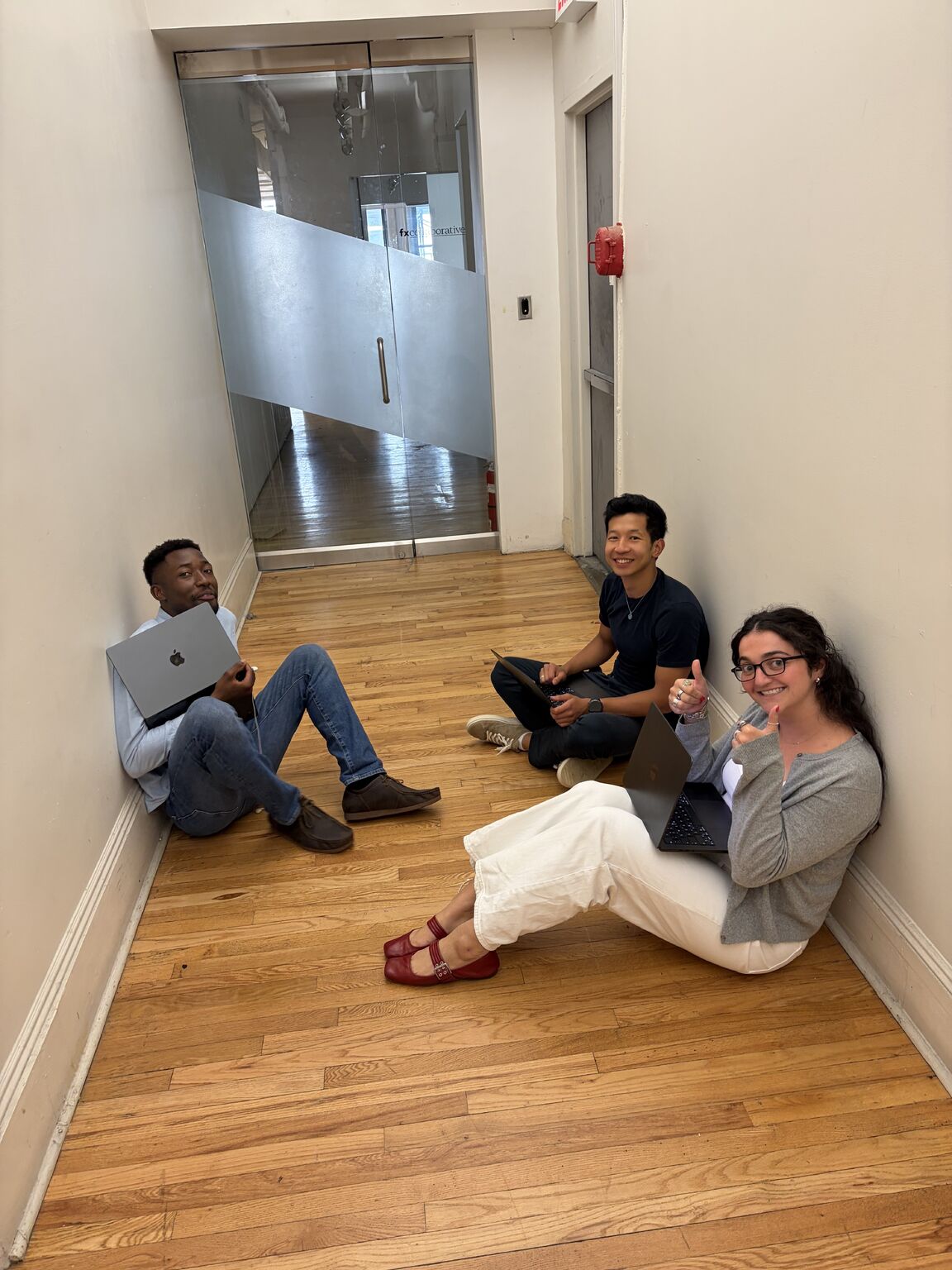
The photograph does not establish how every day at Solstice feels. It preserves one moment in a growing company, and the founder’s decision to share it. He could have confined the account to the number of new hires. Instead, he included the makeshift arrangements that made their arrival tangible.
From debate partner to hallmate to co-founder, Saxena’s story has accumulated through working relationships. Now the circle includes engineers, creatives, commercial colleagues and investors. The next office will have to accommodate more of them. For the moment, the laptops are open, the team has found somewhere to sit, and the hallway is taking the meeting.
Follow the conversation
Profiles, company & further reading