The brake light is a small thing. On a car, nobody gives it much thought. On an electric bicycle, it can reveal an entire theory of transportation. A rider slows down; the person behind needs to know. In Ariel Rider’s account of its own reinvention, this ordinary exchange became a design problem worth solving, right down to hiding the wiring inside the rear mudguard.
- Electric commuters and motorcycle-inspired bikes, sold directly online.
- A design reset built around everyday riding needs.
- Big batteries bring useful range - and substantial weight.
- The private-property power bikes serve a different kind of trip.
It is an appealingly modest place to begin a company story. Ariel Rider has plenty of louder material: fat tires, substantial batteries, machines dressed like small motorcycles. But the light poses the better question. What has to happen before somebody chooses a bicycle for a trip they would otherwise make by car?
First, change the question
Arda and Berk Onal’s origin story turns on a family loss. Their father died in May 2014, while the brothers were handling orders for their young brand. They describe packing shipments to Singapore before leaving for his funeral. Afterwards, they stopped operations, moved their factory to monitor suppliers more closely, replaced suppliers, and hired engineers.
The consequential change was the brief. Appearance had been the starting point. Now, they wrote down commuters’ needs and the useful features they believed were missing. Their account names brake lights, motor torque, charging, and battery management. These are founders’ recollections, but they describe a recognizable product decision: redraw the problem before redrawing the bike.
“we prioritized a list of daily commuter needs”Arda and Berk Onal, describing the redesign
There is a lesson here for anyone making physical products. Write the list in the customer’s order: leaving home, climbing the hill, being seen, stopping, getting back. A feature earns its place by improving one of those moments. It gives an engineering team something more specific to argue about than whether the latest sketch looks exciting.
A little motorcycle in the bicycle
By 2016, the N-Class and W-Class made the proposition visible. The bikes borrowed the vocabulary of vintage cruisers: upright posture, generous saddles, tank-like shapes. A contemporary Electric Bike Report review described integrated brake lights and a headlamp developed with Spanninga. It also noted customizable N-Class covers for customers such as resorts and hotels. Personality could carry somebody else’s logo.
That matters because transportation is rarely purchased on arithmetic alone. People want a vehicle they can picture themselves using. Ariel Rider’s motorcycle references offer a familiar role to inhabit: relaxed, slightly mischievous, going somewhere. The practical equipment then has to make that role survive an actual weekday.
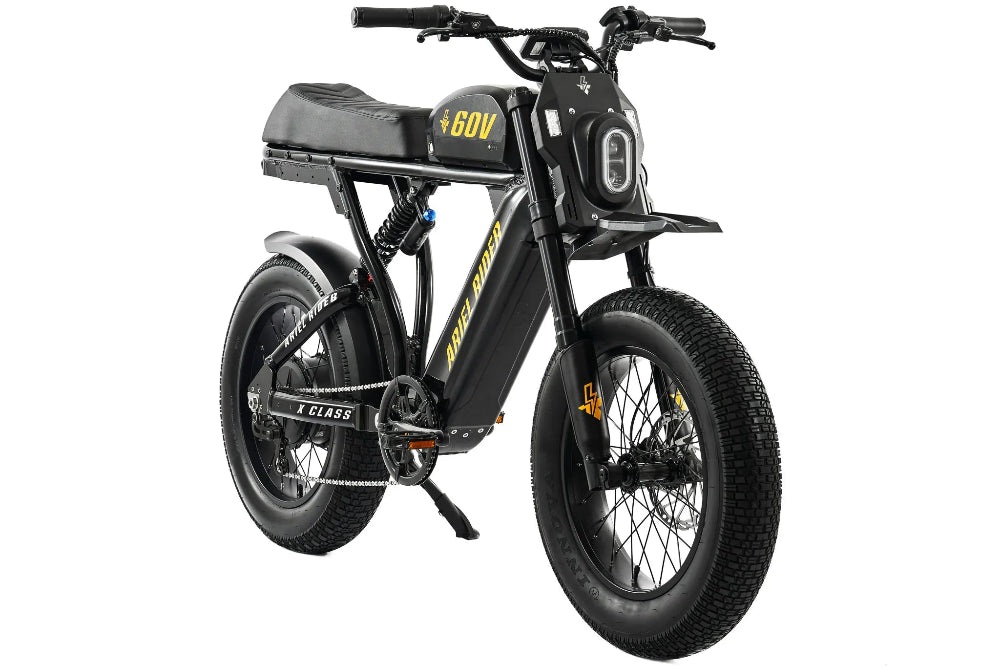
The current X-Class 60V keeps that visual argument. Its editions combine suspension, hydraulic braking, lighting, and different battery arrangements. The Performance edition adds a second pack. A buyer comparing it with a SUPER73 or Ride1Up Revv 1 should begin with the exact build: the family name alone will not explain the suspension, battery capacity, or intended riding conditions.
The battery has to go home, too
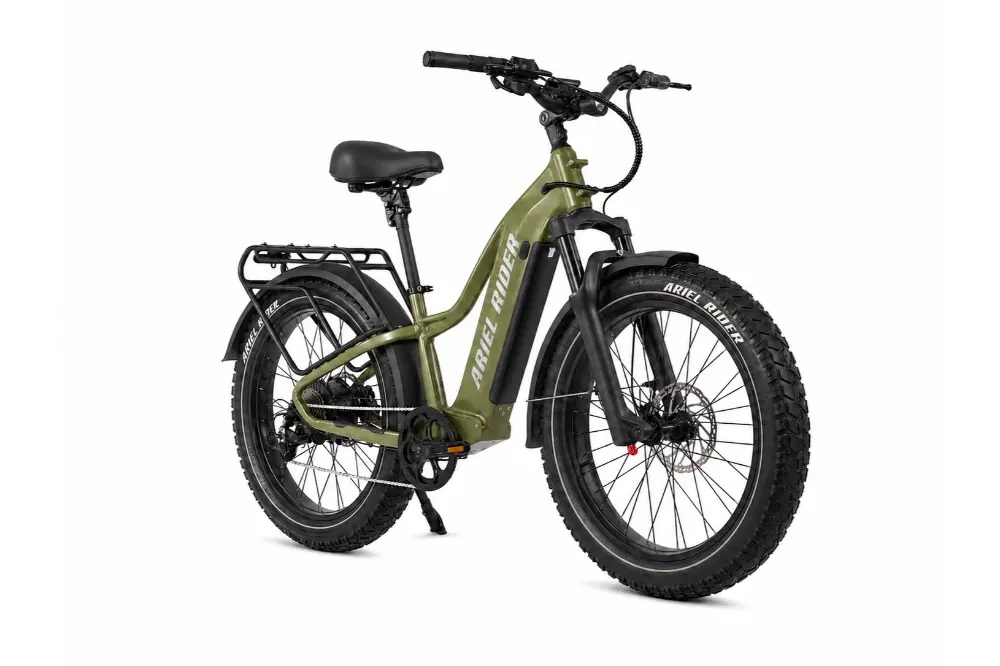
For a more conventional daily journey, there is the 2026 Kepler. Its advertised sale price was $1,699 when researched. The current model uses 24-inch fat tires and a 52V, 20Ah battery, with torque and cadence sensing and built-in Apple Find My. The proposition is a commuter equipped for more than a ceremonial lap around the neighborhood.
Ariel Rider advertises up to 75 miles, while acknowledging that conditions change range. Speed, hills, rider weight, temperature, and assist settings all matter. Treat that figure as a planning input. The journey you need to finish is more useful than the largest number on the page.
Then comes the less photogenic specification: the high-step Kepler is listed at 98.6 pounds. Imagine the route ending at an upstairs apartment. Electric assistance helps with the hill outside; the staircase remains a personal negotiation with gravity. Storage, lifting, and access to repairs belong in the buying decision alongside battery capacity.
What the money was meant to fix
In November 2021, Ariel Rider announced a $14.8 million Series A at a reported $74 million valuation. The company named three uses: inventory, customer service, and product development. Its accompanying sales forecasts were ambitions. They should not be mistaken for bikes delivered.
Those spending priorities explain the business better than a growth slogan could. A direct online seller needs machines available to ship, people who can help when something goes wrong, and products worth buying again. Money gets tied up in objects before a customer clicks the purchase button. The customer’s experience continues long after it.
Inventory02
Customer
service03
Product
development
The published ownership terms deserve equal attention. The limited warranty runs for one year for the original owner and requires registration within 30 days. The return policy specifies unopened, unused bikes, a 14-day window, shipping both ways, and a possible restocking fee up to 25 percent. Choosing the wrong bike can become an expensive measurement error.
Two journeys, one shop window
The company’s newest ambitions stretch beyond commuting. Its Grizzly 72V listing advertises an 8,000W peak motor and a $3,199 pre-order price. Crucially, it identifies the machine as a private-property power bike. The website also promotes the MUDD 72V for pre-order. These machines answer a different question from how to get to work.
This leaves Ariel Rider occupying an interesting patch of the market: useful transport with motorcycle character, alongside products aimed at recreational power. The distinction should guide the purchase. Start with Tuesday’s route, storage space, and riding access. Then consider Saturday. The brake light was always pointing toward the same idea: the trip is the product.
Keep riding
Explore the bike range, model-year manuals, and company newsroom. Watch the N-Class and W-Class video review or the Kepler assembly guide.