Consider the institutional lunch. Someone has to buy the ingredients, schedule the cooks, check the allergens, clean the kitchen, and make the numbers work. The diner sees a sandwich. The organization sees a small operating company it would rather somebody else run. Aramark has spent decades occupying that gap. Its product is the arrangement behind the meal: a workforce, a purchasing system, a set of routines, and someone accountable when lunch goes wrong.
- Institutions hire Aramark to run food and facilities.
- Contracts decide who carries the financial risk.
- Its newest audience: workers building AI data centers.
That helps explain a surprising new customer. In April 2026, Aramark launched Nexus, a hospitality and workforce support platform for AI data centers and other remote operations. The computers get the headlines. The construction workers still need dinner, beds, housekeeping, and a ride to the site. For Aramark, the fashionable new industry contains a very familiar problem.
01First, find the hungry people
In 1936, Davre Davidson and his wife, Charlotte, started a vending business. The books lived on their kitchen table; their 1932 Dodge served as a warehouse. According to Aramark’s account, their first week produced $7.56 in profit. Douglas Aircraft became an early major customer. Here was a useful discovery: a workplace could gather hungry people more reliably than a restaurant could attract them.
Davidson’s business and William Fishman’s operation combined in 1959 to create Automatic Retailers of America. International expansion and acquisitions followed. ARA served the Mexico City Olympics in 1968; the Aramark name arrived in 1994. The geography changed, but the basic opportunity endured. Find an institution with an audience already assembled, then take responsibility for the services that audience needs.
02Who pays for the sandwich?
Aramark sells to institutions and serves the people inside them. Its operations span college dining, school nutrition, workplace food, healthcare support, sports concessions, refreshments, and facilities management. A university wants appealing meals within a budget. A hospital needs dietary requirements respected and rooms cleaned. A stadium needs to turn a brief rush of hungry fans into sales.
The contract determines who carries the risk. In fiscal 2025, roughly two-thirds of revenue came from profit-and-loss contracts: Aramark collected revenue and paid operating expenses, sometimes also paying the client a share or a guarantee. About one-third came from client-interest arrangements, including reimbursed costs plus management fees. Education and sports contracts commonly run five to fifteen years and can require investment in equipment or renovations.
The scale is large; the room for error is small. Fiscal 2025 revenue was $18.506 billion, with $792 million in operating income. That leaves about $4.28 of operating income per $100 of revenue, before interest and taxes. Food waste, a poorly staffed shift, or a contract priced too optimistically can matter enormously when repeated across many locations.
of revenue
03A sandwich is local. Purchasing is global.
Aramark’s advantage is its combination of purchasing scale and experience across demanding settings. That is an advantage competitors can also claim. Compass Group, Sodexo, and Delaware North compete for overlapping business; institutions can also keep services in-house. A big procurement operation helps win a bid. It does not, by itself, make a student like dinner.
The company’s Local Restaurant Row program addresses that tension by bringing neighborhood restaurants and food trucks into client locations. Aramark supplies access to customers and infrastructure; partners bring menus and staff. At the ballpark, the same appetite for specificity produces food designed for the home crowd. The Phillies partnership reached its 40th year in 2025. Familiarity, managed well, becomes something a new bidder has to displace.
Healthcare shows how far the offer extends beyond food. A systemwide Penn Medicine agreement announced in October 2025 covered dining, environmental services, patient transportation, and an integrated call center across seven hospitals. By May 2026, Aramark reported the launch fully operational. The sale was a coordinated bundle of everyday tasks.

04The contract cannot taste the food
There is a hard limit to this model: the institution signing the agreement and the person receiving the service are different customers. Their interests can diverge. Procurement may celebrate savings while diners experience a smaller portion, a substitution, or a longer queue. Any assessment of an outsourcing contract should listen to both.
Michigan supplies a concrete warning. In July 2015, the state and Aramark agreed to end a three-year, $145 million prison-food contract early. Reports documented food and sanitation complaints, employee misconduct, and sanctions. The failure was in daily execution, the very thing the contract was supposed to purchase. Michigan hired another vendor. The broader lesson is that staffing, supervision, and independent checks on service quality deserve as much attention as the bid price.
“I like to describe Aramark as a hospitality leader, powered by technology.”Baker Smith, Chief Information Officer
Aramark, February 2026
05New machines, old appetites
Aramark is also changing what it owns. In October 2023, it spun off its uniform and workplace supplies business as Vestis. Management described the separation as a way for each company to focus on its own strengths. Uniform rental belongs to that separate company now; treating it as a current Aramark service would miss the strategic narrowing.
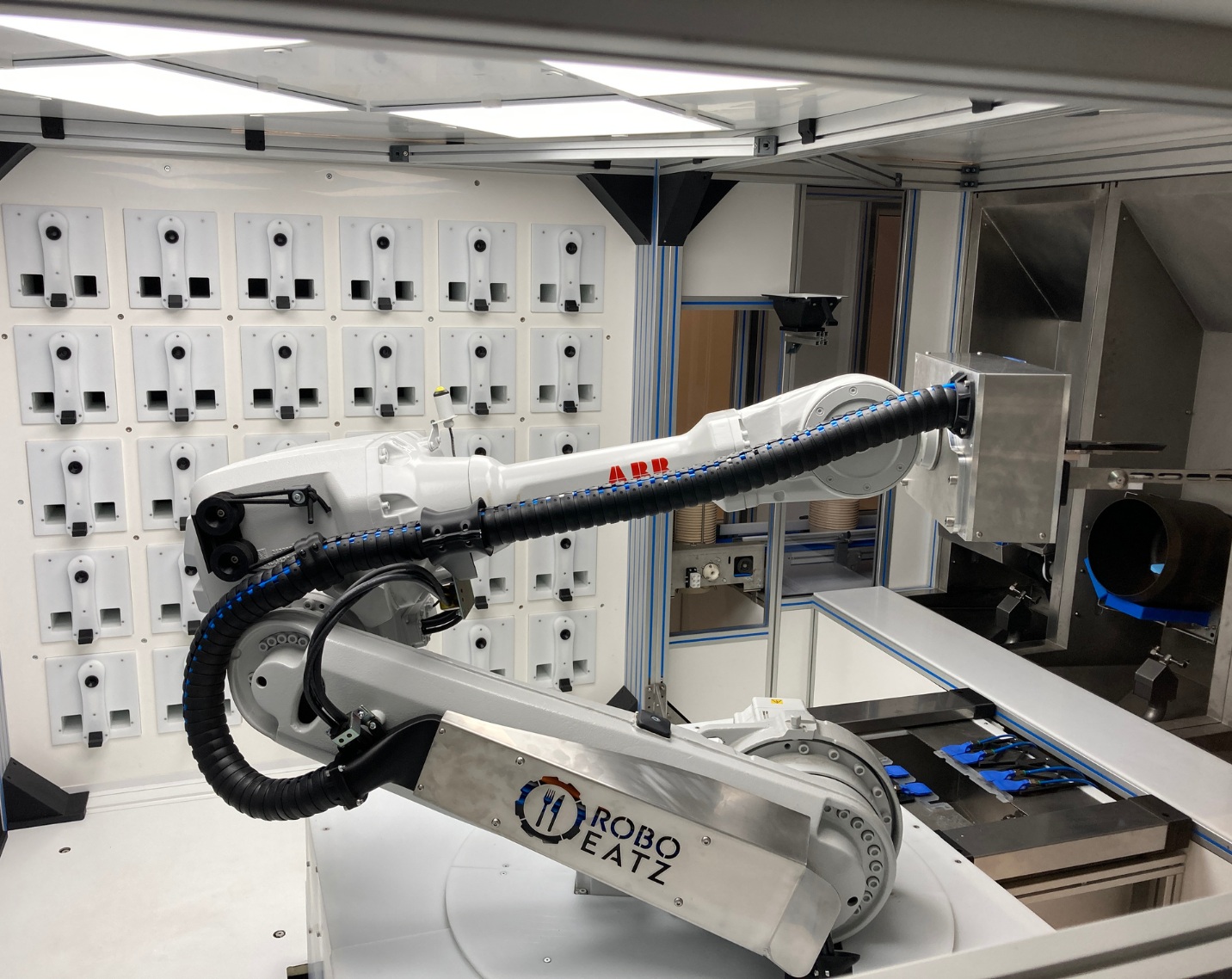
Technology is entering the remaining operations in practical places. In 2025, Aramark invested in RoboEatz technology alongside work with ABB Robotics and WellSpan Health. The robotic kitchen prepares customizable bowls and targets gaps in overnight hospital dining. Its Hospitality IQ tools support decisions such as menu planning; building sensors support maintenance and monitoring. These are attempts to improve specific jobs, with their success dependent on what happens at the site.
Nexus applies existing remote-site expertise to a new market. By August 2026, Aramark said operations had begun at a Texas AI data-center site, with a second location being mobilized. It also reported a separate multi-year engagement with a colocation provider. The company raised its fiscal 2026 organic revenue growth outlook to 9%-10%. Those were expectations, not completed annual results.
What can another operator copy? Start with a recurring inconvenience inside someone else’s larger mission. Build the routines to solve it, earn the renewal, and expand into adjacent tasks only when the team can deliver. For buyers, ask who absorbs rising costs, who funds renovations, and how complaints reach decision-makers. Outsourcing can help an institution concentrate on teaching, treatment, or entertainment. It works poorly when oversight disappears, staffing assumptions fail, or the people eating the food have no meaningful voice. The humble lunch remains an excellent test of an impressive contract.
Meet the operation behind the meal.