Six Turkish lira is an unpromising opening number for a company profile. At arabam.com, it bought a memory. Product manager Pınar Akgül recalls that when Garaj earned its first six lira, the then chief technology officer, Umut, marked the occasion by giving team members a lira each. Garaj had begun as a way to track a car’s market value. It was becoming something people might actually use between buying one vehicle and selling the next.
That interval is the interesting part. A classifieds website has a built-in goodbye: find the car, finish the transaction, close the tab. arabam.com has spent years adding reasons to return. Alongside listings, it now offers direct vehicle purchasing, dealer sourcing, inspections and an ownership service that, in July 2026, added Motul motor oils. The platform that helps you dispose of a car would also like to help you keep it running.
The result is a business with several different jobs. Private sellers need a buyer. Shoppers need useful comparisons. Dealers need stock and enquiries. Owners need maintenance products and a sense of what their vehicle is worth. arabam.com’s ambition is to serve those needs within the same commercial relationship. Whether that feels convenient depends on the handoffs between them.
A $4.24 million second act
The brand dates to 2000 and the Doğan media group. Ercan Cingi, identified in contemporary coverage as one of its founders, left his general-manager role in 2010. The ownership change that shaped the present business arrived five years later: on December 25, 2015, Doğan approved selling the website and associated domains, brand rights, customer contracts and other assets to iLab or an affiliate for $4,237,288, excluding VAT.
That was an asset-purchase price. It should not be mistaken for a venture funding round or today’s valuation. Company histories place arabam.com’s entry into iLab in 2016. The new owner already operated internet businesses in categories including recruitment and insurance, giving the car site a home among other specialist online services.
The early changes were practical. A 2016 report described an overhaul reaching from the logo to the mobile application, with listings rising from 70,000 to 90,000 in that year’s first half. It also described an Otorapor inspection partnership. Even then, the company was confronting a problem that prettier photographs could not settle: the uncertainty surrounding a used car’s condition.
The buyer behind the buy button
Trink sat, introduced in 2019, changed the company’s role more substantially. Instead of simply bringing a seller an audience, arabam.com could become the buyer. The motorist submits vehicle information, receives an initial offer and attends an inspection. A completed deal depends on the checks and the seller accepting the final terms.
iLab describes the business as consumer-to-business-to-business. In everyday language, it buys from motorists and sells on to dealers through closed digital auctions. That downstream buyer matters: the online offer has to make sense for an actual vehicle that another business will want to acquire.
- 01Private ownerDescribe the vehicle
- 02Offer + inspectionCheck the actual car
- 03Trink sat purchaseAgree final terms
- 04Dealer auctionFind its next business buyer
The service’s published terms say arabam.com covers its purchase-process inspection and notary sale fee, and that the owner can withdraw without paying a cancellation charge. This makes the visible fee question relatively straightforward. The economic question is more personal: does the final offer make the convenience worthwhile compared with continuing to advertise the car?
An online valuation is useful preparation, but it is not cash in the bank. A listing shows what a seller asks; a valuation estimates a market value; a purchasing offer states what a buyer is prepared to pay, subject to its conditions. Treating those numbers as interchangeable is an excellent way to leave an appointment annoyed.
Dealers buy more than space on a screen
For professional sellers, arabam.com sells a broader working relationship. Its corporate range includes Standard, Gold and Platinum packages, with different listing allowances and benefits. Higher tiers include visibility features such as priority placement and homepage exposure. Kokpit supports listing work; Turbo Hat lets businesses examine incoming calls and how well their teams answer them.
The commercial logic is plain. A dealership does not ultimately want an advertisement. It wants a conversation with somebody who might buy. Call tracking addresses the unglamorous gap between generating an enquiry and having a person answer it. Sourcing through arabam tedarik tackles another recurring need: finding the next vehicles to sell.
This produces several ways to earn money: professional packages, advertising and visibility products, inspection services and vehicle trading. Ownership commerce adds another activity. The mix also means that growth in website visits alone cannot explain the whole business. A browsing session, a dealer subscription and a purchased vehicle represent very different commitments.
“Digitalization in the automotive world is now a basic expectation.”
Önder Oğuzhan, CEO · December 2025 · translated excerpt
The app still needs a workshop
arabam.com added its branded auto inspection service in 2023. Its packages examine different aspects of a vehicle and produce reports for private and corporate customers. The service can be booked through the company’s channels, while its guide also describes walk-in access. Package scope determines the price.
This is where an internet business acquires a physical workload. Someone has to assess bodywork, mechanical condition and evidence of prior damage. A search filter can narrow the choices; it cannot perform those checks. The expertise on sale is therefore a combination of vehicle data, software and people who can examine what the seller has brought in.
Trink sat also has eligibility limits. Its terms exclude conditions including serious damage history and impose requirements concerning the vehicle and its paperwork. A motorist with a car outside those purchasing criteria may still find classifieds useful. The direct-buying route and the open listing market serve different situations, even when both sit behind the same app icon.
The competitive comparison needs similar care. Sahibinden’s Oto360 already offers valuation and related automotive services. arabam.com’s combination is not evidence that every component is exclusive. Its case rests on how effectively an automotive-focused business connects discovery, purchase, dealer supply and ownership. A rival or a local dealer remains a meaningful alternative whenever it offers a better fit for the particular transaction.
What broke was the release process
One unusually candid piece of company history sits in Arabam Labs. Writing in December 2017, engineer Umut Yenilmiş described inheriting eight web projects and two mobile apps that crashed on opening. A rewrite began in May 2016 and went live on June 30.
Speed then created another problem. Technical debt arrived sooner than the team expected; deployments could take hours. The response was to prioritize recurring pain, automate releases, improve tests and reserve time for maintenance. The lesson readers can copy is specific: fix the repeated work that makes every subsequent release harder. This is a historical account of one engineering team, not a claim about today’s entire workplace.
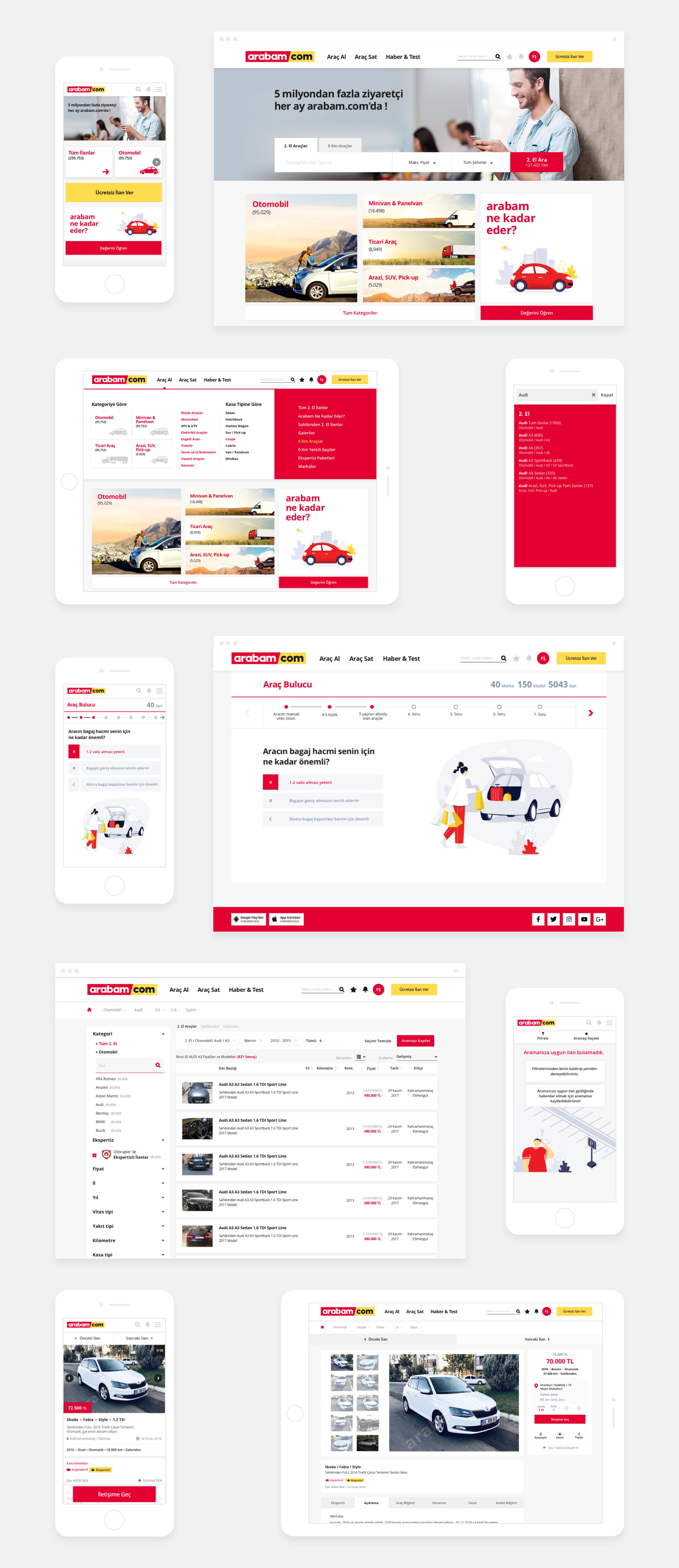
FUHA’s separate 2018 design case study shows another part of the product work: a revised logo, interfaces for web and mobile, a design system and a custom icon set. Consistency is useful in a service asking people to make consequential decisions across several screens. A familiar layout lets the vehicle, rather than the interface, receive the attention.
Growth figures meet the small print
The scale is substantial, though the units deserve care. iLab’s December 2025 newsletter said arabam.com’s monthly traffic rose from 15 million at the start of the year to more than 30 million at year-end. It also reported growth above 100 percent for Trink sat, without attaching an absolute total to that summary. Neither statement supplies a count of unique car buyers.
Reported traffic, not unique users or completed sales. Bars show 15M and the 30M lower bound.
The company has also faced concrete limits on its marketing. In a 2023 settlement, Turkey’s Competition Board imposed a TL2,726,850.04 fine after a 25 percent reduction over agreements with competitors to place brand names on negative-keyword lists for Google text advertising. The decision found that the arrangements restricted competition.
Separately, on February 12, 2026, the Advertising Board ordered specified arabam.com promotions stopped after finding claims insufficiently substantiated. These included assertions about selling speed and safety. The order concerned the advertising in question; it was not a shutdown of the marketplace. For a business selling confidence, the distinction between a demonstrable service and an expansive promise is commercially important.
The business in the years between
Garaj supplies the clearest view of where the company wants to go. By December 2025, arabam.com said the service held more than two million registered vehicles. Its July 2026 Motul announcement made the next step tangible: users could order motor oil and other automotive care products within Garaj, with an authorized supplier fulfilling orders to their addresses.
That is an ordinary purchase with a useful strategic implication. A driver may postpone changing cars, yet still need products or services for the one outside. Garaj gives arabam.com a reason to be present during that period. Keeping checkout inside the service also shortens the distance between noticing a need and ordering something to address it.
For another marketplace operator, the transferable idea is to identify a recurring need beside the occasional transaction. For the motorist, the test is simpler: are the valuation, inspection, offer or maintenance purchase useful on their own? The six-lira celebration makes a good origin story. The next reason to open the app has to earn its place.
Take it for a spin
Explore the marketplace, Trink sat, vehicle valuation and the motoring blog.
Follow LinkedIn, X, Instagram, Facebook and GitHub. Watch the Trink sat video guide, the 25th-anniversary film or explore the YouTube channel.