In January 2016, Imad Hammad and Ali Malik gave themselves a March launch date. They had no customers, no mechanics lined up and no website. Even the company’s name was unsettled. The calendar, at least, was ready for business. It was an odd way to begin a car marketplace, but a useful way to stop discussing one indefinitely.
The deadline made their ambition smaller in the places where it needed to be smaller. A complete online car-buying experience could take years. A first version could show the condition of a particular vehicle, including photographs of its scratches, and help someone buy it. They launched within 60 days. Then the founders personally shepherded the first 40 cars through inspections and ownership transfers, appeared in the homepage video and answered customer calls late at night.
That beginning gives Hammad’s career a useful scale. Before the regional marketplace, before the presentations about artificial intelligence, there were individual cars and individual people waiting for something to happen. A business plan could describe the opportunity. Someone still had to pick up the telephone.
Learning to start again
Hammad grew up moving between Canada, Lebanon and the UAE. Changing schools repeatedly taught him to adjust, he has said. He later studied electrical and computer engineering at the University of Toronto, graduating with Dean’s List standing. His description of himself as a “tinkerer at heart” is a modest clue to the appeal of building something whose workings he could alter.
He spent more than eight years at McKinsey & Company, working on marketing in consumer and technology businesses and becoming an associate partner. Malik was a colleague there. Their eventual partnership carried years of shared professional experience into a situation where neither could expect the first answer to be the final one.
There was operating experience, too. At OSN, Hammad held a regional sales and pricing role, with responsibility for product and promotion decisions across more than eight markets. Television subscriptions and secondhand cars make an unlikely pair on a résumé. Both put commercial decisions within reach of a customer who can decline them. Pricing, presentation and execution have consequences beyond the meeting room.
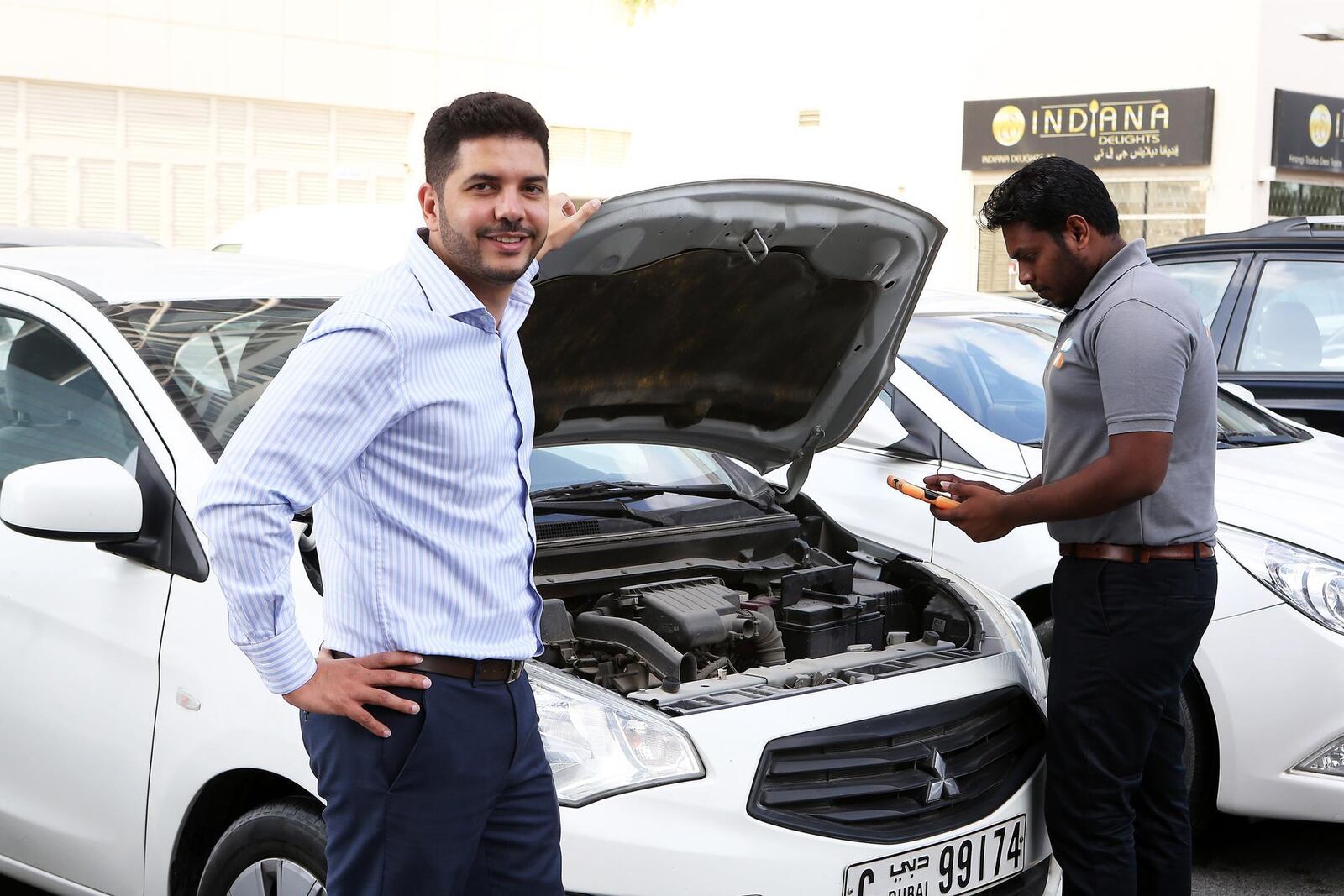
The scratch is part of the product
The early CarSwitch proposition was unusually attentive to what happens after a listing attracts attention. The company’s 200-point inspection gave buyers a structured account of a vehicle’s condition. Advertising, calls, test drives and transfer paperwork became part of the service offered to sellers. The car remained a physical object with a history; putting its photograph online could only do so much.
Hammad’s interest lay in that awkward interval between discovering a car and completing a purchase. By 2020, he described a service that visited sellers to inspect and photograph their vehicles, then helped handle the transaction. Buyers could see inspection reports and detailed photographs online. Finance, insurance and administrative help sat alongside the search experience. The work followed the customer beyond the moment of choosing.
His explanation for starting in Dubai was practical. He regarded the UAE as a regional centre for car transactions, with high internet use and customers who expected services to work well. It also offered a setting for recruiting and establishing a business. The choice provided a place to learn quickly from demanding customers, rather than an abstract pin on a map.
- 01Inspect
& photograph - 02Make condition
visible - 03Coordinate
the test drive - 04Help finish
the transfer
A service sequence, not a claim that every sale follows the same timetable.
CarSwitch subsequently extended into Saudi Arabia. By February 2022, its public footprint included Riyadh, Jeddah, Dammam and Khobar. That made Hammad’s project a business operating across two countries. The underlying proposition travelled with it: an owner could sell directly while receiving help with the jobs that made a sale inconvenient.
The money, and the people beside it
In 2017, CarSwitch announced $1.3 million in investment from Glowfish Capital. The beta had been live since March of the previous year. Funding would support technology and the growing operation, including a planned valuation tool. A year later, another $1 million round brought in Dubai Angel Investors as lead investor, alongside further support from Glowfish.
Hammad’s account of choosing an investor was less preoccupied with the ceremony of a valuation than with the years that would follow. He wanted alignment, useful capabilities and people the founders could trust working alongside. His advice was to begin conversations before cash became urgent. That left room to understand an investor’s own priorities and timetable.
The relationship had an operational dimension. Glowfish offered shared infrastructure and a community of businesses as well as money. For a company taking responsibility for many small parts of a transaction, support could arrive in several forms. Capital mattered; so did the ability to turn it into a functioning service.
- 2016
- March beta launch
- 2017
- $1.3m investment announced
- 2019
- MBRIF’s first accelerator cohort
- 2025
- AI presentation at AutosBuzz Berlin
Two whiteboards and a red pen
Hammad and Malik’s account of planning in 2018 contains a wonderfully ordinary obstacle: two whiteboards covered with things they wanted to do. Once the team estimated the time, staff and spending each initiative required, the list exceeded the resources available. Whiteboards are generous employers. Payroll is less accommodating.
The founders worked backwards from a three-year ambition into annual targets, then a detailed six-month financial plan. They used cars sold and revenue to help choose priorities, testing simplified versions of initiatives before committing more. Monthly reviews allowed the plan to change. There was structure, but it included permission to discover that an attractive idea deserved less attention.
It is a revealing part of Hammad’s public thinking. The enthusiastic tinkerer also wanted a way to decide which experiment should survive. The discipline was in connecting an idea to something observable, then revisiting the decision. An unfinished roadmap could be evidence of choices being made, rather than a failure to imagine enough features.
“real feedback trumps conceptual research any day”
Imad Hammad and Ali Malik, on launching CarSwitch, 2017
A garden, a notebook, a very large screen
His descriptions of daily work make the same practical temperament easier to picture. Hammad joked that his memory amounted to “256 KB” and described keeping written task lists, complete with empty squares to tick. In his consulting years, he reserved the first 20 pages of a notebook for them. Even a complicated business benefits from the small satisfaction of a completed box.
For late-evening work, he had a garden space he called the Bat Cave. The joke suited a founder willing to cast himself as a busy Bruce Wayne after office hours. His daytime description of leadership was more prosaic: helping the team through problems, including making sure its headsets worked. The comic-book reference had to share a desk with customer-service equipment.
Hammad also described a rule for colleagues: take responsibility for finding a solution, and make an effort when someone asks for help. Independence and assistance belonged together. A problem could be owned without requiring its owner to solve every part alone.
There were occasions when the audience grew unexpectedly. Through the Mohammed Bin Rashid Innovation Fund, whose first accelerator cohort included CarSwitch in 2019, he received an opportunity to present at GITEX. He expected a small, informal gathering. Instead, he found a large screen in the government area and hundreds of people. His recollection carries the surprise of someone arriving prepared for a conversation and discovering a stage.
The conversation moves into software
At AutosBuzz in Berlin in 2025, Hammad appeared with CarSwitch’s Head of Product, Mohammad Ali Raahim, to discuss AI in the buying and selling process. The company described a chat agent called Abu Abdallah that could answer questions, provide price guidance and help mediate negotiations. It reported a tripling of conversion rates through its AI work, a company claim rather than a universal measure of what such tools deliver.
The connection to the early service is clear enough. Customer questions, price discussions and follow-up had always been part of the work. Software now offered another way to handle some of those interactions. Hammad’s public interest in the technology sat beside the same persistent concern: helping a person get from uncertainty to a completed transaction.
His more recent market commentary has returned to concrete differences between buyers. In August 2026, he discussed the mismatch between interest in used hybrids and available listings in the UAE. In October, he commented on Dammam’s appetite for Chinese brands. These were observations about particular pools of cars and customers, where an average for a larger market could conceal a useful local difference.
The distance from the January whiteboard to an AI-assisted marketplace is considerable. Yet the early choice remains legible in the later work. Give the idea a deadline. Make the condition of the car visible. Find out what the customer still needs. For Hammad, the interesting part of the sale keeps extending beyond the advertisement, into all the small jobs required before someone can finally hand over the keys.
Continue the conversation
- CarSwitch website
- Imad Hammad on LinkedIn
- Watch: TFN Meets CarSwitch
- Watch: Business Link interview
- The 60-day launch account
- Hammad and Malik on planning
- Hammad on working habits
- The early fundraising interview
- MBRIF member profile
- Hammad on CarSwitch in 2020
- The 2018 career interview
- The Saudi expansion in 2022
- CarSwitch’s UAE hybrid analysis
- CarSwitch’s Dammam market note