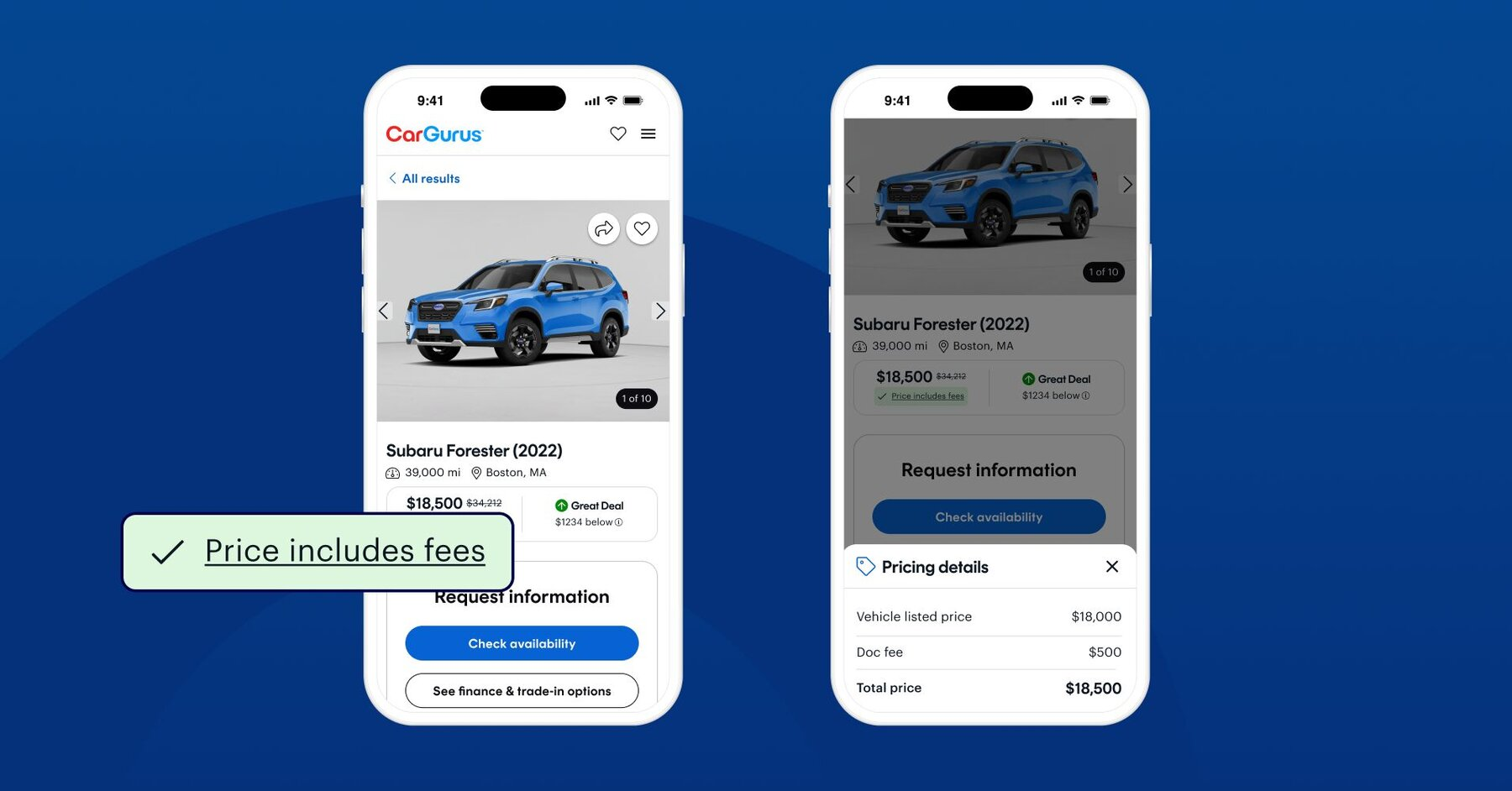
A cheap car has a way of getting more expensive between the search result and the sales desk. The advertised number looks agreeable; the dealer fees arrive later. CarGurus has spent two decades building a business around that gap between what shoppers can see and what they need to know. In July 2026, it gave dealers a pointed incentive to close it: disclose mandatory fees or lose the listing’s Deal Rating.
That small badge carries considerable weight. CarGurus helps people compare new and used vehicles, judge asking prices, research sellers and contact dealerships. Dealers pay for access to those shoppers and for software that helps sell cars. The company reported $907 million in 2025 revenue from continuing operations. An internet business can grow quite substantial by answering a question asked in millions of driveways: am I about to overpay?
But CarGurus also tried to do more of the transaction itself. Its purchase of CarOffer took it into automated wholesale trading, inspections and transport. The operation was wound down by the end of 2025. The resulting company is worth understanding from both sides: the information business that worked, and the transaction business that exposed its limits.
01A price tag with an opinion
Langley Steinert, a co-founder of TripAdvisor, founded CarGurus in 2006. The familiar thread was helping consumers navigate a market where sellers knew much more than buyers. CarGurus dates the launch of Instant Market Value to 2010. Instead of presenting a parking lot’s worth of listings and leaving shoppers to squint, it put a judgment beside the price.
The system compares a used vehicle’s asking price with an estimated local market value. Its inputs include make, model, trim, year, mileage, features and history. The resulting labels run from Great Deal through Good Deal and Fair Deal to High Priced and Overpriced. Listing pages add price history, vehicle information and dealer reviews. A shopper can arrive with a shortlist and a better question than “What’s your best price?”
The July change makes that comparison more demanding. Used listings qualify for Deal Ratings only when dealers disclose mandatory fees outside tax, title and registration. Listings missing the information receive No Rating and move lower in search results. New badges and filters help shoppers identify disclosed fees. This is a practical product decision: reward the information you want sellers to supply with visibility they have a reason to value.
02The shopper browses. The dealer subscribes.
CarGurus sits between consumers and an extensive dealer network. Its investor site reported roughly 46 million monthly unique visitors for the second quarter of 2026 and 34,629 global paying dealers at quarter-end. Those are different measures, not a count of cars sold. The company operates in the United States, Canada and the United Kingdom; Autolist and PistonHeads extend its portfolio into other shopping and enthusiast audiences.
The business earns money from dealer subscriptions, advertising and financing partnerships. Dealer pricing varies with inventory size, region and the company’s assessment of the value delivered. The global quarterly average revenue per subscribing dealer was $6,771 in Q2 2026. Treat that as an operating average, not a published package price that a dealership can order.
What dealers buy goes beyond a phone number. Listings packages offer visibility and shopper connections; LeadAI helps prioritize inquiries using shopping behavior. Audience Targeting reaches shoppers elsewhere online. Digital Deal lets customers complete more purchase steps before visiting, including financing-related tasks and appointment scheduling. A dealer’s real test is whether those interactions turn into profitable sales, rather than merely swelling the inbox.
Cars.com, Autotrader, TrueCar and CARFAX listings compete for much of the same attention. Dealer websites, search engines and online retailers such as Carvana are alternatives too. CarGurus’s distinctive combination is price analysis, a large shopping audience and dealer tools fed by that activity. Its marketplace role also means the dealership remains central to the experience. The quality of the eventual handoff matters as much as the elegance of the search screen.
After the wholesale detour,
the marketplace keeps growing.
from continuing operations
03The detour that came with inspections
The wholesale expansion had an understandable pitch. Dealers need to replenish inventory as well as sell it. In December 2020, CarGurus announced an agreement to buy 51% of CarOffer at a $275 million enterprise valuation; the initial acquisition closed in January 2021. CarOffer offered automated bidding and transaction services, with inspection and transport capabilities. The valuation described the business, not the cash price of that initial stake.
The trouble was visible well before the shutdown. In correspondence with the SEC, CarGurus said its third-quarter 2022 revenue and margin forecasts were missed primarily because wholesale prices fell while operational problems amplified arbitration, or vehicle-return, losses. Management discussed better inspections and fewer arbitrations. The early failure was at the intersection of changing prices and the physical condition of cars.
CarGurus nevertheless accelerated its commitment. In 2023, it agreed to pay $75 million in cash for the remaining minority interests, completing the acquisition that December. The argument then was that closer integration would improve operations and unlock product and data opportunities. Buying more was the proposed remedy before leaving became the decision.
On August 6, 2025, the board approved winding down CarOffer’s dealer-to-dealer and Instant Max Cash Offer businesses. The company concluded that the model had become less effective in a volatile pricing environment and could not provide the flexibility and fulfillment automation dealers required. Closure was complete by December 31. Reported wind-down expenditures totaled $13.3 million. That figure is the shutdown bill, not the total cost of the experiment.
ANNOUNCED
Enterprise valuation when the 51% acquisition was announced.
PURCHASE
Cash price for the remaining minority interests.
WIND-DOWN
Reported expenditures to wind down the business.
04The data stays. The trading operation goes.
The retreat did not mean abandoning the dealer’s inventory problem. PriceVantage, announced in December 2025, uses current consumer-demand data to recommend used-car pricing moves. Its guidance is tailored to a dealership’s objectives, including how quickly it wants stock to sell. The commercial proposition is straightforward: help the person holding the inventory decide what to charge.
The product’s practical details are more revealing than its AI label. CarGurus describes VIN-specific recommendations, comparable listings, market-value lookup and integrations that update prices in supported inventory systems. A recommendation becomes more useful when the dealer can act on it without retyping the same number across several screens.
Sell My Car also survives in the current portfolio. Dealers establish bidding preferences and receive seller leads; they finalize transactions after an in-person appraisal. That leaves a visible checkpoint between an online offer and a completed purchase. On the dealer product page, Kelsey Evans of Nouri Shaver Automotive Group describes the leads as “higher quality.” It is a named customer’s endorsement, not proof that every store will achieve the same result.
05The assistant follows you onto the lot
For consumers, the newer products tackle the awkward translation between a life and a vehicle specification. CarGurus launched AI-powered shopping in June 2025. The Discover experience lets people describe priorities in ordinary language and see matching listings. A family can start with space, budget and daily routines instead of knowing the correct trim designation before the search begins.
Dealership Mode carries that assistance into participating dealerships through the mobile app. It uses location to surface lot inventory, comparisons and price estimates, with AI summaries of vehicle tradeoffs. There is a commercially revealing boundary: CarGurus tells dealers the feature keeps attention on their own stock. Shoppers who want to compare across dealerships should preserve that wider search themselves.
Financing is another bridge between the browser and the showroom. Chase joined the multi-lender platform in January 2024 alongside lenders including Capital One, Global Lending Services and Westlake Financial. The Chase program lets eligible shoppers pre-qualify and see personalized payment scenarios without affecting their credit scores. Final financing terms are completed through a credit application at the dealership. A useful estimate still has a final approval step.
DAFNA SARNOFF / CMO“CarGurus was founded to redefine the car shopping experience for consumers, bringing more transparency with data and technology.”
February 11, 2026
06A Boston software company, with car people optional
The company’s expertise is a mix of marketplace engineering, pricing analysis, consumer marketing and dealer relationships. Its verified GitHub organization offers a modest public glimpse: a webpack caching plugin, React utilities and shared diagramming resources. Those repositories are easier evidence of software work than a long, unverified list of vendors supposedly installed across the company.
CarGurus’s careers site says being a “car person” is optional. Its stated values emphasize transparency, collaboration, experimentation and decisions tested against data. These are the company’s description of its culture. The more tangible expression opened in October 2024: approximately 225,000 square feet in Boston’s Back Bay, bringing together employees previously split between two Cambridge offices.
The headquarters includes collaborative spaces, quiet libraries, terraces and a video production suite. It was designed around hybrid work. Steinert remains executive chairman, while Jason Trevisan runs the company as CEO. On September 3, 2026, CarGurus announced Matthew Mandel as its incoming CFO, effective October 19. The appointment accompanies a strategy increasingly centered on software and dealer intelligence.

07What survives the test drive
The financial picture after the retreat is more focused. Second-quarter 2026 revenue was $251 million, up 13% from the comparable period; GAAP net income from continuing operations was $49.2 million. Full-year 2025 continuing-operations revenue grew 14%. These figures describe the retained business and should not be mixed indiscriminately with older totals that included wholesale activity.
There are useful lessons here for other marketplaces. Put a clear interpretation next to a complicated number. Give suppliers a reason to provide better information. Build tools around a decision customers already make repeatedly. Before moving into transactions, examine who bears the cost when the asset changes value, arrives damaged or gets returned. CarOffer made that last question expensive.
For a shopper, the repeatable routine is simpler: compare like-for-like vehicles, check fee disclosure, read the listing history, consider financing terms and arrange an inspection before committing. A Deal Rating assesses a price; it cannot establish a car’s mechanical condition. CarGurus’s own terms say it cannot verify all third-party information or guarantee the vehicles offered.
The approach needs sufficient comparable inventory, accurate listing details and dealers willing to act on what the software reveals. Rare vehicles, incomplete histories and a poorly handled dealership visit can defeat the convenience. CarGurus’s next chapter turns on a prosaic measure of success: whether the number that brought someone through the door still makes sense when they sit down to buy.