There are heroic problems in technology, and then there is the rectangle that refuses to line up with the other rectangle. Apoorve Singhal has worked on both kinds. As an undergraduate, he helped software find lanes, avoid obstacles and guide an autonomous vehicle toward GPS targets. Today, as co-founder and CEO of Slidely AI, he is occupied by a different sort of navigation: getting an idea across a PowerPoint slide without losing an afternoon to nudges, menus and corporate templates.
The change in scenery is almost comic. The engineering instinct is not. A road is full of visual signals, constraints and imperfect information. So is a presentation. In each case the system has to understand what it sees, respect a set of boundaries and suggest a useful next move. One course ends at a waypoint. The other ends, ideally, with an audience that understands the point before the coffee goes cold.
Slidely works inside PowerPoint, where business presentations already live. It can create new slides, improve existing ones, rewrite copy, redesign layouts and keep the objects editable. It also learns the colors, fonts and patterns of a company’s old decks. This is a product decision disguised as a technical one: do not make the customer abandon the room simply because you have invented better furniture.
A habit of making the machine useful
Singhal arrived at IIT Kharagpur in 2017 to study computer science. His public academic record is full of the sort of projects that make a laptop appear underdressed: speed-breaker detection, lane fitting, driver-attention systems, GPS-and-camera mapping, face recognition and a three-wheeled autonomous robot called EKLAVYA 7.0. He co-authored papers on real-time lane navigation and the design of an intelligent ground vehicle. At the 2019 Intelligent Ground Vehicle Competition in Michigan, his team placed first in the AutoNav qualification round and second in the final.
There was theory, but there was always a demo nearby. During a 2020 internship at the Wadhwani Institute for Artificial Intelligence, he worked on self-supervised 3D human reconstruction from video. At IIT, he studied visual question answering, the task of teaching a model to answer natural-language questions about images. The research produced a 2021 conference paper on improving attention in VQA systems.
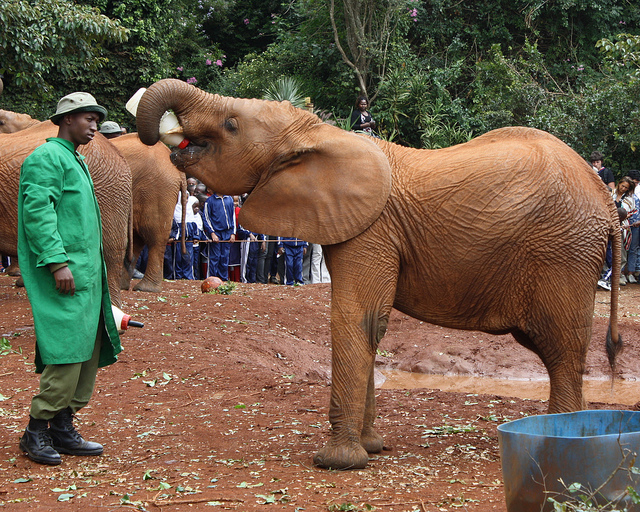
Then he turned the research into something strangers could poke. His open-source demo, called AMA - Ask Me Anything - let a user upload an image, type a question and inspect the image regions and words the model attended to before answering. The elephant above was not decoration. It was an invitation to interrogate the machine’s gaze.
“The goal of my research is to develop useful systems that work for the right reasons!”
That line appeared on his personal site in 2021. It is a tidy description of the path that followed. BookMySlot and Auto-OTP, products he made during college, reached more than 10,000 users according to his Y Combinator profile. They were not moonshots. They removed little pieces of friction. Slidely applies the same appetite to an office ritual so common that its inefficiencies have become nearly invisible.
The expensive little slide
A business slide is a tiny canvas carrying unreasonable expectations. It should compress analysis, respect a brand, please an executive, survive edits and make sense when forwarded without its author. Teams will spend thousands of dollars polishing an important deck because the deck may help win a contract, raise money or move a decision. The temptation is to treat this as a beauty problem. Singhal’s writing argues that it is first a problem of thought.
Singhal’s 4S presentation hierarchy
His 4S framework puts Story at the top, followed by So what, Spotlight and Style. The order matters. A deck is an argument before it is an arrangement of shapes. Each slide must earn the next one. The implication for an AI presentation product is severe: automatic polish is easy to demonstrate, but polish cannot rescue a missing point. The software needs to help with narrative structure, hierarchy and emphasis while leaving the author in control.
This is why Slidely’s native setting matters. The product does not export a decorative approximation of a slide from some distant web app. It operates on PowerPoint objects, on Windows and Mac, within the habits of the people doing the work. For enterprise users, the company emphasizes private deployment, data residency and the ability to connect a customer’s own model endpoints. The grand promise of AI is brought down to the practical level of the file that legal, marketing and finance still need to edit on Thursday.
The roadmap at four times speed
The more revealing part of Singhal’s product philosophy has little to do with model architecture. Slidely’s designer, Rishikesh Sarangan, spends an hour each morning watching session recordings at four times speed. He looks for the pause that lasts too long, the button clicked twice and the action repeated as though persistence might improve the interface.
In one example, users wanted to download a finished deck. Instead of pressing the download button, they typed “download” into the agent. The team treated that as an interface failure and surfaced the button when those keywords appeared. Singhal reported that agent and support requests about downloading fell to zero. During one month, the team found 14 such patterns, many of which had not appeared in its analytics dashboard.
A support request records what a customer managed to explain. A behavior trace records the struggle before explanation. Watch for pauses, repeats and workarounds.
This is the unshowy craft beneath an AI product. A user should not need to phrase a request to reach an action that the interface already supports. Models may be clever, but cleverness is no excuse for making the button mysterious. Singhal’s public posts return often to this border between intelligence and usability: the technology should understand context, but the product should still have taste.
He made that argument more directly in a debate with a founder friend who believed large model labs would overtake most software businesses. Singhal’s countercase rested on the instability of model leads and the durability of product taste, distribution, workflow depth and domain understanding. Slidely itself routes different parts of the job to different models, selecting one for slide design, another for structured slide data and other services for outside research. The model is a component. The product is the judgment about when and how to use it.
An airhorn, not a throne
For someone with CEO in his title, Singhal describes leadership with cheerful suspicion. He has written that it feels like spending time with friends, doing interesting things, discussing passionately, working, playing and competing. Slidely’s team has used no meetings, he said in a recent post. Its office has an airhorn that sounds when a target is reached. One target came with an offsite, chosen by the team at the previous offsite.
The airhorn is a better piece of culture than a framed value statement. It is loud, faintly ridiculous and tied to a visible result. It also suits a small Bengaluru company whose Y Combinator page lists five people. In a hiring post, Singhal described a tight four-person team where engineers owned systems from design through deployment and metrics. Small-team arithmetic changes quickly, but the operating idea is stable: responsibility should travel with the work.
His collaborator in the founding story is Nikhil Shah, Slidely’s co-founder and technical leader, another IIT Kharagpur computer-science graduate with a background in machine learning and computer vision. The pair entered Y Combinator’s Summer 2022 batch. Their company now presents itself as an AI system for professionals who want to create and improve complex, editable presentations without switching out of PowerPoint.
There is a neat temptation to frame Singhal’s career as a descent from difficult science to ordinary software. The facts point somewhere more interesting. Ordinary software is where difficult ideas meet stubborn habits. A robot on a competition course can be evaluated against lanes, obstacles and waypoints. A presentation product has to navigate legacy templates, personal taste, organizational politics, security rules and the peculiar certainty of someone who wants the logo three pixels to the left.
The next useful move may begin with a lane line, a blinking cursor or the pause before a second click.
Singhal’s aspiration for Slidely is broad: change how business presentations are made. His method is specific. Stay inside the familiar tool. Preserve what must remain editable. Make the machine’s reasoning useful. Watch where people get stuck. Improve the small thing by morning. Then, if the target is hit, sound the airhorn.