Aparna Divaraniya entered entrepreneurship through a side door, carrying a scientist’s notebook and no particular affection for business school. She had trained in biology, bioinformatics, genetics, and genomics. She had spent years looking at molecular networks and asking the question that keeps good researchers awake: is this pattern real, and will it appear again? When she became a founder, the scenery changed. The habit did not.
Oova, the New York biotechnology company she founded and leads, started with the kind of deadline that produces either clarity or chaos. In 2016, the Institute for Next Generation Healthcare at Mount Sinai held an “Innovation Shark Tank” retreat. Graduate students had two days to form teams, turn an idea into an execution plan, and pitch faculty judges for $10,000. Divaraniya recruited for difference: a clinical researcher, a mechanical engineer, a machine-learning specialist, and an MD-PhD candidate joined her. The resulting blueprint won.
The prize was modest by venture standards, but the consequences were not. The project became the institute’s first commercial spinout. Oova formally arrived in August 2017, and several of those early collaborators remained advisers. The clean version of the story is irresistible: two days, one pitch, a company. The useful version contains all the stubborn work after the applause - studies, chemistry, manufacturing, software, clinical relationships, fundraising, and the slow conversion of a promising prototype into something a person can use without a lab technician standing nearby.
A founder assembled from spare parts
Divaraniya’s route to the CEO chair is better understood as accumulation than reinvention. She earned a biology degree at Temple University, followed by a master’s in bioinformatics at the New Jersey Institute of Technology. At Hoffmann-La Roche, she worked as a senior scientist from 2009 to 2014. She has also described work with Bristol Myers Squibb. Her job was to make sense of molecular systems, supporting research across areas including virology, inflammation, and oncology.
At Mount Sinai, where she completed a PhD in Biomedical Sciences focused on Genetics and Genomic Sciences, the questions grew more computational. She co-authored work on the reproducibility of probabilistic causal molecular networks. The title is a small forest of nouns, but the concern beneath it is universal: when data produces a beautiful map of cause and effect, can you trust the map?
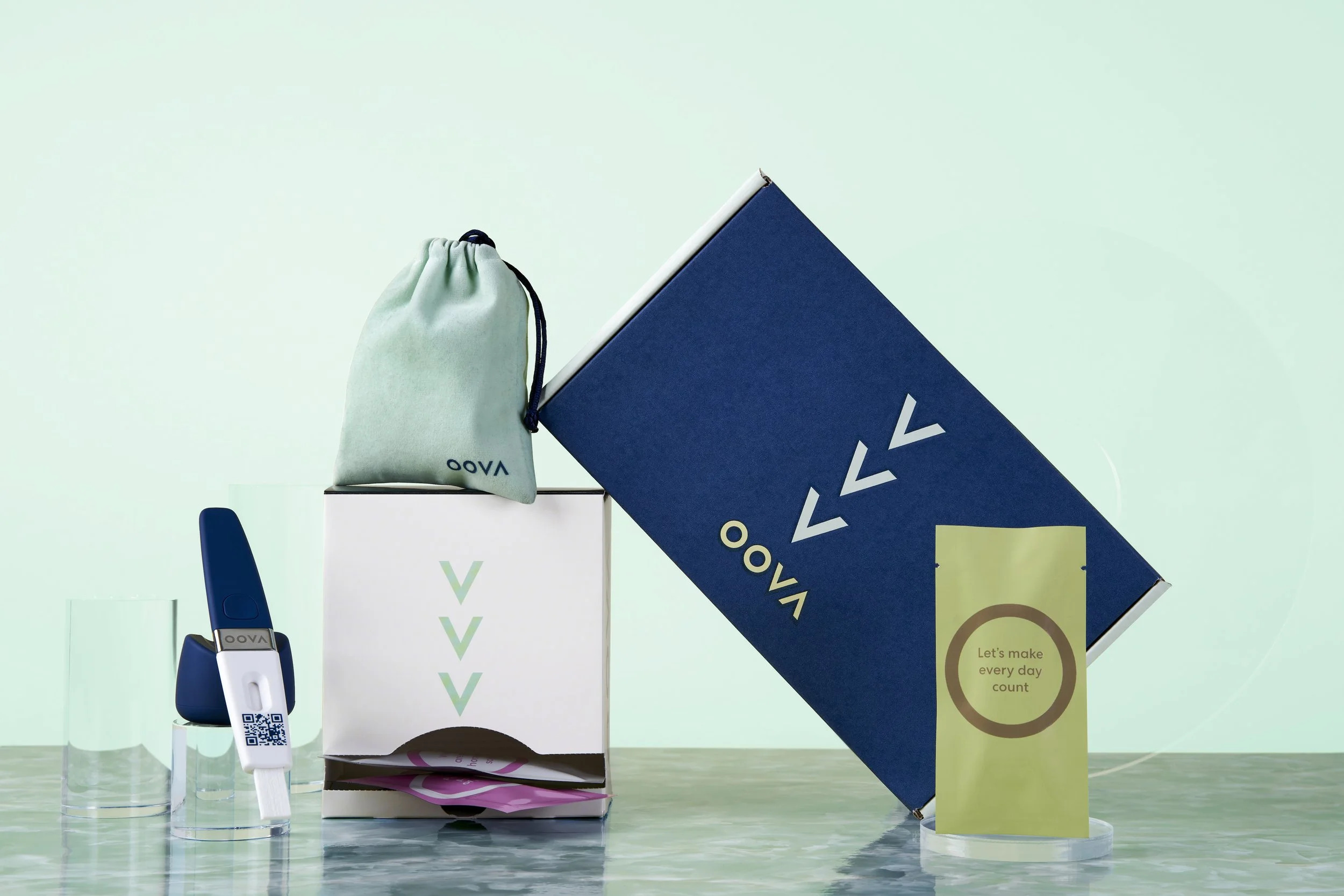
That question followed her into product design. Oova’s system combines a physical test, gold nanoparticles, smartphone image processing, personalized software, and reports designed to travel between a user and a clinician. Each handoff is an opportunity for information to blur. Chemistry has to survive the bathroom counter. A line on a strip has to become pixels. Pixels have to become numbers. Numbers have to become a trend that someone can read without first earning Divaraniya’s degrees.
The translation chain
The company’s technical approach ultimately produced a patent. In March 2026, the United States granted Patent No. 12,591,974 for methods, devices, and systems for detecting analyte levels. Divaraniya and Oova co-founder Jerome Scelza are the named inventors. Patents can be forbidding documents, written in a dialect that makes a toaster sound like a lunar vehicle. This one nevertheless makes the company’s ambition legible: use nanoparticles and image processing to quantify what a paper test reveals, rather than settling for a binary glance.
The discipline of asking for help
There is a useful contradiction in Divaraniya’s public account of herself. She speaks with the conviction required to carry an unfashionable idea through years of doubt, yet she describes humility as one of her operating strengths. She knows her expertise, she says, and is equally aware of the skills she does not possess. The response is practical: ask for advice and surround herself with people who are smarter or more experienced in those areas.
On her desk, she keeps a Post-it bearing the line “A rising tide lifts all ships.” It risks becoming office wallpaper until you notice how closely it matches Oova’s origin. The founding pitch was stronger because its makers did not look alike on paper. Later, Divaraniya reached out to clinicians while she was still a doctoral student, trying to understand what information could be useful on both sides of an appointment. The company grew through the same instinct: expertise should connect, not compete for the last word.
“A rising tide lifts all ships.”Aparna Divaraniya’s desk mantra
Her advice about rejection is similarly unsentimental. Get used to hearing no, she tells early founders. Pull the objection apart. Strengthen the product, revise the position, and try again. She has also offered the necessary companion principle: “If I have to convince you this is a problem, you’re not the right partner for me.” One line encourages learning; the other protects attention. Together they form a decent fundraising compass. Feedback is data, but not every data point deserves equal weight.
A two-week turn
In early 2020, Oova was still preparing a consumer launch while planning to work with clinics later. Then New York City shut down. Care moved away from offices, and clinicians asked whether patients could use Oova from home while sharing results remotely. The company responded by producing a beta clinician dashboard in two weeks.
Speed is often narrated as a kind of founder athletics: sleepless nights, heroic caffeine, a finish-line photograph. The more interesting part of Oova’s sprint is what it changed. The clinician tools moved forward in the plan. A temporary response became evidence about where the product belonged. Divaraniya did not protect the original sequence simply because it was original. She let demand rearrange the roadmap.
The Mount Sinai innovation team wins $10,000 with the blueprint that becomes Oova.
Divaraniya completes her PhD and founds Oova in August.
A clinician dashboard moves from request to beta release in two weeks.
Oova launches its consumer kit and announces a $1.2 million seed round.
A $10.3 million Series A brings investors from healthcare, technology, and consumer businesses.
The underlying detection system receives a US patent, and the platform adds Oura data integration.
By July 2021, Oova had launched its consumer kit and announced a $1.2 million seed round led by BBG Ventures. Two years later came the $10.3 million Series A led by Spero Ventures, with a varied group around the table: US Fertility, Virgin Group, Jefferson Health, Samsung Next’s Q Fund, Connecticut Innovations, and individual investors including Sara Blakely and Hannah Bronfman. The mix mirrored the product. Oova was not purely a laboratory instrument, consumer brand, mobile app, or clinical service. It had to borrow the standards of each.
Recognition followed. The National APIDA Panhellenic Association named Divaraniya its 2019 Professional of the Year. In 2024, Crain’s New York Business included her among 53 Notable Leaders in Health Care. Mount Sinai reported that more than 10,000 people had used Oova, while other public profiles have noted adoption across more than 100 clinics and hospitals. Those numbers are markers, not a conclusion. Building a measurement company means the finish line has the impolite habit of moving whenever the technology improves.
The pattern is the product
Oova has continued to expand what its platform can connect. In 2026, it introduced an integration with Oura, placing sleep and recovery information on the same timeline as Oova’s measurements and user-logged observations. The company also announced a partnership with Mamaya Health. The direction is consistent: collect fewer isolated snapshots and make more relationships visible over time.
This is the data scientist’s worldview turned into company strategy. A single point can be accurate and still be misleading. A pattern gains meaning from sequence, context, and comparison. Divaraniya’s own career makes the same argument. Roche did not disappear when she entered Mount Sinai. Research did not vanish when she entered a pitch contest. The founder did not replace the scientist. Each role became another point in a longer line.
“I didn’t set out to be a founder. I’m a scientist at heart.”Aparna Divaraniya
She has said her aim is to raise the standard so that whatever follows must meet or exceed it. It is a revealing ambition because it makes competitors part of the desired result. The point is not merely to own a category. It is to make the old baseline embarrassing.
The most stealable piece of Divaraniya’s story is therefore not a growth hack or fundraising script. It is a method. Start with a problem precise enough to test. Assemble people who can see different ways the plan might fail. Treat rejection as evidence, not identity. Change the roadmap when reality makes a better argument. And keep the mission stable enough that eight years of revisions still describe the same work.
The woman who avoided business classes ended up building a company in the most scientifically respectable way possible: she kept running the experiment.
Continue exploring