Anurag Byala had opened a training business. Then he had to wait for somebody to join it. A month passed before the first student enrolled. For a founder who had left a corporate job, that interval offered a rather pointed introduction to entrepreneurship: opening the doors and persuading someone to walk through them are separate accomplishments.
The business was Techies, an industrial training institute in Amritsar. By 2015, Byala said it had about 700 students across Amritsar, Gurdaspur and Mohali. Its audience included engineering students seeking practical experience and working software professionals adding skills. The early problem he chose to work on was the distance between having an education and being ready for a job.
“Our first student enrolled after a month of operations.” The sentence is worth keeping beside the later numbers. It gives his career a human starting point: a technical professional with a new venture, waiting for its first sign of life. There is very little grandeur in waiting. There can be quite a lot of instruction.
The engineer who kept a classroom nearby
His technical education included a BTech at Guru Nanak Dev University and study in embedded systems at IIT Bombay. His early professional record includes embedded programming at IIT Bombay in 2010, followed by a project engineering role. In his own account of leaving corporate employment, he identifies Wipro as the employer he left to start his company. Techies Infotech’s founding role is dated April 2012.
Byala describes the training institute and Techies Infotech as separate chapters in his work. That distinction matters. Teaching people to use technology and selling technology services require different kinds of trust. Both put a technically trained founder in the position of having to make his knowledge useful to someone else.
He later returned to formal study at Clermont School of Business, completing a Doctorate in Business Administration. His LinkedIn education entry describes research into consumer behaviour on e-commerce checkout pages in the GCC. After embedded systems and technical training, the subject had become the small decisions a shopper makes before paying. A checkout page is a compact place to study a business: many promises, one final button.
Amritsar was more than an address
In his introduction to Amritsar Founders, Byala presented himself through both his work and his enthusiasms. He wanted to contribute knowledge and ideas to the city’s startup community. He also listed cricket, ebooks and travel among his interests. The result is a more recognisable person than the usual executive biography permits: an engineer, a business owner, a reader, someone who would like a game.
The group placed him alongside other local entrepreneurs, including people working in software, marketing and tourism. His stated reason for joining was to help Amritsar’s startup ecosystem develop. That is a modestly specific aspiration. It has a city attached, and people with whom to work.
The later international story can make Punjab seem like a prologue. His own account gives it more weight. Amritsar supplied an early business, a professional community and a place where he wanted his experience to be useful. Moving into other markets did not erase the fact that he had first learned to build a company there.
The clients changed the question
Byala’s account of 2020 begins with cancelled contracts on a screen in the company’s Indian office. At the time, he says, its main work was digital marketing, including search optimisation, paid campaigns and web development. Clients began asking for help selling online. Their immediate needs were changing the kind of work the business had to deliver.
He describes the resulting shift into e-commerce and digital transformation as the largest pivot in the company’s history. The distinction was operational. A campaign brings people to a business; a commerce platform also has to let them transact. Orders, stock and the systems behind a store become part of the assignment.
In 2021, he moved his base to Dubai. He says the company established itself in Dubai CommerCity and began building platforms for clients in Saudi Arabia, the UAE and Oman. The move gave the new direction a location. It also put him closer to the customers whose requests had helped change the company.
- 2012AmritsarTechies Infotech founding role begins
- 2021DubaiByala moves his base to the Gulf
- 2026South AfricaJohannesburg + Cape Town operations
Showing up in Dubai
When Byala explains why he chose Dubai, he remembers an early Gulf client call about trust. He says brands in the UAE and Saudi Arabia were frustrated by agencies that did not understand how they operated. His response was to treat the region as a place to be present, with a team and relationships, rather than simply an overseas sales opportunity.
He credits Dubai CommerCity with helping the transition. In his telling, the appeal included the pace of business and customers’ expectations of clear, committed partners. These are his reasons for the move, rather than a universal recipe for entering the Gulf. They reveal what he thought the company needed to learn.
The local detail becomes visible in a later project for Muscat Duty Free. Techies Infotech’s launch account describes replacing an ageing Magento-based website, redesigning the shopping experience and connecting it with enterprise resource planning systems. The scope included stock and order synchronisation, guest checkout and switching between three stores. An airport shop has enough moving parts before anybody starts discussing the software.
A checkout, a launch, and the cake
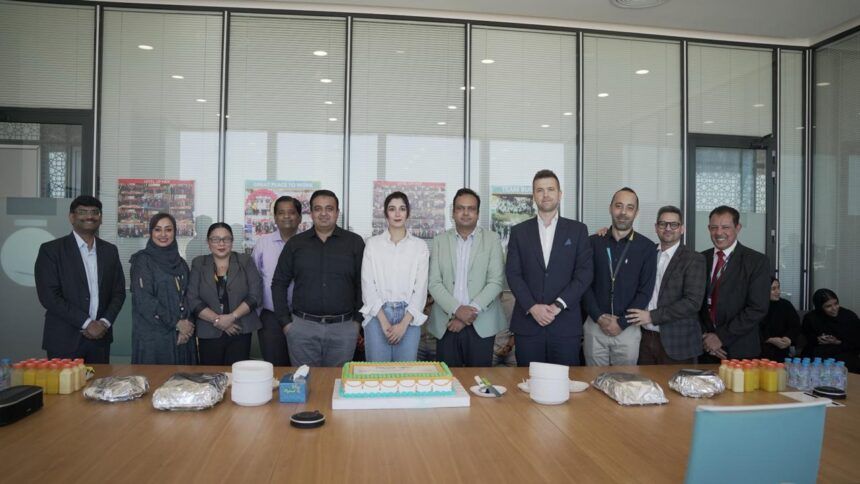
The Muscat platform launched in December 2025. The company says the redesign, migration, replatforming and ERP integration took three months. That is a delivery claim from the business itself, and the useful detail is the combination of tasks: the shop window and the machinery behind it had to move together.
The launch photograph records a team gathered around a table at Muscat Duty Free, with a cake in front of them. It is a pleasingly ordinary endpoint for a complicated technical assignment. The celebratory object requires no systems integration at all.
The practical emphasis also turns up in Byala’s conversations with other commerce professionals. His podcast guest Lina Gallagher described discussing slow or confusing shopping experiences, unnecessary requests for information at checkout, and the reassurance GCC shoppers need. Her account of their discussion centres on removing obstacles between a customer and a purchase. It is a useful companion to the work his company sells.
The host was nervous, too
Let’s Talk eCommerce began as an initiative from the marketing team led by chief marketing officer Deepak Kumar. Byala became its host, though he says being on camera was unfamiliar and uncomfortable. He remembers feeling nervous before recording his first podcast with Adriano Silva of VTEX. Expertise in the subject did not automatically supply ease in front of the lens.
“Facing the camera was not natural for me.” By May 2026, he was celebrating the channel reaching 10,000 subscribers. He credited the guests, viewers and production support, describing the conversations as a way of learning about commerce, technology and leadership. The milestone was his reported count at that moment, rather than a permanent measure of the audience.
The conversation with Silva covered preparation for the 2025 holiday season, connected commerce and the following year’s retail trends. Other guests brought their own operating experience. Hosting gave Byala another kind of classroom: he could ask the questions, leave room for someone else’s expertise and learn in public. For a former training founder, it was a familiar activity with a less familiar piece of equipment.
“Facing the camera was not natural for me.”Anurag Byala, reflecting on starting his podcast
A sceptic with AI in the brochure
Byala’s business offers AI services. He has also criticised the pressure to attach the label to products regardless of what it contributes. In a discussion of the Gulf’s startup economy, he described AI becoming a “designer label” that signals relevance. His objection concerned the incentive to repackage existing features for attention.
That position gives his public persona some useful friction. A technology executive has commercial reasons to talk about new tools. Byala has also argued that the language around those tools can outrun their value. Customers are entitled to ask where, precisely, the improvement appears.
His own continuing education offers another view of his priorities. In a Teachers’ Day reflection after completing his DBA, he connected the training institute, his business and mentoring younger entrepreneurs. He thanked teachers for shaping how he learned and said he wanted to pass knowledge on. The recurring ambition is to help other people build something of their own.
The next beginning has two South African cities
In August 2026, Techies Infotech’s expansion into South Africa became concrete: a registered local entity, a Johannesburg head office and an engineering delivery centre in Cape Town. The company had participated in a Dubai Chamber of Commerce trade mission in June. Local partnerships and memorandums of understanding followed, alongside senior appointments on the ground.
Byala credits the chamber’s help with accelerating the move. His stated ambition combines enterprise technology work with training South Africans and creating local jobs. Plans for the following three years include growing the delivery team and exploring neighbouring markets. Those remain plans, with the work of establishing the new operation still ahead.
There is a small personal footnote to all this movement. After his first trek in Himachal Pradesh, which he wrote about in December 2021, Byala compared the experience with entrepreneurship. He dwelt on preparing, beginning, being patient and wanting to attempt a larger peak. He had gone travelling and returned with business lessons. Some people bring back a fridge magnet. Byala apparently brings back a syllabus.
The first student, the new city and the first recording all asked him to do something before he could be sure of doing it well. Now there are two South African cities on the map. The scale has changed. There is still a beginning to get through.