The truck arrives. The tank has plenty left. A little fuel goes in, a delivery ticket comes out, and everyone can feel reassured. The customer will not run dry. The driver has completed a stop. The supplier has kept a promise. There is just one awkward question: why did the truck need to come today?
- Anova connects industrial tanks and equipment to cloud software.
- Distributors use the readings to time deliveries, spot problems and plan routes.
- River Valley Coop reports 50% fewer deliveries to monitored cylinder fuel stations.
- The savings require people to change the operation after the sensor goes on.
The expensive reassurance of a full tank
Anova works in the gap between keeping a customer supplied and visiting that customer too often. Its customers distribute industrial gases, propane, chemicals, fuels and lubricants. They have inventory scattered across other people’s premises. Knowing what remains in those tanks is a practical advantage when the next decision involves a driver, a vehicle and a day’s route.
Consider River Valley Coop. In a testimonial published by Anova, the cooperative says it installed monitors on cylinder fuel stations and cut deliveries to those tanks by 50%. Previously, someone went every week to check and top them off. With monitoring, visits became roughly fortnightly.
“Now we go about every other week.”
River Valley Coop · Anova-published customer testimonial
The achievement is pleasingly uncinematic. No truck becomes faster. No tank grows bigger. Information makes an existing journey unnecessary. A weekly habit had been doing two jobs: finding out how much fuel remained and delivering more. Monitoring lets the supplier separate them.
A quieter truck yard can be a useful result. But fewer deliveries must still mean reliable supply. The work is to distinguish a tank that can wait from one that cannot, early enough for the dispatcher to do something about it.
A reading becomes a route
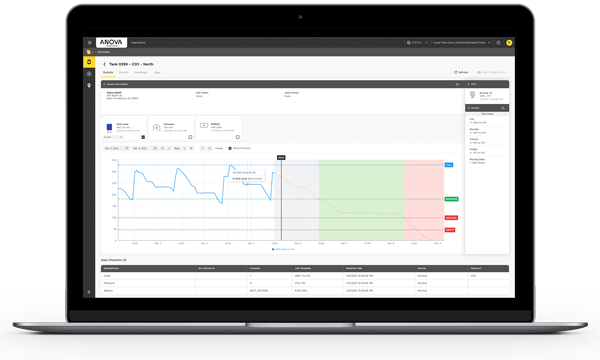
Anova’s equipment captures measurements such as tank level, pressure and temperature. Communications carry those readings to its cloud platform. Software supplies alerts, history, forecasts and tools for scheduling and routing. The customer buys a chain of capabilities, with installation and support available alongside it.

Its Universal Tank Monitor is a useful example of what industrial technology looks like once the adjectives have been stripped away. It accepts several sensor inputs, uses clip-in cables and can monitor more than one tank or input. Anova lists a universal cellular SIM, intrinsically safe construction and a five-year warranty. These are features for equipment that has to spend its working life outside, beside the thing it measures.
The product page also lists half-hourly sampling and daily reporting. That distinction matters. A device can take readings more often than it transmits them. Buyers should match the reporting configuration to the pace of their operation, rather than assume that a connected tank produces a continuous stream.
- 01 / MeasureLevel, pressure, temperature
- 02 / ConnectA suitable communications link
- 03 / InterpretHistory, forecasts, alerts
- 04 / DispatchChoose the next useful stop
Transcend, Anova’s industrial telemetry platform, extends the picture beyond tanks to vaporizers, pipelines, programmable controllers and other advanced systems. A distributor can see several kinds of operating data together. Anova also offers Unify and the Go mobile app; the December 2025 update added mobile fuels and lubricants tank setup and support for radar sensors.
The sensor cannot retire the truck
The most revealing part of Anova’s proposition is its willingness to discuss what happens after installation. Its Transform offering combines analytics with operational advice. The process examines delivery history, district and customer profitability, optimization strategy, operations alignment and change management. This is considerably less glamorous than counting connected devices. It is also closer to the money.
In its explanation of Transform, Anova argues that reaching a target of 60% average fill takes more than deploying monitors. Strategy, logistics and IT need to work toward the same objective. Staff must participate, systems must exchange information, and management must turn spare capacity into an actual operating change. A truck still on the payroll does not vanish because a dashboard looks encouraging.
Eastern Propane & Oil provides a bounded example: its CTO, Chuck Clement IV, credits Anova and the Transform process with reaching 57% average fill on monitored tanks. That reported result and Anova’s 60% target are different things. Neither is a promised outcome for the next customer.
Average fill on monitored tanks, reported by Eastern Propane & Oil. A customer result, rather than a universal benchmark.
Cost belongs in the same conversation. Anova sells hardware and offers Hardware-as-a-Service subscriptions. Its HaaS materials describe bundles including hardware, software, communications, hosting, support and upgrades. A buyer comparing offers needs the whole deployment bill, including installation, rather than just the price of a box.
A useful calculation is deliberately plain: the value of avoided visits and improved deliveries, less the full monitoring cost. An illustration, not an Anova price quote: removing ten visits worth $100 each creates $1,000 of gross avoided expense. Monitoring only produces a net gain if its costs and the expense that remains leave something over. Fleet size, labor commitments and route geography decide how much of a paper saving becomes cash.
The customer gets a window, too
Inventory visibility can travel in the other direction. MyTankApp lets distributors give customers a branded view of tank levels, history and notifications, with ordering and service requests. The supplier’s name stays on the relationship, while Anova supplies the technology behind it.
In a 2020 case study, Deckman Oil supplied monitoring and the app to TNT Express Lube, a two-location Buffalo business. Managers checked lubricant readings; the owner could compare inventory with counter software. During the pandemic, the same visibility helped him manage fills without visiting each location. Deckman reported larger fills and less frequent stops. It also described a customer who valued the app enough to make the supplier relationship stronger.
This is a second reason to buy telemetry. Better dispatch helps the distributor. Better visibility helps the customer manage a business. A delivery can become a service the customer understands, instead of an interruption whose timing is mysterious.
Thirty-seven years behind a small box
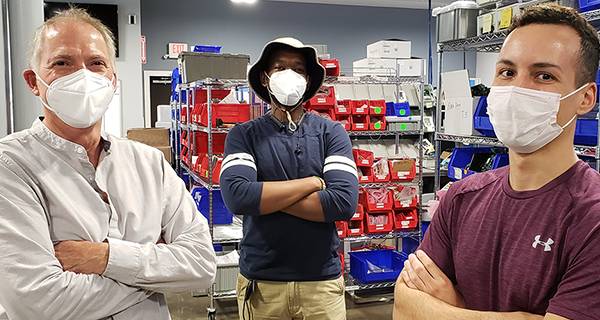
Martin Adams and Robert Barnacle founded DataOnline in 1989. The Anova identity arrived in April 2019, bringing together DataOnline, WESROC, Wikon and iTank; Portugal-based Intelligent Sensing Anywhere joined later that year. That history helps explain a company selling both devices and the accumulated knowledge of deploying them.
Matthew Toone became CEO in July 2022, succeeding Chet Reshamwala. Anova received the 2023 IoT Analytics Platform of the Year award from IoT Breakthrough. By January 2026, the company reported more than 1.8 million monitored assets, over 2,000 customers and operations spanning more than 80 countries.
That January, Aurora Capital Partners acquired Anova from FFL Partners. The transaction closed on January 20. Anova’s announcement kept Toone at the helm and identified product innovation, international expansion and growth into additional markets and technologies as priorities.
Anova occupies the industrial telemetry market, where buyers need equipment and software to cooperate in the field. SkyBitz SmartTank offers a direct alternative with monitoring hardware and cloud tools. Anova’s case rests on its range of applications, communications options, international deployment experience and operational services. Those are useful criteria to test against a particular fleet; they do not make the buying decision on their own.
Start with the stops you regret
The transferable idea is to begin with delivery history. Find the accounts where small drops, uncertain demand or awkward journeys make guesswork expensive. Check sensing and connectivity at those sites. Establish a baseline, put monitoring into the dispatch workflow, and measure whether trips, delivery sizes and service outcomes change.
Give someone responsibility for responding to alerts. Choose a reporting cadence that fits consumption. Keep the back-office data usable. In December 2025, Anova added consumption exports to Transcend after customer requests, particularly from chemicals users. Even in a connected operation, information sometimes has to leave the platform to become useful elsewhere.
If routes stay fixed, readings arrive too late or the avoided expense is small, the economics can disappoint. The lesson is narrower and more useful than “connect everything”: measure something whose measurement can change what you do. A tank may need another delivery. It rarely needs another visit just to establish that fact.
Follow the readings
Anova website · News and product updates · Company blog