Early in his career at McKinsey, Anil Kaul completed an analysis to test a hypothesis and took the results to his manager. The reply was an education. There was a simpler way to reach a sufficiently good answer. For a quantitative researcher, that is a useful little humiliation: the mathematics can be perfectly respectable while the method makes everyone work harder than necessary.
Kaul would later describe the lesson in five words: “simplicity always wins over complexity.” His recollections of that first job include another adjustment. After orientation, he asked when the office opened for work. A senior colleague explained that there was no prescribed start or finish. Until a project arrived, he could decide how to use his time. The newly minted PhD had acquired discretion before he had quite worked out its operating instructions.
He also organised Saturday brunches that included colleagues’ spouses. Sometimes there was a potluck; sometimes a restaurant. The gatherings became a place to arrange holidays, parties and sport. Among the models and client work, he had found a fairly dependable piece of organisational technology: people enjoying a meal together. No implementation manual required.
When AI came with a waiting list
Before the consulting office came Cornell. Kaul studied there from 1991 to 1995, earning graduate qualifications in marketing. During his doctoral years he experimented with neural networks, at a time when access to the necessary computing power had to be arranged well in advance. He has recalled booking supercomputer time weeks ahead for an hour in which to run his models. Today’s instant answer once required an appointment.
His academic interests were rooted in how people buy. In 1995, he and Dick R. Wittink published research examining advertising, price sensitivity and pricing. Their review distinguished advertising that foregrounded price from advertising that emphasised something else. The distinction mattered because different kinds of messages could be associated with different responses to price. A customer was already more complicated than a row in a spreadsheet.
At McKinsey, he also tried genetic algorithms to optimise large spreadsheet models, but the available computing power proved inadequate. The idea had arrived before the machinery could comfortably carry it. That early mismatch gives his later AI career a longer perspective: he had encountered the practical limits of the technology well before its conversational party tricks became familiar.
- 1991-95Cornell
Marketing & neural networks - 2001Absolutdata
Three co-founders - 2020Infogain
Acquisition announced - 2024Agent Mira
A new venture in Miami
The founder changes his own job
Kaul worked at McKinsey and Personify before co-founding Absolutdata in 2001 with Sudeshna Datta and Suhale Kapoor. Datta was also his wife. Their ambition to build a company had begun while they were students. Entrepreneurship, in his account, offered the freedom to create and the responsibility for how things turned out. The appeal included having nobody else to blame.
The early company did not grow as quickly as he wanted. Looking back in 2010, he identified two mistakes: the business model and his own role. He had been absorbed in operations when the business needed him to concentrate on building the company. They changed the model; he changed his work. It is a revealing admission from someone whose product was better judgment. The founder’s judgment needed revision too.
By that account, the organisation had grown from three people to 150. The number tells only part of the story. A business that can fit around one conversation eventually needs different habits, different responsibilities and a founder prepared to give up some familiar tasks. Kaul’s explanation of the change puts that uncomfortable adjustment near the centre of the growth story.
“simplicity always wins over complexity”
Anil Kaul, reflecting on an early management lesson
The customer who leaves without leaving
Consider the kind of problem Absolutdata took on. A customer renews a contract or maintains the same spending. The dashboard looks reassuring. Meanwhile, every extra purchase goes to a competitor. The relationship continues on paper while the opportunity quietly moves elsewhere. Kaul discussed this as silent customer churn: a loss that does not announce itself with a cancellation.
The analytical challenge is to notice behaviour that a renewal number conceals. A customer can remain on the books and still be drifting away. That makes prediction useful only when it changes what the business does next. Which relationship needs attention? Where should a salesperson spend time? A plausible explanation becomes commercially interesting when somebody can act on it.
Absolutdata called its approach decision engineering. The phrase gave the work a practical destination. By the middle of the 2010s, the company was also working with GoodData to distribute predictive and advanced analytics through its platform. That partnership addressed another obstacle: information scattered across different systems. Bringing the data together and getting the resulting intelligence to users were part of the same job.
A weekly plan beats another presentation
The NAVIK products made this concern tangible. SalesAI offered salespeople customised weekly plans, including which opportunities to prioritise and how to approach customers. MarketingAI dealt with personalised marketing decisions. ResearchAI aimed to make market research reusable and accessible across a business. The products translated analytical capability into recognisable pieces of somebody’s working week.
Kaul’s enthusiasm came with some caveats. In 2018, he discussed data quality, bias, accountability, privacy, skills and adoption as obstacles to using AI. A system can inherit the limitations of its training information. An organisation can also buy technology without equipping people to use it. The sale of a tool and its successful use are separate events, however conveniently a sales forecast might place them together.
He was also thinking about ordinary questions inside his own company. Absolutdata built a chatbot to answer employees’ queries about policies and administrative processes. Asking about a tax form or leave procedure is less theatrical than demonstrating an algorithm. It is also an excellent test of whether a system has understood its assignment: help a person finish a task and get on with the day.
Research that survives the slide deck
In his 2019 writing, Kaul argued for research that could be used again, rather than stranded inside a single project. One example involved a Middle Eastern dairy business that wanted employees to find answers in accumulated studies. The work required collecting and organising the material, then making it accessible through natural language questions. The apparently effortless answer depended on rather effortful preparation.
He described another project involving a beverage company with more than 500,000 outlets. Internal and external information fed recommendations about sales opportunities and product mix. The scale is striking, but the essential unit remained a decision about a particular outlet. That is the recurring shape of his work: many inputs, a specific recommendation, and a person who needs to use it.
His argument also left room for researchers’ imagination and judgment. Algorithms could handle repetitive work while people interpreted results and found useful stories in the data. The division of labour was the point. Business context still had to enter the system, and someone still had to decide whether an answer made sense in the world beyond it.
The acquisition was a junction
Infogain announced its acquisition of Absolutdata on December 24, 2020. The combination brought the analytics business together with a larger organisation’s engineering, cloud, strategy and experience capabilities. NAVIK became part of Infogain’s offering. For clients, the proposition was that analysis and the infrastructure needed to implement it could be delivered together.
The transaction covered the entire equity stake in the Absolutdata group. Its legal structure involved businesses across several countries, a reminder that a company founded by three people eventually accumulates a considerable amount of corporate plumbing. Kaul and his fellow founders joined Infogain. In 2021, he announced that he was taking on the chief AI officer role alongside his Absolutdata responsibilities.
The appointment brought an old interest into a broader job. He recalled his early neural-network experiments and the limits of computing at McKinsey, then described work on machine learning for a mining company’s large Internet of Things database in 2014. The vocabulary had changed over the years. The question of what a model could usefully accomplish had stayed with him.
A new set of keys in Miami
In March 2024, Kaul announced his departure after more than three years at Infogain. Later that year he introduced Agent Mira, beginning in Miami. The new venture brought AI into residential real estate, with an initial emphasis on helping buyers navigate the search and offer process. He had moved from decisions inside large companies to decisions attached to a front door.
His fellow founders included Gladys Margarita Diaz-Jourdain and Rajat Narang. The founding team combined real estate and design experience with analytics and technology. At launch, Agent Mira described a flat success fee and AI tools intended to help buyers evaluate homes and offers. Those were the venture’s stated propositions, with the practical ambition of giving buyers clearer information at moments when choices become expensive.
By 2026, Kaul’s public discussion of Agent Mira focused increasingly on an AI teammate for agents and brokers, working through phone, text and email. His March article was titled “From ‘Help me understand’ to ‘Help me get it done’.” The phrasing neatly captured the distance between receiving an explanation and completing the work that follows. In this chapter, the interface itself had become part of the problem he was trying to solve.
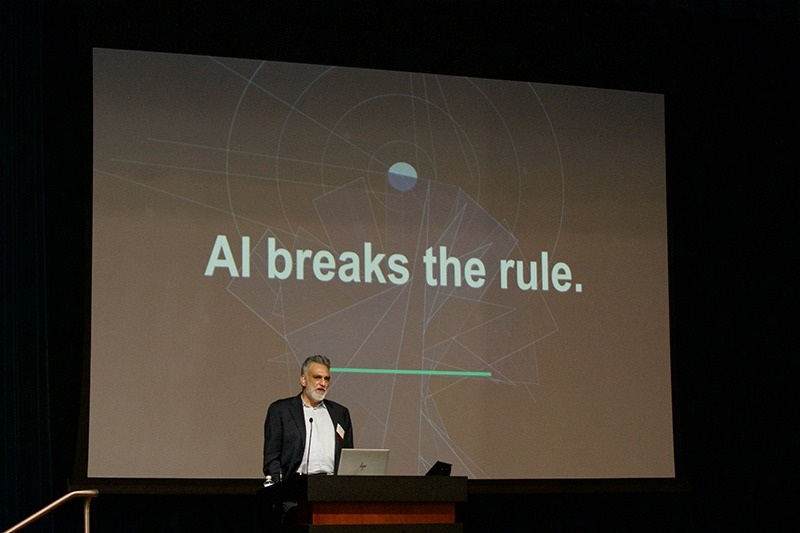
Still taking the longer way uphill
On May 12, 2026, Kaul spoke at the Worcester Economic Club’s annual meeting about AI’s effects on work, organisations and the economy. The photograph from the evening shows him beneath a slide reading “AI breaks the rule.” After years of explaining how companies might use the technology, he was still making the case in a room full of people.
Away from that room, he has a well-documented affection for hiking. His earlier biographies describe Mount Whitney and a climb to roughly 20,000 feet in Ladakh. When he announced his departure from Infogain, he reached for the language of a fresh ascent. It suited someone who had already made a habit of choosing demanding terrain.
There is an appealing complication in this portrait. Kaul likes a hard climb, yet keeps trying to make other people’s work easier. The manager’s lesson at McKinsey, the founder revising his own job, the weekly sales plan and the real estate assistant all belong in that tension. He can enjoy the difficult route himself. The customer should be allowed a simpler one.
Follow the next decision
Explore Kaul’s work, writing and conversations.
- Agent Mira
- Anil Kaul on LinkedIn
- Anil Kaul on Twitter / X
- Watch: HumansBehindAI conversation with Puneet Shivam
- Listen: My Journey to AbsolutData, NITKAAST
- Read: Kaul on reusable market research
- Interview: early lessons in entrepreneurship
- News: the Infogain acquisition
- May 2026: Worcester Economic Club appearance