At dinner in 2001, Anil Aggarwal brought home a piece of Silicon Valley gossip. A company called Google, he told his wife Benu, was growing at a startling rate. She had an answer ready: she was already taking classes on how to market hotels online. It was a domestic exchange with the tidy hindsight of a founding myth, except neither spouse was starting from mythic material. Anil was immersed in semiconductors. Benu was building a practical marketing business for hotel owners. Between the curry and the quarterly growth figure sat a question that would redirect his career: could the machinery of discovery become a business?
Aggarwal's first professional language was electrical engineering. He earned his bachelor's degree at the Indian Institute of Technology Bombay, followed it with a master's in electrical engineering at the University of Hawaii, then added an MBA at the University of Georgia. The sequence matters. He did not abandon one discipline for another so much as stack them: systems, then markets, then management. In business school in 1993, he started an entrepreneurship club and a small tutoring operation. His recollection gives the venture a cheerfully unvarnished motive - students could make some beer money. The entrepreneurial instinct arrived before the executive vocabulary.
The chip before the click
His first consequential company, Zeevo, attacked a physical constraint. Bluetooth hardware was too large and technically awkward for the devices designers wanted to build. Digital and analog functions had to coexist in a compact system. Zeevo developed semiconductor and software solutions for wireless audio products, including stereo headsets, and became one of the early companies to squeeze that capability toward thumbnail scale. Aggarwal co-founded the Santa Clara business and led it through the unforgiving choreography of a chip startup: research, product decisions, manufacturing realities, customers, capital, and timing.
Broadcom completed its acquisition of Zeevo in March 2005. The announced deal was worth roughly $32 million, most of it cash, and absorbed a company of about 50 people. This is the sort of exit that can provide a neat full stop to a founder's biography. Aggarwal used it as a semicolon. By then, Benu's hotel-marketing operation had customers, a waiting list, and evidence that its work produced measurable returns. He later recalled walking into a meeting with roughly 20 executives and potential clients and hearing that her programs returned $47 for every dollar a client spent. The engineer noticed a system ready to scale.
A one-year business date
Joining Milestone introduced a different kind of engineering problem. It also introduced the delicate prospect of working with his spouse. Anil and Benu gave the arrangement a name that sounds both romantic and suspiciously well-governed: a business date. They would try it for a year. They wanted to know whether the company could become more than customized work, and whether two people with a good marriage could share an operating life without getting on each other's nerves. Anil could still return to wireless consulting if the experiment failed.
It did not fail. Benu remained Milestone's founder and president, with deep command of search, product, and hospitality. Anil became CEO, bringing management, product-marketing, and sales experience. Their roles were complementary without being ornamental. The pair also co-authored From Hotels to HTMLs in 2010, a guide to internet marketing for the lodging industry that found its way into hotel companies and hospitality classrooms. A business date became a durable division of labor, then a book, then a company spanning software and services.
That line contains his preferred management method. Aggarwal talks about leadership as the work of creating understanding: ask for input, draw the picture, connect a person's task to its effect on the company, and tolerate the uncomfortable conversation required to get there. He believes most people want to do good work. Confusion is therefore not a character verdict; it is a design flaw in the way a goal has been communicated. The old engineer is visible here. If the output is wrong, inspect the system before blaming the component.
He is equally direct about the system's non-negotiables. In his account, innovation keeps ambitious people from becoming bored, empathy allows them to contribute, and integrity makes the whole arrangement possible. He has said he has zero tolerance for compromises on trust. Yet his definition of success leaves room for different lives. One employee may want upward mobility; another may want to do excellent work between nine and five and be home with family. A leader can demand quality without drafting everyone into the same ambition.
Teaching hotels to be found
In 2007, Aggarwal stood before hotel owners at the AAHOA convention with advice that now sounds obvious only because the industry eventually absorbed it. Travelers were moving online. Search engines were gateways. Hotels needed authentic local information, pages devoted to the reasons people visited a destination, and a sensible combination of organic and paid placement. Getting found was not merely a marketing flourish; it was part of bringing demand home instead of surrendering it to an intermediary.
Milestone widened that playbook. The company moved through websites, content management, local listings, reviews, analytics, schema, personalization, paid media, and digital experience software. Aggarwal became a frequent speaker and writer, translating technical search mechanics into the language of customer acquisition. In 2012, HSMAI named him among its Top 25 Extraordinary Minds in hospitality sales and marketing. In 2017, Owler placed him among 1,000 top-rated Silicon Valley CEOs after examining a pool of 167,000 executives. The awards are useful markers, though the more revealing continuity is his appetite for the next technical layer.
Search without the search box
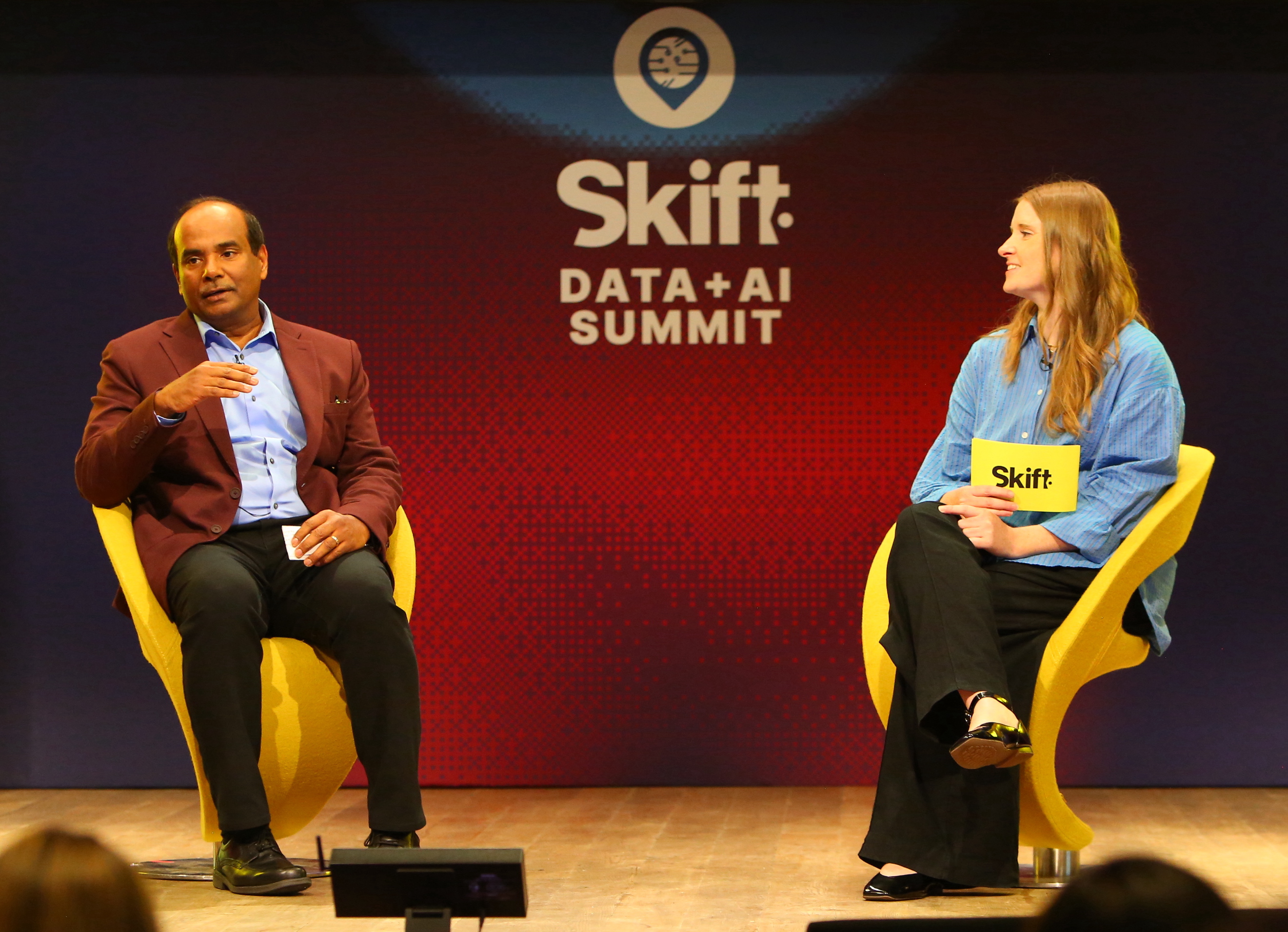
The next layer is AI discovery. At the Skift Data + AI Summit in June 2026, Aggarwal framed the hotel website as part of a larger machine-readable supply chain. A property can publish handsome, useful material and still disappear from an AI answer if crawlers cannot access it, the site is slow, or its schema leaves key facts ambiguous. Content matters, but only after the technical gate opens. His phrase for the adoption curve was blunt: “It's a one-way train. It's not reversing, it's not slowing down.”
He described a guest journey splitting three ways. Some travelers still click through to a website. Others discover and decide inside a large language model. A third path lets an agent take steps on the traveler's behalf. Each route makes different demands on a hotel's information. Milestone's current vocabulary - GEO-first content management, AI visibility intelligence, conversational agents, schema, personalization - may sound far from Bluetooth silicon. Structurally, it is familiar territory. Different systems must communicate, errors multiply at scale, and a compact interface hides considerable complexity.
The guest journey has forked
His proposed response is deliberately operational: measure where a brand appears for relevant prompts, find gaps, create material that closes them, add structured data, publish consistently, and repeat. In a July 2026 guide, he turned that into a 90-day loop for hotels. The plan also reflects a conviction visible across his career: a good strategy needs a process that ordinary teams can run. Inspiration is pleasant. A deployment schedule is billable.
The hospitality focus is not incidental. Aggarwal has spent two decades in the sector and talks about travel with an affection that exceeds market sizing. Hotels, in his telling, help make people's imagined trips real. Technology serves that moment, not the other way around. This may be why he keeps returning to discovery. Before a guest experiences a lobby, a room, or a neighborhood, someone - now sometimes something - must understand what the property is and why it fits.
The transferable lesson
Aggarwal credits his mother with a compact piece of advice during his transition away from engineering: excellence in one field can carry into another if the commitment travels with it. He had been comfortable with technical research and less certain about management in a new country and business environment. Her confidence gave him permission to treat learning as transferable. His own study habit follows the same logic. He reads as if he will have to stand up, explain the subject, and draw it. Imagined teaching exposes the fog that passive reading politely conceals.
This helps explain why “chief storyteller” appears alongside CEO and head of sales in his Milestone speaker profile. Storytelling, for him, is not decorative polish applied after the engineering. It is the test of whether the engineering has been understood. Can the founder explain the system to a customer? Can the manager connect a role to an outcome? Can a hotel describe itself so a traveler wants to visit and a machine can retrieve the right fact?
In 2026 he joined the newly formed AI Hospitality Alliance as a founding partner and advisory-board member, placing Milestone among hotel operators, cloud companies, academics, and travel-technology firms trying to build shared approaches to AI. It fits his stated preference for ecosystems over heroic self-sufficiency. Smart people can become attached to doing everything in-house, he has warned. The better move is to understand which partners, vendors, and colleagues make the combined result larger.
There is no need to force a grand reinvention onto Aggarwal's career. The smaller pattern is better. A palm-sized technical problem became a chip. A one-woman hotel-marketing practice became a platform and services company. A list of webpages became structured information for machines that answer in sentences. Each chapter begins with complexity and ends, when it works, with something another person can use.