Before Andrew Sullivan had a corner office, he served aboard a nuclear submarine. He graduated from the United States Naval Academy, studied mechanical engineering and earned a Navy and Marine Corps Achievement Medal for his leadership and performance on the USS Nebraska. It is an unusual opening chapter for an insurance executive. It also gives a useful starting point for understanding the question that follows him into Prudential: what does being responsible for a complicated institution actually require?
By October 2026, that question had acquired a very large price tag. Prudential had agreed to sell its businesses in Brazil and Mexico for $4.025 billion in cash, subject to adjustments. Sullivan, its chairman and chief executive, was narrowing the company’s geographic reach to concentrate its resources. The agreement was signed; completion was expected in the second half of 2027, subject to approvals and other conditions. Changing course, in this business, comes with considerable paperwork.
The sailor had become a custodian of promises stretching across decades. His task was to decide which businesses belonged together, which should have another owner and how to make the remaining company work better. There is a human story inside those corporate verbs. Sullivan had spent years learning the institution from within. Now he was asking it to change.
An engineer learns about followership
Sullivan belongs to the Naval Academy’s class of 1992. His education paired the technical demands of mechanical engineering with an institution explicitly concerned with developing leaders. Later, he would add an executive MBA from the University of Delaware. Engineering, military service and business school make a fairly orderly sequence on a résumé. The more revealing detail is the word he uses when he talks about leadership: followership.
Reflecting on his Academy years in 2026, he wrote that he had learned leadership was about “accountability, integrity, and developing followership.” The phrase puts some weight on the people being led. A title can establish who approves an expense. Getting people to trust a decision is a separate undertaking. Sullivan explicitly connected those early lessons to the standard he still applied after becoming a chief executive.
Accountability, integrity,
Andrew Sullivan · On lessons from the Naval Academy
and developing followership.
He discussed those years on the Sing Second alumni podcast, an appearance that also returned to his Delaware origins and his vision for Prudential. His accompanying LinkedIn post ended with an uncomplicated expression of school loyalty: Go Navy. Corporate language tends to sand away such affiliations. Here was something recognizably personal, surviving several promotions and a considerable increase in meeting invitations.
The long apprenticeship inside the Rock
Sullivan’s civilian career passed through DaimlerChrysler and Diamond Technology Partners, then senior leadership roles at Cigna and CareFirst BlueCross BlueShield. He arrived at Prudential in 2011. The path matters because the eventual chief executive came with experience beyond the institution he would lead. He had worked across different organizations before learning Prudential’s own operating habits, customer relationships and layers of responsibility.
At Prudential, his responsibilities included the Group Insurance underwriting, claims and service organizations. He became president of Group Insurance and also led Workplace Solutions. Those jobs sit close to the machinery that makes an insurance company useful: evaluating commitments, administering them and serving the people who depend on them. Much of that work is unlikely to produce a glamorous photograph. Customers tend to notice when it goes wrong.
From December 2019 through December 2022, he headed Prudential’s U.S. businesses. In January 2023, his remit moved to international businesses and global investment management. That brought international insurance and PGIM, the company’s investment management arm, under his oversight. By the time the chief executive position opened, his experience crossed both sides of the company’s central proposition: making financial commitments and managing investments.
- 2011Joins Prudential
Insurance operations - 2019U.S. businesses
Beginning in December - 2023International + PGIM
Beginning in January - 2025Chief executive
Effective March 31
This was an apprenticeship measured in expanding responsibilities. A leader who has worked through service operations, domestic businesses and international markets has encountered different versions of the same problem. What looks efficient from one desk may look cumbersome from another. Sullivan’s eventual emphasis on simplification would have to survive contact with those desks, and with the people sitting behind them.
A birthday, a handover, a very long horizon
Prudential announced Sullivan’s selection on December 3, 2024, with the handover set for March 31, 2025. He succeeded Charles Lowrey as the company approached its 150th anniversary. Lowrey initially remained executive chairman to support the transition. In March 2026, Sullivan also became chairman, while Michael Todman continued as lead independent director. A succession that began with two senior roles separated had brought them together again.
On his first day as chief executive, Sullivan described a company that makes and keeps promises lasting a lifetime. The language fit the institution’s anniversary, but it also captured a practical constraint. Insurance and retirement businesses ask customers to believe that an organization will still be dependable years after the original conversation. A new chief executive inherits those earlier conversations along with the current balance sheet.
His aspiration therefore carried two different clocks. He wanted better execution and clearer decisions in the present. He also had to preserve an institution’s capacity to honor obligations far into the future. An anniversary is excellent at producing commemorative material. It is less helpful at deciding which reporting line should disappear on Monday morning.
The retirement question after the saving years
At the Milken Institute Global Conference in May 2025, Sullivan spoke with Bloomberg about the meeting of insurance and asset management. He pointed to a gap in the retirement conversation: substantial attention had gone into accumulating savings, with less devoted to helping people turn those savings into protected income. It was a business opportunity expressed through a familiar household concern. Eventually, money that has been saved must do some spending.
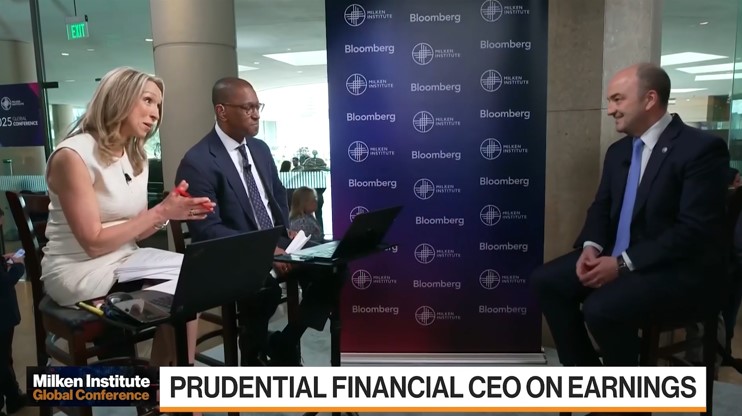
That concern helps explain why his earlier responsibilities are relevant to his present role. Investment management concerns how assets are invested. Insurance and retirement products can involve commitments about future payments. Sullivan’s argument placed these capabilities in the same discussion. A retirement customer needs an answer that can be understood across the kitchen table, even when the organization providing it has several divisions and a vocabulary worthy of its own dictionary.
The idea gives his strategy a personal point of focus. His public discussions return to retirement security, execution and the relationship between the company’s businesses. These are operating questions with consequences for ordinary financial lives. The work of the chief executive is to make the organization behind the answer coherent enough to deliver it.
Simpler is a decision with consequences
In December 2025, Prudential changed its leadership structure so that the heads of U.S. businesses, emerging markets, its Japan group and PGIM reported to Sullivan. Phil Waldeck became head of U.S. businesses. In his first shareholder letter as chairman and chief executive, Sullivan described priorities of evolving the strategy, improving execution and building a performance-driven culture. The language was familiar; the changed reporting lines made it possible to see where responsibility would land.
By September 2026, Prudential had announced agreements to sell its stake in South Africa’s Alexforbes for approximately $185 million in aggregate. The transactions were expected to close in the first half of 2027, subject to conditions. October brought the larger Brazil and Mexico agreement. Together, these announced transactions gave substance to the decision to leave emerging markets and concentrate capital and management attention elsewhere.
There is an interesting reversal in Sullivan’s trajectory. Before becoming chief executive, he oversaw international businesses. As chief executive, he was choosing a smaller geographic footprint. Experience in a business does not oblige a leader to keep every part of it. It does, however, make the decision more revealing. The professional who had managed the portfolio was now responsible for deciding its boundaries.
Agreed cash purchase price for Prudential’s Brazil and Mexico businesses, subject to adjustments.
Accountability meets a difficult test in Japan
Japan made the leadership discussion more immediate. On October 9, 2026, Prudential disclosed regulatory orders extending the period in which Prudential of Japan could not solicit new business through January 31, 2027. A partial suspension applied to Gibraltar Life’s Life Consultant channel through the same date. The orders followed scrutiny of misconduct and required business improvement plans from the affected businesses and their Japanese holding company.
The distinction between the businesses and channels matters. This was a specific set of restrictions, with specific requirements for repair. Sullivan said Japan remained central to Prudential’s future. For a leader who publicly emphasizes accountability, the episode creates a concrete test: whether governance, oversight and customer trust improve. The words he associates with his Academy education now have to be visible in an operating system, well beyond the chief executive’s office.
Prudential’s second-quarter 2026 results offered another part of the picture: $985 million in net income attributable to the company and $1.642 trillion in assets under management as of June 30. Those figures describe scale and a quarter’s financial outcome. They cannot settle the questions about reform in Japan or establish that the strategic changes will succeed. Both the earnings and the unresolved work belong in Sullivan’s story.
Service beyond the job title
Sullivan also serves on the board of the Tragedy Assistance Program for Survivors, known as TAPS, which supports military loss survivors. The connection gives his naval service a continuing place in his public life. His career has carried him a long distance from the USS Nebraska; the association with the military community has remained. It is a quieter detail than a chief executive appointment, and a useful one.
What emerges is a career built through institutions: the Academy, the Navy, a succession of businesses and finally Prudential. Sullivan’s public account of leadership emphasizes obligations to other people and the need to earn their willingness to follow. His current decisions give that account a demanding setting. He is selling businesses, concentrating resources and overseeing repairs in a market the company intends to keep.
The next chapter will depend on completions, customer experience, operating results and the conduct of people far from Newark. For Sullivan, changing course is already a matter of signed agreements and revised responsibilities. Keeping people’s confidence will take longer. A lifetime promise is an awkward thing to measure by the quarter, but it is the business he has chosen to lead.