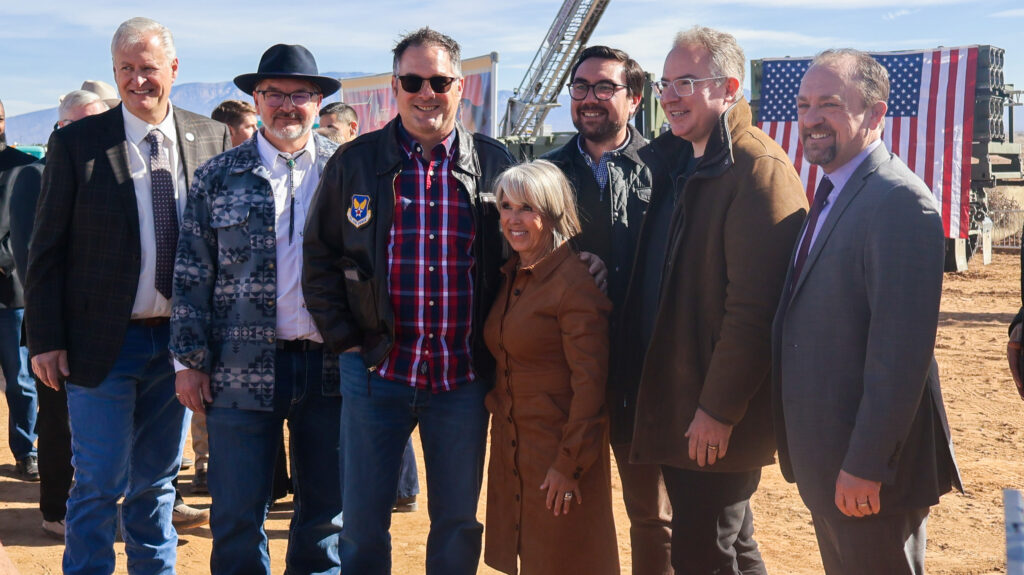
On a bright January morning in Sandoval County, New Mexico, Andrew Kreitz stood on raw ground with a governor, military leaders, local officials, and his fellow Castelion co-founder Bryon Hargis. Behind them, a ladder truck held an American flag against the blue. Underfoot lay the future of a factory that did not yet quite exist: Project Ranger, one thousand acres intended for the production of hypersonic strike systems.
Kreitz looked like what he is these days, a chief financial officer at a consequential public ceremony. Yet the setting offered a better summary of his career than a conference room could. He is a finance specialist who has arranged his working life around physical objects. Rockets. Flight computers. Propellant. Factories. Things that stubbornly refuse to be reconciled by adjusting a cell in Excel.
The job at Castelion is to make the cells answer to the objects. The company wants to build Blackbeard, its hypersonic strike weapon, at a price and volume unlike the bespoke economics of traditional defense programs. Kreitz is responsible for the financial discipline inside that ambition. His three preferred nouns are almost brutally plain: speed, scale, cost.
01 / OriginsThe job before the job description
Castelion began in 2022 with three SpaceX colleagues and an unwelcome observation. Hargis worked on national-security satellite programs. Sean Pitt sold launches to allied customers. Kreitz handled finance for launch forecasting, government proposals, and classified programs. From those seats, they believed the United States had allowed its capacity for producing long-range strike systems to thin out. They also had watched an engineering culture move difficult aerospace programs by getting to hardware early, testing it, and returning quickly with a better version.
The trio worked on the idea at night and on weekends. Then, in November 2022, they left SpaceX and started Castelion. The polished founder story usually skips from insight to incorporation. Kreitz supplies the more revealing middle. When the company was roughly ten people, he went into the desert to support tests. He bolted hardware together. He did, as he has described it, whatever might advance the engineering.
There is something pleasantly indecorous about the image. A CFA charterholder, former Goldman Sachs vice president, and future steward of a billion-dollar financing crouches beside test hardware with a wrench. A startup that small has little use for elaborate borders between functions. The finance person is also an extra pair of hands.
“The critical objectives are speed, scale, and cost.”Andrew Kreitz, on Castelion’s operating brief
The experience matters because cost in manufacturing is not merely a figure negotiated after the machine has been designed. It is buried in the design, the components, the tooling, the number of times a process can be repeated, and the speed with which a failed test becomes a useful revision. A CFO who has watched the hardware misbehave has met the limits of financial abstraction.
02 / ApprenticeshipMoney learns the shape of hardware
Kreitz did not arrive in the desert by accident. At UCLA, he studied business economics. He later earned an MBA in finance from the University of Chicago Booth School of Business. At Goldman Sachs, he focused on aerospace and defense investment banking, eventually becoming a vice president. Castelion credits him with executing more than $10 billion in mergers and acquisitions there.
Banking taught him how aerospace businesses are valued, combined, and financed. SpaceX brought the work closer to the vehicle. Kreitz led its launch forecasting process and government cost-proposal efforts, and supported financial planning and analysis for classified programs. Forecasting a launch business is not a meditation on tidy quarterly widgets. Hardware slips. Tests expose problems. Government customers bring their own procedures. Capital arrives on one calendar while engineering advances on another.
Those tensions followed him to Castelion, only now the assumptions were his to help set. The company mixed its first propellant and fired its first internally developed rocket motor in 2023. It flew its first hypersonic test vehicle in early 2024, less than four months after beginning the design. It produced a flight computer in-house, added propulsion work in Texas, and moved into a 90,000-square-foot headquarters in Torrance in 2025. The corporate timeline reads less like a parade of unveilings than a metronome.
Three SpaceX colleagues leave to found Castelion.
First government contract, propellant mix, and internally developed motor firing.
First hypersonic test-vehicle flight and first in-house flight computer.
Twenty-one flight tests, a new Torrance headquarters, and Project Ranger announced.
New Mexico construction, Navy awards, a production framework, and a $1 billion Series C.
Kreitz invokes the engineering habits of the mid-century American aerospace programs as readily as those of SpaceX: reach hardware quickly, test early, improve without ceremony. It is a useful clue to his temperament. His public language is not especially enchanted by prototypes. He is interested in the repetitive and less photogenic moment when a product can be made again, and then again, without its economics collapsing.
03 / CapitalA financing is a promise to the production line
In December 2025, Castelion announced a $350 million Series B. Kreitz explained that the money had three jobs: finish Blackbeard’s development, build the New Mexico production site, and accelerate a larger, longer-range system. He described the company as being in “a dead sprint to production.” The phrase has none of the repose normally associated with a balance sheet.
Eight months later came a larger round. Castelion’s August 2026 Series C combined $800 million of equity with a $250 million committed revolving credit facility, a structure totaling $1.05 billion in available capital. The company said the equity round valued it at $13 billion. Kreitz led the raise, the first Castelion financing led by its own CFO.
Two kinds of fuel for one manufacturing push
The arithmetic is large; its intended uses are tangible. Expand Blackbeard production. Continue a longer-range strike system. Begin defensive systems. Put working capital beside fixed infrastructure so the company can buy, build, hire, and carry inventory as production increases. In a software business, a surge of customers may require more servers. In missile manufacturing, demand can ask for buildings, qualified suppliers, propellant capacity, specialized equipment, trained technicians, certification work, and years of cash committed before the line reaches rhythm.
That is why Kreitz’s repeated emphasis on capital deployment is more interesting than the valuation. A private round can reward a story before the factory rewards the decisions. Production is the audit. Every optimistic assumption eventually meets a tool, a shift schedule, a test, or a delivery date.
04 / Project RangerThe factory hidden inside the forecast
Project Ranger gives physical form to the forecast. Castelion selected Sandoval County after a nationwide search. Kreitz cited New Mexico’s “technical talent, regional infrastructure, and history of scientific achievement.” The site is designed to make solid rocket motors, conduct static tests, assemble components, and finish rounds in one production ecosystem. Its name nods to NASA’s Ranger missions, the lunar probes that helped prepare the way for Apollo.
The choice also placed Kreitz in a role rarely celebrated in founder lore: the public meeting. In late 2025 he presented to county commissioners and attended community office hours in Rio Rancho. A missile campus is not built only through private conviction. It needs land, local trust, regulatory work, contractors, workers, and an answer to the neighbor who reasonably wants to know what will happen three miles beyond the city limit.
By September 2026, Castelion said twenty of the campus’s twenty-one buildings had been completed within nine months of groundbreaking, with initial operations expected late in the year. The company’s public milestones had also shifted decisively from development toward orders. A Navy agreement announced in September carried a value of up to $200 million for an initial production lot of Blackbeard. Earlier awards supported prototypes, aircraft integration, safety work, and a target of early operational capability in 2027.
There is a moral seriousness to the product that makes casual founder worship feel especially misplaced. Castelion builds weapons. Kreitz frames the purpose as conventional deterrence: sufficient capability, in sufficient quantity, to make conflict less attractive. That is the company’s case. It also places an exacting obligation on its claims. A deterrent that exists only as a beautiful prototype is a sculpture. One that can be produced, maintained, integrated, and afforded becomes policy.
The round is an announcement. The factory is the argument.YesPress
05 / The measureWhen the spreadsheet has to leave the building
Kreitz once joked that these days he mostly pulls together spreadsheets. It was an accountant’s modesty, quickly followed by an explanation of why the cost objective matters. Castelion says it wants to produce systems at more than an order of magnitude below the price of comparable weapons. Lower cost is not a decorative efficiency. In the company’s logic, it determines whether the United States can buy enough units for deterrence to be credible.
His career now resolves into a neat, if improbable, progression. Goldman Sachs showed him the defense industry through transactions. SpaceX showed him aerospace through programs. Early Castelion showed him the indignities and pleasures of hardware before the organization grew around it. Project Ranger asks him to combine all three lessons under a roof, or rather under twenty-one of them.
The appealing version of finance ends with the money arriving. Kreitz’s version begins there. The dollars must turn into test articles, the tests into revisions, the revisions into a stable design, and the design into a line that can run at useful volume. Each conversion loses a little romance and gains a little reality.
Somewhere between the desert wrench and the billion-dollar round, the CFO’s task remained surprisingly consistent: decide what the next piece of hardware needs, then make sure the company can afford to learn from it. The spreadsheet has done its job only when something leaves the factory.