Andrea Oliveri chose a peculiar moment to become her own boss: when the business that had taught her the job was becoming a less comfortable place to stay. She and Nicole Vecchiarelli had spent their careers around magazines, celebrities and the elaborate diplomacy required to bring the two together. In 2016, they founded Special Projects. The decision carried a useful piece of logic. A publication could lose pages without making its editors’ experience worthless. Someone would still need to know whom to call.
A contacts book seems an obvious place to look. Oliveri’s magazine career had brought her into contact with agents, managers and publicists. But a list of names has limited powers. It cannot explain why a particular person suits a particular occasion, or persuade a publicist that an invitation deserves a reply. Oliveri’s second act is more interesting when seen as a change in where she applied her judgment. The magazine had been the employer. The judgment could become the business.
The useful part of an old job
Oliveri and Vecchiarelli met at Details. Before they became partners, they were colleagues in an industry where the finished object concealed an impressive quantity of negotiation. A cover looks simple when it is printed. Getting the person onto it involves competing schedules, editorial ambitions, agents, managers and publicists, each with a reason to prefer a different outcome. The image at the newsstand is the part the reader sees. The agreements that made it possible rarely receive a caption.
The founders’ shared background extended across publications including W, Teen Vogue, Elle, InStyle and DuJour. Those names describe their combined experience, rather than identical résumés. What united them was the work of bringing entertainment into an editorial setting: choosing people for features and covers, and assembling the events associated with magazine brands. Such work asks for taste, certainly, but also for patience. A promising idea must survive contact with somebody else’s calendar.
At Special Projects, the same skills could serve multiple clients. A publisher might need a cover subject. A fashion company might need a campaign partner. A studio might need a screening audience. Each assignment still involved selection and persuasion, but the founders no longer had to fit every opportunity into one publication’s identity. Their professional experience had acquired a wider set of possible customers.
Oliveri and Vecchiarelli launch Special Projects, taking editorial booking into an independent agency.
A business that could choose its own assignments
Oliveri’s account of going independent is strikingly practical. Staying in a contracting print industry looked more daunting than starting a company. There is no need to dress that calculation in the language of destiny. Sometimes a new enterprise begins with a fairly sober assessment of the old workplace. The risk of leaving has to be weighed against the risk of remaining exactly where you are.
Asked what excited her about ownership, Oliveri answered, “Making our own rules.” Her ambitions included shaping the culture of the company and choosing a team and clients she believed in. These are modest words for decisions that occupy an enormous amount of a founder’s life. They put the appeal of independence close to the working day: who is beside you, what the work feels like, and which assignments you agree to take.
For Oliveri, the new company also preserved a partnership formed before either woman needed to be the other’s co-CEO. Their friendship and professional history gave the enterprise an existing relationship to build around. In February 2019, they appeared together on Claire Mazur and Erica Cerulo’s podcast to discuss working together across two coasts. The subject was appropriately unglamorous: how a professional partnership actually functions. A business built on relationships has to manage the relationship at its center, too.
The meeting before the invitation
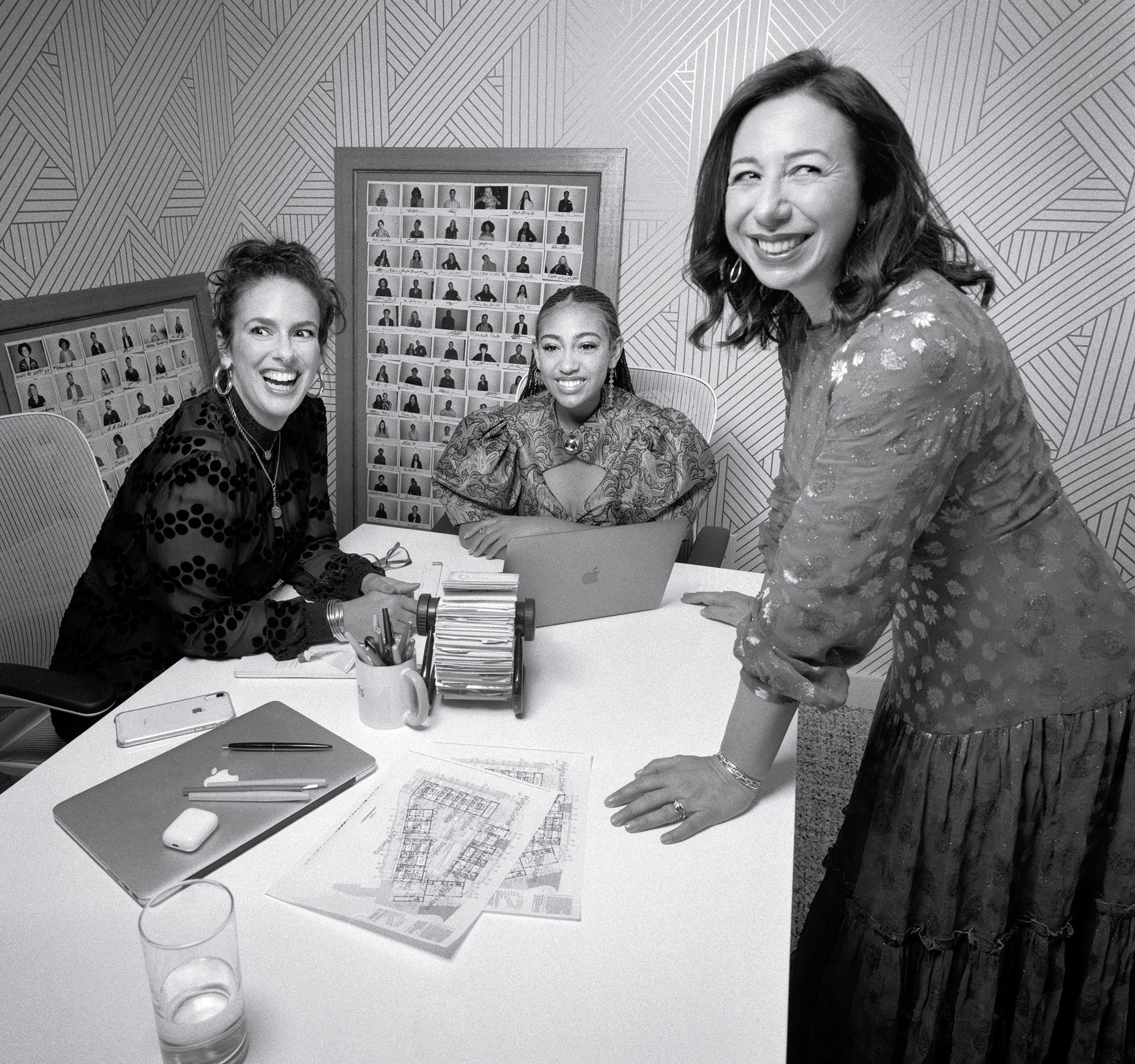
A photograph from 2020 offers a useful glimpse of the job. Oliveri and Vecchiarelli are in the Special Projects office with actress Lexi Underwood, ahead of the premiere of Little Fires Everywhere. The setting is a conference room. There is a laptop, paperwork and a wall of small photographs. Oliveri stands at the right, smiling. For a business so associated with public occasions, this is a pleasantly ordinary workplace scene: people around a table, learning about one another.
The picture suggests a useful way to understand the profession. Booking depends on knowing more than the title of someone’s forthcoming project. A conversation can reveal how a performer thinks, what interests them, and which settings might suit them. There is a difference between recognizing a face and having a reason to invite its owner. The latter gives a partnership something to stand on once the first photograph has been taken.
This is also where Oliveri’s work becomes hard to summarize in a job title. Talent booking sounds administrative. Creative strategy sounds abstract. Event production summons visions of loading docks and lighting plans. Her agency’s services include all these kinds of work, from selecting speakers for summits to handling RSVPs and front-of-house arrangements. There is room for an idea, and there must also be somebody to tell the idea which entrance to use.
An illustration of the agency’s service range, rather than a required sequence.
A calendar with very different destinations
Special Projects’ early assignments included the guest list for Kanye West’s Wyoming listening party and work on the performers and attendees for Jonah Hill’s Mid90s screening. Even without knowing every conversation behind those projects, their contrast is revealing. An album gathering and a film screening carry different expectations. The appropriate audience has to relate to the work being presented. A familiar name can help an occasion attract attention; a relevant name can help it make sense.
That distinction gives Oliveri’s career a thread beyond proximity to famous people. The recurring task is to connect a public figure with a setting in which their presence has a purpose. A magazine cover makes one kind of claim. A campaign makes another. A conference asks whether someone can contribute to a conversation. The same person may be suited to several formats, but each format requires a fresh decision.
The agency’s public service list makes this range explicit. It includes editorial bookings, advertising and branded content, festival programming, hosts and presenters, premieres and tastemaker screenings. These are related assignments with different practical demands. A presenter must know when to walk onstage. A guest must know where to arrive. The cultural judgment and the mundane instruction belong to the same job. An invitation is considerably more effective when it contains the correct address.
Thirty to forty minutes, please
In 2020, Oliveri offered a compact piece of advice for virtual gatherings: aim for 30 to 40 minutes. She also identified engagement as the central challenge. It was a concrete answer to a format problem. An audience at a screen needed a different rhythm from an audience at an evening event.
There is an editorial instinct in that recommendation. Length should earn its place. The organizer’s enthusiasm cannot be allowed to set the running time by itself. For someone whose work includes assembling occasions, knowing when to end one is a useful qualification.
“The main challenge is engagement.”
Andrea Oliveri, on virtual events, 2020
Selling the company, keeping the job
On October 2, 2023, Dolphin Entertainment acquired Special Projects. The announcement followed the next day. Oliveri and Vecchiarelli continued as co-CEOs, and the agency retained its name. The business they had started seven years earlier became part of a larger collection of marketing and communications companies, including 42West, Shore Fire Media, The Door, The Digital Department and Viewpoint Creative.
The founders described the deal as a chance to expand. Their stated interests included developing new event franchises of their own, beyond assignments attached to an existing brand or editorial title. That possibility changes the founder’s question again. Running an event for a client begins with someone else’s brief. Creating an event franchise means deciding what deserves to exist, then building the occasion around that conviction. Oliveri’s editorial background offers a recognizable starting point for that kind of choice.
In May 2024, Dolphin CEO Bill O’Dowd described Special Projects as an eleven-person business across New York and Los Angeles. He also discussed its potential role in developing events that Dolphin could own or co-own. The historical headcount gives some scale to the operation behind the public occasions. Eleven people is small enough for individual judgment to remain visible. It is also enough people for management to become a substantial occupation of its own.
The next assignment
Oliveri’s route has taken her from magazine work to agency ownership and then into leadership within a larger company. Each stage has changed the business arrangement around a durable skill: choosing people and finding productive ways to bring them together. Her work now sits among fashion, entertainment, media and live events, with offices on both coasts and a partner who knew her before there was a company to run.
The appealing detail is how much of this career remains recognizable as editing. There are choices to make, combinations to test and schedules that decline to cooperate. Oliveri built a company around work that can look effortless from the outside because somebody has already done the difficult part. The finished occasion gets the photograph. Her career has been built in the conversations that come before it.