Andrea de Anda had a fishing lesson for political consultants. Speaking at Campaign Tech in Puebla in 2017, she put the audience ahead of the person holding the rod: “No pescas con lo que te gusta a ti; pescas con lo que le gusta al pez.” You fish with what the fish likes. It is a pleasantly undignified image for an industry accustomed to discussing power. Somewhere between the candidate’s preferred photograph and the consultant’s preferred slogan, somebody ought to consider the fish.
For de Anda, founder and CEO of Ojiva Consultores, that meant paying closer attention to the people on the receiving end of political communication. What moved them? What did their comments reveal? What might a campaign miss if it counted responses without asking what those responses meant? These questions became central to Capisci, the audience analysis technology she created, and to her work in Mexico’s digital campaign industry.
Her public career offers a useful way into a profession whose finished products are easier to see than its working methods. A voter encounters a video, a post or an advertisement. Behind it sit choices about research, language, timing and distribution. De Anda has spent her career making those choices a business. The interesting part is how often she returns to an apparently simple preliminary: before deciding what to say, work out whom you are talking to.
The audience has a life of its own
At Campaign Tech 2017, de Anda presented Capisci in a conference called “Big Data a la Mexicana.” The platform was described as combining quantitative analysis with qualitative depth, examining people who interacted naturally with brands, public figures and institutions online. Its purpose was to understand those audiences in greater detail, including their motivations.
She gave the technical subject a decidedly personal vocabulary. “A mí me gusta creer que los datos tienen alma,” she said. She liked to believe that data had a soul. The phrase sounds almost mischievous in a room devoted to measurement. Yet it identifies a practical distinction: a comment is a countable event, and it is also something a person chose to say.
Consider the difference between recording that a message received attention and understanding why it attracted attention. Agreement, anger and amusement can all generate activity. A busy comment section may contain several conversations at once. Treating the total as a complete explanation risks losing the very information that would help a communicator respond intelligently. This is the problem her approach set out to address.
The business implication reaches beyond elections. A company speaking to customers and a candidate speaking to voters both need a reason for people to listen. De Anda’s presentation explicitly addressed public and private organizations. The common task was to ask useful questions about an audience before buying more opportunities to address it. A larger megaphone can be an expensive way of repeating a misunderstanding.
A comment is a countable event, and it is also something a person chose to say.
A presidential campaign, then six trophies
De Anda’s professional base is Querétaro. Her education includes the Universidad Autónoma de Querétaro, where her public professional profile lists study from 2006 to 2010. Her work would take her into national politics: she was responsible for social media strategy in Ricardo Anaya’s 2018 Mexican presidential campaign.
That assignment placed her inside a broader professional campaign operation. Anaya’s team included other specialists in strategy and image; de Anda’s responsibility was the digital sphere. Keeping that distinction matters. A presidential campaign brings many disciplines together, and a consultant’s contribution has to be understood within the team and the contest rather than credited with every outcome.
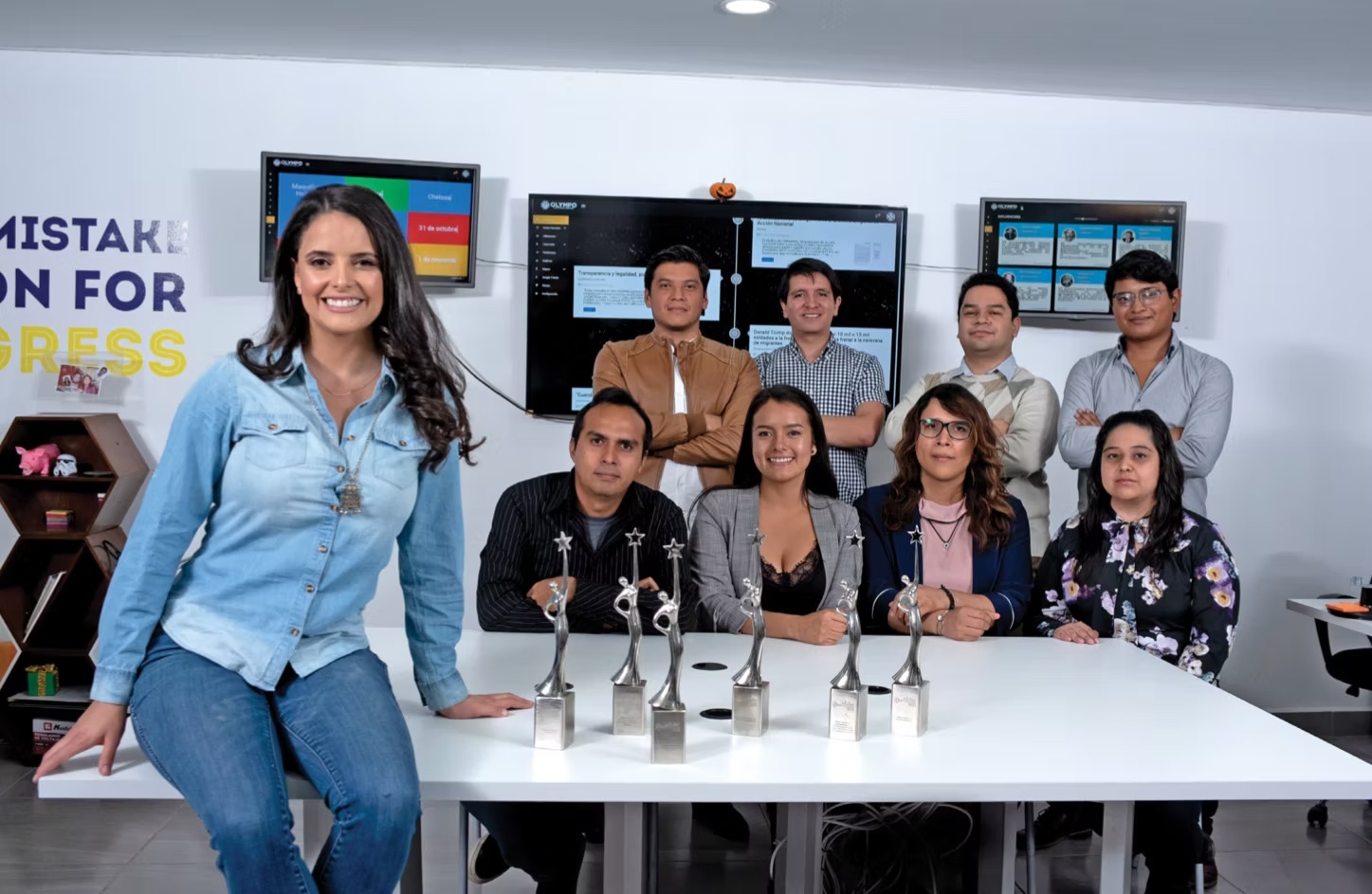
Later in 2018, Ojiva received six Reed Latino awards. They covered work including mobile advertising, email automation or personalization, an electoral innovation tool and a campaign activation built around a hackathon. Capisci received the electoral innovation recognition. De Anda herself received the Digital Strategist of the Year award.
The range is revealing. An analysis platform and a hackathon occupy different corners of campaign work. One concerns understanding an audience; the other creates an occasion for participation. Mobile advertising and email involve still other decisions about format and delivery. Taken together, the awards describe a consultancy operating across the route from audience research to public contact.
There is a temptation in profiles of campaign professionals to let the trophies do all the talking. They can explain professional recognition. They cannot explain the whole relationship between a campaign and the electorate. De Anda’s work is more interesting when the awards are read as evidence of the kinds of problems her team tackled: how to investigate, how to make something, and how to put it in front of people.
Plans meet the calendar
In January 2019, de Anda appeared at TEDxPaseoDeLasTorres with a talk titled “El poder de los planes,” or “The power of plans.” Its stated theme addressed millennials, work and the possibility of shaping a world that did not arrive as advertised. It extended her public voice beyond the technical vocabulary of campaigns.
Planning also surfaced in her June 2021 appearance on the podcast Rompiendo la Caja. The episode’s advertised subjects included drawing up a plan, entrepreneurship, professional and personal success, and the place of social networks in professional life. Across these appearances, there is a consistent interest in connecting an intention to the work it requires.
That connection gives the word “strategy” a little resistance. It is easy to admire a plan when it is still on paper. Nobody has missed a deadline inside a diagram. Nobody has yet needed to explain why a carefully approved sentence sounds peculiar when spoken aloud. Implementation introduces people, schedules and inconvenient details. The attraction of a plan is its order; the test arrives when the work begins.
De Anda’s public speaking sits comfortably beside her consulting practice in that respect. The subjects differ, but both ask how a proposed future becomes a sequence of actions. The talk title supplies no guarantee that a plan will succeed. It does make an apt companion to a career spent dealing with the distance between a campaign’s intentions and what an audience actually encounters.
The candidate has to turn up
By July 2021, de Anda was making an explicit case for execution in political consulting. She urged consultants to consider whether their work met the expectations of society and their political clients. Her advice also assigned responsibility to candidates themselves: they had to invest time in digital communication.
“Si el candidato no cree en las redes sociales, las redes sociales no creerán en el candidato,” she said. The sentence gives a platform a personality, but the obligation belongs to a person. Her recommendations included spending time developing a project, creating content, listening to data and considering how to reach voters efficiently.
It is a useful complication to the idea that digital expertise can simply be purchased and left running. A client still has decisions to make. Someone still has to provide the material, take part in the communication and consider the response. Hiring an agency does not make participation unnecessary. It gives that participation a professional structure.
Ojiva’s current service offering reflects that operational emphasis. Communication and digital strategy sit alongside crisis work, design and other production capabilities. Its description of strategy promises involvement from the initial idea through measurable results. The services can be commissioned together or separately, allowing research and delivery to form parts of the same commercial relationship.
The team photograph makes that relationship tangible. De Anda stands beside colleagues around a conference table, with awards in front and monitoring screens behind them. There is both information and evidence of completed work in the frame. The photograph cannot tell us what any colleague was thinking. It does show that the founder’s work depends on a group of people, rather than on the solitary glamour sometimes attached to the word strategist.
The screen is a crowded room
Her later public commentary returned to the audience’s choices. In September 2024, speaking with Luis Cárdenas on MVS Noticias, de Anda compared online attention around the judicial reform debate with attention around Adrián Marcelo and the reality show La Casa de los Famosos. The figures she discussed put video reproductions at 1.8 million for the judicial subject and 32 million for the entertainment subject.
Those were observations about particular digital conversations. They were not a census of what every Mexican valued. Their usefulness lay in showing the scale of the competition for attention within the material being monitored. A politically consequential subject enters a feed alongside entertainment, jokes and whatever else people decide to share.
For a consultant, the comparison creates an awkward question. A campaign may regard its own subject as urgent, but the audience has other appointments. Importance does not automatically confer an audience. Understanding the setting in which a message appears becomes part of understanding the message’s reception.
In January 2025, Ojiva shared another appearance by de Anda, this time with Carmen Aristegui, discussing the political and social impact of Donald Trump’s return to the White House and its circulation online. The subject had changed again. Her role remained recognizable: examine a public conversation and help explain the attention it attracted.
Back to the person at the other end
There is a steady line through these different assignments. Capisci asks what can be learned from digital audiences. Campaign work asks how to communicate with them. Public commentary asks what their conversations reveal about the moment. Each makes the audience an active participant with interests of its own.
That is also what gives de Anda’s fishing analogy its staying power. It punctures the idea that a communicator’s enthusiasm is sufficient evidence of an audience’s interest. The joke is at the expense of the person who arrives thoroughly equipped and has forgotten to consider the creature in the water.
Her career has given that proposition several forms: a technology platform, a presidential campaign assignment, industry recognition, a TEDx talk and interviews about the subjects occupying public attention. The settings have expanded; the question remains usefully specific. What does the person receiving this message care about, and what have you done to find out?