Anand Tumuluru found something to enjoy in accounts payable. This is an unusual beginning for a restaurant story, where the conventional attractions include food, company and the possibility of somebody else doing the washing up. But at Flipkart, building the systems behind a growing business, he discovered that the supposedly dull machinery could determine what the business was able to become.
Years later, as the co-founder and CEO of Loop AI, he is working on the machinery behind another familiar transaction: ordering dinner. The customer sees a menu, a total and a delivery estimate. The restaurant has to understand payments, commissions, refunds, advertising and whether the whole exercise left anything worth keeping. Tumuluru has spent enough time on both sides of that screen to find the question interesting.
The pleasure of accounts payable
His technical career includes an early chapter in language research. In 2012, he co-authored Fully Automatic Semantic MT Evaluation with Chi-kiu Lo and Dekai Wu at the Hong Kong University of Science and Technology’s Human Language Technology Center. The work examined how to judge whether a machine translation preserved meaning. A second paper, with Tumuluru as first author, investigated the reliability of similarity measures used in that evaluation.
The subject was specialized, but the underlying difficulty is easy to recognize: a machine can produce an output that looks plausible while a more useful measure asks whether it did the job. That is an editorial connection across his career, rather than a claim that a translation metric somehow became restaurant software. His early publications simply establish that his involvement in AI predates Loop by a decade.
He dates the start of his work on Flipkart’s enterprise resource planning systems to 2012. Receivables, payables and supply chains gave him a view of the business underneath the storefront. He remembers the people he learned from there, and the importance of the systems they were building. Later, an attempt at a fintech startup taught him a less comfortable lesson: enthusiasm for a technology could lead a founder away from the customer’s actual problem.
That lesson has stayed in his account of his career. Start with what the customer needs to accomplish, he argues, then decide how the technology fits. It is a useful discipline for someone now building an AI company. A restaurant operator has a limited appetite for technical fascination when there are invoices waiting.
- ResearchMeasuring meaning
- FlipkartBusiness systems
- UberDelivery at scale
- Loop AIRestaurant operations
Career sequence, not a proportional timeline.
A restaurant on the other side of the screen
Tumuluru subsequently joined Uber, where he met a future co-founder. Alongside his software career, he opened a restaurant with friends in India. He has described it as a side project, a practical experiment whose digital orders and payments could be brought together in a spreadsheet. Restaurant ownership supplied a different kind of feedback from engineering. The numbers belonged to a business he helped run.
His accounts of that restaurant emphasize its operating system: orders arriving through delivery services, digital payment rails and the ability to see what was happening in the business. The experiment gave him reason to believe that delivery could work for an operator who understood it. He was learning about a meal’s journey through a set of records as well as through a kitchen.
At Uber, he also saw the delivery platform’s side of the relationship. Those two perspectives eventually met in efforts to help Bay Area restaurants make sense of their delivery businesses. Loop was founded in 2022 by Tumuluru, Sundar Annamalai and Vinod Pachipulusu. Its founding team brought engineering and restaurant experience to a problem that required both.
There is an appealing lack of romance in the starting point. Restaurant stories tend to dwell on the recipe, the room or the chef. Tumuluru keeps returning to the systems. Dinner can be delicious and the accounting can still be a mess. The second fact has a way of spoiling the first.
First, make the money legible
In his early discussions of Loop, the recurring difficulty was delivery’s fragmented paperwork. A restaurant might have several marketplaces, each with its own reporting, payout arrangements and adjustments. An order, its associated charges and the money eventually received needed to be understood together. A busy service could produce plenty of activity without giving the owner a usable account of the result.
Loop’s initial proposition gave finance teams a way through that work. Tumuluru has discussed connecting delivery information with existing accounting tools, including QuickBooks and Restaurant365, so operators could reconcile transactions and close their books. The value was concrete: less manual assembly, a clearer view of the delivery channel and a better basis for the next decision.
A conceptual view of reconciliation. No illustrative dollar figures.
His June 2024 conversation with Dana Zukofsky explored the complications surrounding third-party delivery, including fees, chargebacks, payment schedules and differing platform policies. The following month, Aprio announced a collaboration with Loop focused on helping restaurants manage delivery sales and transactions. That relationship placed his software alongside the people already responsible for making the books intelligible.
It also made sense of his earlier apprenticeship. Business systems become useful when they fit into the work someone is already doing. An accountant needs records that agree. An operator needs to know which problem requires attention. A founder who has enjoyed working on accounts payable has, at least, chosen an audience unlikely to be frightened by the subject.
The table gets bigger
By May 2024, Tumuluru was onstage at the Fast Casual Top 100 gala in Chicago, presenting Nekter Juice Bar with the Most Loved Delivery Brand award. The photograph is a small change of scene from the spreadsheet: an award plaque, a group of smiling restaurant people and Tumuluru in the middle, wearing a bright blue shirt.
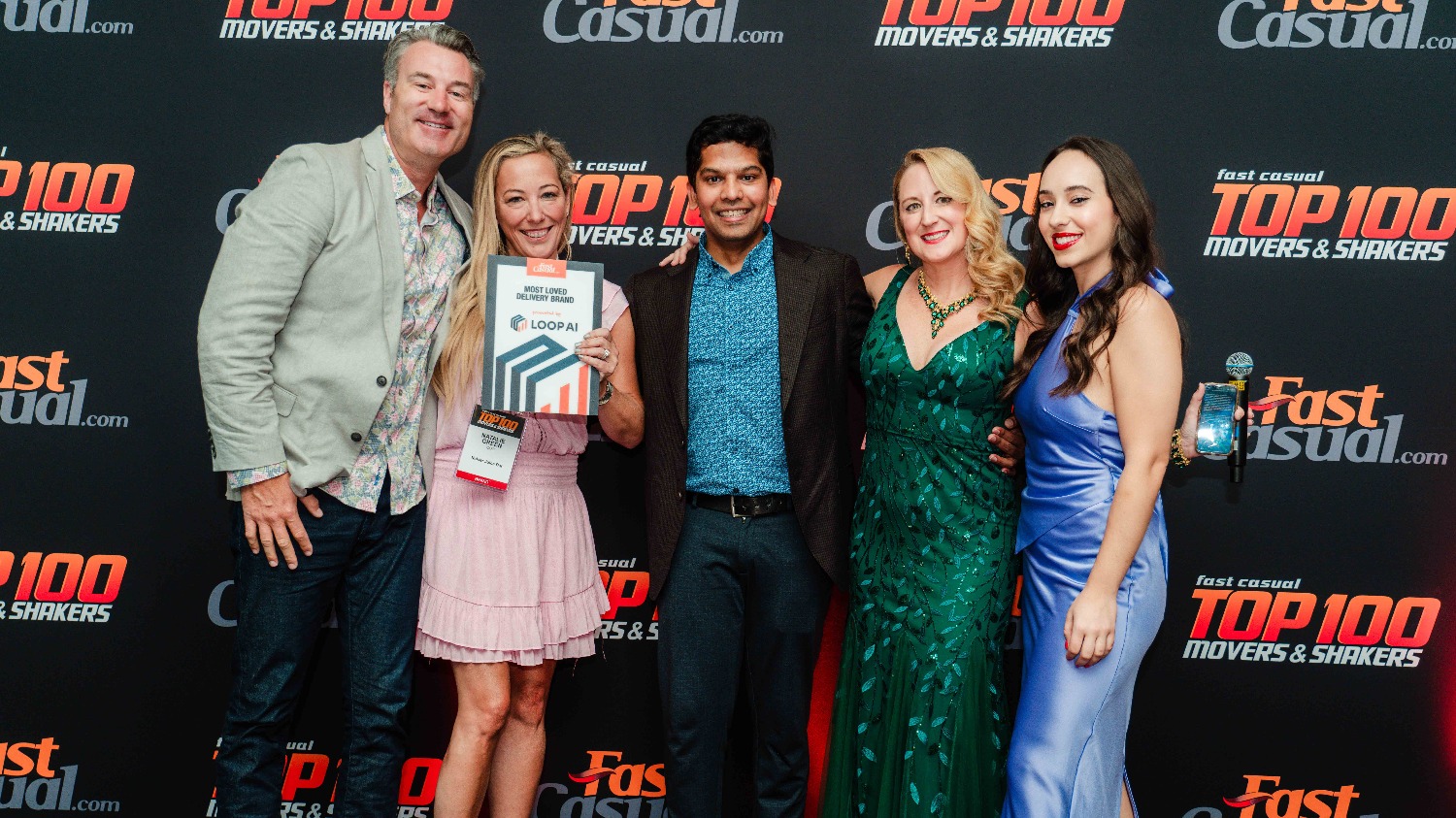
He was recognizing an operator’s delivery performance, an appropriate public role for someone whose company depends on understanding it. His involvement continued beyond the stage. For the 2025 Top 100 awards, an index developed with Tumuluru and Loop’s team brought measures such as location growth, customer sentiment and sales into the judging process.
His ambition connects restaurant ownership, AI research and Uber: give operators greater control over the business, from guest experience to finances. The connections are practical ones: accountants, restaurant executives, fellow founders and customers all encounter different parts of the same operating problem.
When the queue was inside Loop
Building tools for operators did not spare Tumuluru the work of becoming one himself. As Loop grew, its own capacity became a constraint. In the period leading up to March 2026, new customers had to wait for onboarding while sales and customer success teams were stretched. Tumuluru was taking as many as 25 to 30 interviews a week.
The response involved changing how he thought about hiring. Instead of filling positions individually, Loop brought in leaders who could organize functions and recruit their teams. Loop made 13 hires through Paraform in four months, including directors in customer success and inside sales. Tumuluru describes a recognizable transition: the engineer learning to build an organization.
“Paraform helped us move from filling specific roles to building organizations.”
Anand Tumuluru
His candor about unfamiliar job distinctions and compensation questions gives this chapter some texture. Software engineering had prepared him for part of the company’s work. Leading a growing business demanded expertise he could bring in through other people. The systems now included responsibilities, reporting lines and the ability to welcome a customer without adding another queue.
A drive-thru without the driveway
On February 2, 2026, Loop announced a $14 million Series A led by Nyca Partners. Osama Bedier, a former Google and GoDaddy executive, was joining its board. The company said it served more than 300 brands across thousands of U.S. restaurant locations, and planned to expand its products and teams in New York, San Francisco, Tampa and Bangalore.
2 February 2026
That financing supports a broader version of the job Tumuluru began with. Loop now presents finance, marketing and operations agents working from a shared view of restaurant systems. His argument for connecting those functions is straightforward: spending to generate more orders makes more sense when an operator can also understand the costs and the operational consequences.
“Delivery is the new drive-thru,” he said when the round was announced. It is a compact expression of his view that delivery belongs in a restaurant’s lasting business design. Packaging, pricing and marketing all deserve attention in that design. The customer’s convenience creates work elsewhere, and he wants operators to have tools that help them manage it.
For a quieter detail, consider his January 2026 conversation with Bloomberg Intelligence. Amid discussion of restaurant economics, Tumuluru mentioned that he finds washing dishes meditative. It fits, rather nicely, with the engineer who enjoyed enterprise systems. Someone still has to deal with what dinner leaves behind. He seems willing to take an interest.