The first version of Buyers Edge Platform looked less like a software company than a dare. In 1998, 21-year-old John Davie and his father asked 45 independent restaurants in Rochester, New York, to pool their purchasing. The immediate target was Pepsi costs. The larger promise was that local operators might bargain like a chain if enough of them acted as one. There was one awkward detail: Buyers Edge did not yet have the volume or vendor contracts required to save anyone money.
So Davie sold the future. He knocked on restaurant doors for five years, asking owners to share information and wait for the network to become useful. His father kept the business alive with $1,000 or $2,000 at a time from a retirement account. Davie, whose monthly rent was $500, had no restaurant resume and little credibility beyond stamina. It is the sort of origin that sounds charming only after it works.
One operator handed over a stack of crumpled, coffee-stained invoices and asked the young company to find savings. Davie and his team went home and typed the pages into Excel. Product descriptions did not line up. Distributor numbers did not match manufacturer numbers. A case might be described three different ways by three suppliers. The grubby clerical problem contained the company's future: before anyone could negotiate intelligently, somebody had to make the purchasing data legible.
The rebate is the front door
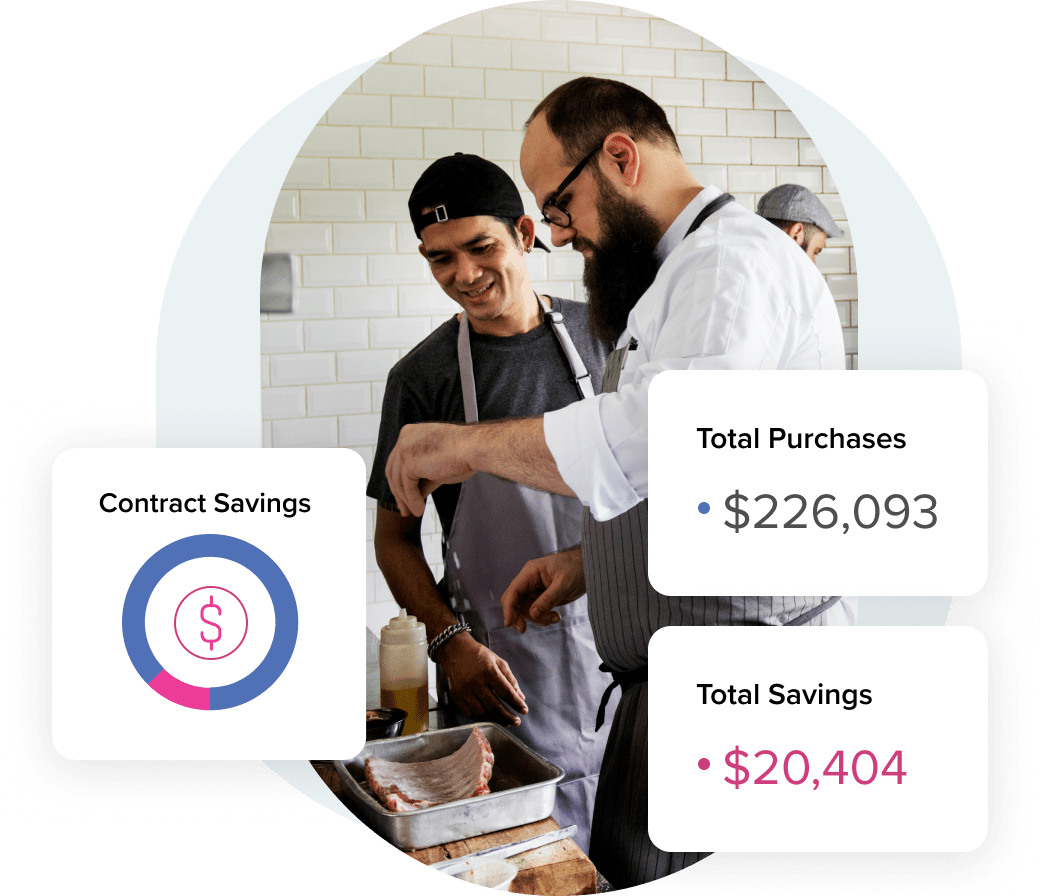
For an independent restaurant, the pitch remains disarmingly plain. Join without a membership fee, connect the distributors already supplying the kitchen and collect manufacturer-funded rebates on qualifying products. Buyers Edge advertises programs from more than 350 manufacturers covering over 175,000 line items. A restaurant does not necessarily have to change its distributor or even its shopping list. The company says eligible cash back can begin within 30 days.
The money does not materialize from software pixie dust. Manufacturers already use rebates to encourage restaurants to buy their brands. Buyers Edge aggregates enough demand to negotiate those programs, identifies eligible purchases, handles the claim and passes the displayed earnings to the operator. It keeps a small portion for doing the work. The restaurant gets scale it could not create alone; the manufacturer gets measurable demand; Buyers Edge gets both revenue and another purchasing signal.
One purchase, three winners - when the match is clean
That last clause matters. Many business networks fail because they demand a new behavior before creating value. Buyers Edge attached itself to an old behavior - ordering food - and worked behind it. The restaurant did not need to become a procurement expert. It needed to let the platform see the invoice.
Buying power was not enough
The first strategy eventually hit a wall. Eight or nine years in, Buyers Edge was still a small buying group measured against GPOs born inside giant hotel and catering companies. Those rivals began with billions in purchasing volume. Buyers Edge had only tens of millions. It could not win a pure arm-wrestling contest.
What changed the founders' minds was the invoice mess. They decided to compete on transparency, data and technology. An early part-time developer built a rudimentary ingestion engine after his day job. Then Buyers Edge found InsideTrack, a specialist with a database that normalized distributor descriptions to manufacturer products. Buyers Edge first paid a large software fee to use it, then acquired the company around 2011. The first acquisition did more than add a product. It supplied the grammar for the whole network.
“We just try to refer to ourselves as sophisticated instead of complicated.”John Davie, founder and CEO
The line is a joke Davie makes about the company's sprawl. Buyers Edge has completed more than 40 acquisitions by his count. Its current offering stretches across four divisions: digital procurement, fresh-food management, supply-chain services and software. Brands including Dining Alliance, Consolidated Concepts, ArrowStream, Back Office, InsideTrack and Fresh Alliance still carry their own identities and expertise.
The portfolio fills in the restaurant back office. Operators can use it for inventory and recipe costing, accounting and accounts-payable automation, price verification, procurement analytics, product sourcing, fresh quality assurance, distributor management and incident resolution. Manufacturers get portals showing contract performance, sales gaps and regional opportunities. Distributors can see categories a customer buys elsewhere, down to items that might deserve space on the next truck.
The moat is a translation service
Buyers Edge now says it manages more than $100 billion in foodservice transaction data and analyzes 171 million purchases each day. A financing announcement in 2024 used a more conservative snapshot: over $60 billion of aggregated spend and more than 200,000 operator locations. By January 2026, the company said its worldwide footprint had crossed 300,000 locations. The figures describe a moving network, not a single tidy customer count.
Scale helps, but diversity is the more interesting asset. Data arrives from independent restaurants, chains, hotels, casinos, schools, healthcare operators and thousands of vendors. Buyers Edge says it cleans and normalizes the records before using machine learning to match products or surface decisions. This is not glamorous AI. It is the laborious prerequisite: making “fry oil, 35 lb.” in one system mean the same thing in another.
Once the match works, a useful loop appears. A restaurant sees a switch that could save money. A manufacturer learns where a competitor owns the case. A distributor discovers what its customer is buying from another truck. Each participant can act, and each action adds information to the network. That combination separates Buyers Edge from a conventional buying group on one side and generic spend-management software on the other.
A $425 million bet on repeatability
In April 2024, a consortium led by General Atlantic Credit's Atlantic Park fund, with Blackstone Tactical Opportunities and Morgan Stanley Tactical Value, invested $425 million in preferred equity. The company said the money would fund product development, acquisitions and European expansion. Bregal Sagemount, its first institutional investor, exited a minority position while Davie increased his majority stake. Buyers Edge reported that revenue and profits had grown roughly 300 percent during Bregal's five-year tenure and that 21 acquisitions had been integrated.
Europe is where repeatability is being tested. Since 2023, Buyers Edge has invested across the UK, Sweden, Germany, Switzerland and the Netherlands. It acquired United Fresh Consortium in January 2026, followed by NCB Foodservice in February, creating a bridge for its fresh-produce model. In August, it announced that three U.S. produce operations would unite under Fresh Alliance, bringing more than 200 specialists under one name over six months.
The pattern is consistent: buy local expertise, keep operators and leaders close, then add data, contracts and sales reach. Sellers are told they can retain their brand and culture, with founders often staying for at least two years. This avoids bulldozing relationships that took decades to build. It also leaves Buyers Edge with the hard job of making a federation behave like a platform.
Where the playbook breaks
The network works when purchases are frequent, products can be normalized, suppliers will fund incentives and customers are willing to share enough data to reveal savings.
It is weaker in fragmented categories with little repeat spend, poor digital records or no manufacturer economics. It also falters if acquired brands stay so autonomous that customers cannot understand the bundle, or if data visibility begins to feel like surveillance rather than service.
What a smaller company can copy
The first lesson is to use a benefit people understand as the wedge. Buyers Edge said “cash back,” not “three-dimensional procurement intelligence.” Second, collect data from the workflow already happening. The invoices existed before the portal. Third, make the ugly translation layer a product. Normalized codes sound like plumbing until the plumbing becomes the only way to see the market.
The fourth lesson is to move upmarket only after proving the overlooked segment. Buyers Edge learned to serve independents that larger GPOs ignored. Once that pool crossed its first billion dollars in volume, it could approach 20-, 50- and 100-location groups with credible purchasing leverage. Finally, acquire the bottleneck when renting it constrains the business. Buying InsideTrack converted an external software bill into a capability that could spread across the network.
None of this is instant. Buyers Edge had five years in which the network promise was more compelling than the current product. Its defensibility came from patient aggregation, tedious data work and restaurant relationships. A startup copying only the dashboard would miss the company underneath it.
The result is neither a simple SaaS story nor a traditional purchasing cooperative. Buyers Edge sits in the middle of a three-sided market and gets paid when information changes a purchase. Its best product may still be the same one it discovered over a stack of stained paper: turning what restaurants already buy into leverage they did not know they had.