A small city makes ambition conspicuous. In Crosby, Minnesota, population roughly three thousand, a hospital cannot disappear into the skyline. It sits in the middle of civic life, as visible as the old iron-mining history beneath the town and as consequential as the roads that carry patients in from the lakes. Cuyuna Regional Medical Center began as a community answer to a community problem: after the Miner's Hospital closed and the mines slowed, local people organized a successor. The Cuyuna Range District Hospital opened in 1964. Six decades later, its chief executive is still working on the same essential question. How does a place keep care close when the economic gravity of healthcare keeps pulling outward?
Amy Hart's answer begins with a word that can sound sentimental until the bills arrive: independence. CRMC remains an independent critical access hospital, a 25-bed institution with five clinics, senior-living ties and a reach across the Brainerd Lakes region. It employs more than 1,000 people. Becker's Hospital Review recently described it as a $225 million organization. The numbers are large enough to puncture the quaint picture that the phrase “rural hospital” can summon. This is not a country doctor's office with a generous parking lot. It is an operating system for a region of about 60,000 people.
The education of an operator
Hart did not parachute into Crosby on a cloud of management theory. Her route was longer and more useful. She studied education at Central College, then earned a master's degree in health care administration from Des Moines University in 1997. The combination is quietly apt. Hospitals teach every day, though not always in classrooms. They teach new staff, explain difficult decisions, translate specialized knowledge and ask communities to understand tradeoffs no one particularly enjoys.
Her early career supplied the less lyrical curriculum. At Unity Health System in Iowa, she worked as an administrative director and corporate compliance officer. At Children's Mercy in Kansas City, she managed corporate compliance. Truman Medical Centers put her over practice management and clinics. HealthEast in St. Paul added system operations. Compliance is the discipline of discovering that every inspiring promise eventually meets a regulation, a process or a form with the wrong box checked. It is a fine place to acquire respect for consequences.
Hart arrived at CRMC as chief operating officer in 2013 and stayed in that post for nine years. She also carried the interim CEO job for about a year. When the board made the appointment permanent in February 2022, it was less a dramatic entrance than a long apprenticeship reaching its logical conclusion. She knew the machinery because she had spent nearly a decade keeping it moving.
“Momentum is built by people who show up every day with purpose and heart.”Amy Hart, CRMC annual report
That line, from Hart's message in CRMC's 2023-24 annual report, is revealing for what it refuses to do. It does not credit momentum to the leader. It locates progress in repetition and distributes it among the people who turn up. One can imagine a thousand glossy leadership slogans dying of neglect beside it. Hart's version has work boots.
Independence, without isolation
The romance of independence is self-determination. The reality is responsibility. An independent rural system cannot send every difficult problem upstairs to a distant headquarters. It has to recruit the specialist, finance the equipment, train the team and persuade patients that the service deserves their trust. Hart has described CRMC as a model for what rural healthcare can accomplish. The proof has to appear not in a mission statement but in what a patient can reach.
The proximity equation
The strategy is circular. Local trust supports investment; investment attracts capability; useful capability gives the community another reason to trust the institution.
Under Hart, the language of growth has stayed tethered to proximity. CRMC has added specialties and continued investing in robotic-assisted surgery, custom 3D-printed implants, training technology and expanded clinics. In September 2026, the organization said it had performed more than 11,000 surgeries in 2025 and outlined expansion in Nisswa and Crosby. The institutional temptation would be to treat each machine or building as its own achievement. CRMC instead frames them as miles removed from a patient's journey.
This is the more interesting meaning of scale. A large urban system can grow by gathering patients toward the center. A rural system grows usefully when it pushes capability outward. The Nisswa clinic, planned with primary and same-day care, is not impressive because its floor plan includes exam rooms. It matters if a parent, worker or seasonal resident can solve a problem nearby and continue with the day.
Hart is candid about the opposing force: labor. In a public conversation shared by the Minnesota Hospital Association, she noted that specialized roles remain particularly difficult to fill at smaller facilities. Lakes and pines are excellent scenery but unreliable recruiters. The answer requires the long game: relationships with schools and training programs, work worth doing, leaders people trust and a community in which recruits can picture an actual life.
The public part of the job
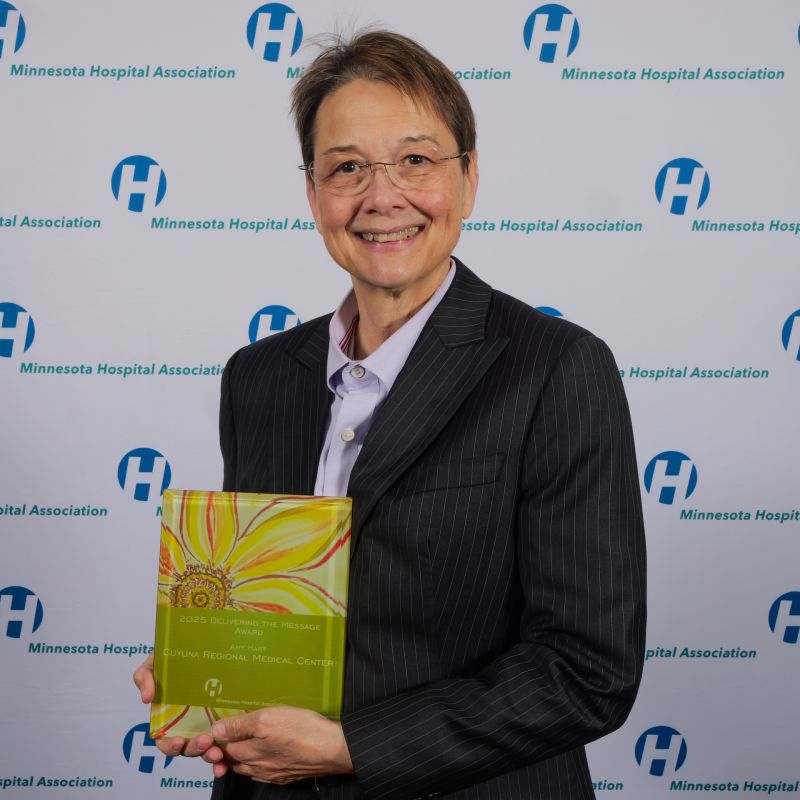
Hospital leadership in a small place is performed under bright civic light. Hart serves on CRMC's board as well as its senior management team. She has participated in statewide discussions about high-performing teams and rural staffing. In 2025, the Minnesota Hospital Association gave her its Delivering the Message award, recognizing work that helps communities understand hospital issues. Becker's also placed her on its 2025 list of 103 critical access hospital presidents and CEOs to know.
The award's phrasing is unusually good. A chief executive does not merely have a message; she has to deliver it. The distance between those verbs contains public meetings, board packets, anxious employees, skeptical neighbors and a dozen opportunities for plain English to lose a fight with institutional vocabulary. Hart's public comments tend to return to support, trust and collective effort. When CRMC was recognized for patient recommendations, she credited the compassion of staff, the expertise of providers and a shared commitment to care close to home.
Her connections to the place also exceed the employment contract. CRMC's annual report lists Hart among substantial donors to its charitable foundation. Her public professional profile records service as treasurer of the Cuyuna Range Youth Center beginning in 2018. These details do not make an argument by themselves, but they give texture to her favored language of community. She has put time and money behind the noun.
“Find something you are passionate about and change lives.”Hart, writing after her son's graduation
That advice appeared in a personal LinkedIn post. Hart wrote that her son had been unsure what to do after high school, went to college, found a passion for law and graduated with honors. She borrowed a line from “Simple Man” and then supplied the injunction above. It is a small window into a public record otherwise dominated by budgets, staff counts and job titles. Careers rarely reveal themselves in a flash. Sometimes the useful thing is to begin, pay attention and recognize the work when it starts to feel like yours.
What the long game buys
Hart's own career makes the case. The bachelor's degree in education did not announce a hospital CEO. The compliance jobs did not advertise glamour. Nine years as COO did not offer the neat, impatient arc of a business-school case study. Yet each stage accumulated fluency: rules, clinics, physicians, operations, people. By the time the title arrived, the education had already happened.
CRMC's future will not be secured by biography. Rural hospitals face hard economics, costly technology and a national competition for labor. Independence offers no exemption. It only places the choices closer to the people who live with them. Hart's wager is that proximity can be an advantage: leaders hear the community sooner, teams see the meaning of their work more directly and investments can be judged by the distance they remove from care.
In Crosby, this idea has history behind it. The community built a hospital when an older one vanished with the mining economy. Its current leader is not trying to preserve that institution in amber. She is trying to preserve its agency by changing its capability. There is a lovely stubbornness in that: remain independent by refusing to remain the same.
The hospital's next era will arrive the way Hart says momentum does. Not as a grand entrance. As a thousand people showing up, solving today's problem and leaving the place a little more prepared for tomorrow. The long game is made of short days.