At 165 University Avenue in Palo Alto, a landlord could watch an unusual procession of tenants. Logitech worked there. So did PayPal and Google. The Amidi family had bought the building in December 1986. Its place in technology history would come later. First, it was an address with rooms to rent. That distinction matters: the family was close enough to watch young companies before their names became shorthand for whole industries.
- Amidi combines property operations, industrial businesses and startup investing.
- Its three familiar platforms are TENTEN, Hollywood Production Center and Plug and Play.
- The recurring proposition: give professionals useful space, then help them meet useful people.
Rahim and Saeed Amidi co-founded Amidi Group in 1980. Their family’s American business history includes a Palo Alto rug shop, bottled water and plastic resins. Those are wonderfully tangible things. You can inspect a carpet, deliver a bottle, count a shipment. Startup investing introduced another kind of inventory: possibilities that might become valuable, provided the people behind them could find money, customers and help.
The tenant who changes the business
The brothers’ experience complicates the familiar picture of a venture investor arriving with a fund and a thesis. Here, property and operating businesses came first. Saeed told Mixergy in 2011 that technology investments had been a side business. PayPal’s success made that sideline more compelling. The shift was grounded in an outcome he had seen, rather than a decision to abandon everything the family already knew.
“This is a really good side business.”
Saeed Amidi, recalling the lesson of PayPal, 2011
Amidi’s portfolio still reflects that sequence. Chemtex distributes raw plastic resins. ALPS operates in bottled water. Real estate supplies another set of operating demands. The group reports more than one million square feet of property and over $2 billion in managed assets across its holdings. Those are company-reported figures on an undated website; managed assets describe holdings under management, rather than a price someone has paid for the company.
For a reader trying to place Amidi in the market, the useful comparison depends on the door being opened. An office tenant could consider a conventional landlord or a serviced-office operator. A relocating professional might compare furnished apartments and corporate housing. A founder seeking commercial introductions could approach an accelerator or corporate innovation program. Amidi has businesses occupying each of those positions.
Hollywood supplies the rehearsal
Hollywood Production Center opened its first location in 2001. In a 2010 Wharton interview, Saeed described how entertainment teams shared ideas, personnel and equipment. A production has an idea, assembles a team and tries to deliver something people will buy. He recognized a practical resemblance to a startup. It was an observation about how work gets organized, made by someone watching businesses use buildings.
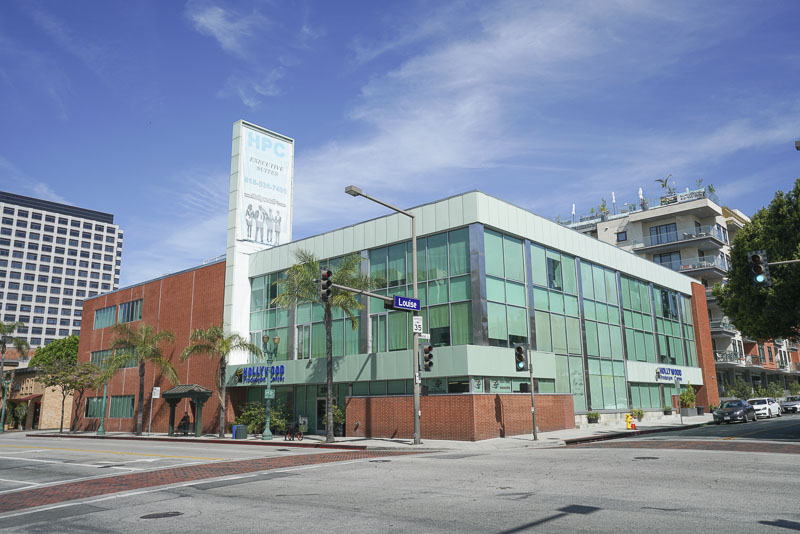
Today HPC lists six campuses across Hollywood, Glendale and Burbank. Its offer includes furnished private offices, internet, reception, maintenance and shared facilities. Production companies remain part of the audience, alongside startups, agencies and professional practices. For a team on a deadline, arranging a desk, a connection and someone to receive a delivery is real work. Bundling those tasks lets the tenant spend more time on the project.
Plug and Play opened its Sunnyvale campus in 2006. The wider proposition connects startups with corporations, investors and other partners through acceleration and innovation programs. Amidi’s description makes an important distinction: joining a program does not require handing over equity. Venture investment is a separate activity. A founder can seek access to potential customers without assuming that every introduction comes with an ownership transaction attached.
In its 2025 financial-services report, Plug and Play described initial investments ranging from $25,000 to $3 million, from pre-seed through Series A. That range belongs to the venture platform; it is not the cost of joining a program or a funding round raised by Amidi Group. For a corporate participant, the useful question is different: which startup can solve a problem the business actually has, and who can authorize a trial?
The bill for putting it together
TENTEN brings the argument home, literally. Its Wilshire offer combines apartments with business facilities and leisure amenities. Current options include furnished or unfurnished homes and different service packages. A consultant arriving for an assignment or a professional moving cities can arrange somewhere to live while retaining access to places to work and meet. The customer is buying convenience with a particular address attached.
The physical investment is substantial. In 2013, the Los Angeles Business Journal reported that converting the former Signal Oil headquarters into 227 TENTEN units had cost approximately $50 million. In September 2021, RENTV reported the completion of 1027 Wilshire, an expansion across the street adding 376 live-work units. These are buildings with construction bills, operating costs and continuing obligations to residents.
Reported project cost in 2013 coverage.
227 units in a former oil-company headquarters.
That helps explain the business model. Property produces rent and service income; distribution businesses sell products; startup stakes offer potential investment returns. Each has a different timetable and risk. A rooftop and a reception desk need paying users whether or not a portfolio startup succeeds. The appealing part of the combination is its range of relationships. Its demanding part is the amount of operating work those relationships require.
The group’s advantage, as an editorial reading of its portfolio, is the overlap between these audiences. A production team needs temporary capacity. A new company needs room to grow. A relocating executive needs a home and a working connection. Serving those situations calls for property expertise, reliable services and relationships maintained over years.
Property and early-stage investing.

Operating businesses and startup connections.
A network needs someone to work it
The most portable lesson is surprisingly unglamorous. In his Mixergy interview, Saeed described making 20 goal-directed calls or emails a day, seeking relationships with entrepreneurs, investors and universities. Useful proximity still needed deliberate outreach. Someone had to arrange the meeting. A smaller operator could copy that habit: identify the people customers need, make specific introductions and keep doing it after the opening party.
The economics still need to fit. Expensive shared amenities require customers who value them enough to pay. Introductions require relevant participants and follow-through. For someone who needs only inexpensive space, the extra services may add little. In a May 2026 TeqTalk interview, Saeed was discussing AI collaboration among companies, universities and governments. The subject had changed again. The practical question remained familiar: who should be in the room together?