At Ohio Stadium, the audio processors were still doing their job. That was the awkward part. By 2024, the university’s network had evolved around them, and equipment that could move sound around a stadium could no longer participate comfortably in the wider IT environment. American Sound’s assignment was to change the hardware without making the operators relearn the system.
- Design, installation, programming, and ongoing support under one roof.
- Meeting rooms, stadium sound, healthcare collaboration, and retail displays.
- A service model that connects room technology to IT operations.
The company replaced the old Q-SYS processors with Core 610 servers, separated audio traffic from management access, and preserved the existing software design. The limitation had been network flexibility, rather than a reported equipment breakdown. The lesson is wonderfully practical: before replacing everything, identify the part that has stopped fitting.
The room is somebody’s system
American Sound occupies the space between equipment manufacturers and the people expected to use their products. A camera, microphone, display, and meeting platform can each function correctly while the assembled room remains confusing. Integration is the work of making those pieces cooperate, then giving someone responsibility when they do not.
Its offering runs from consultation and engineering through installation, programming, commissioning, and support. The company says it delivers this work in-house. That gives buyers a concrete proposition to examine: can the same organization carry the design intent through construction and into daily operation?
The business model combines project delivery with ongoing managed services. Customers buy a working environment and can retain support after handoff. The useful procurement distinction is between the construction scope and the operating commitment. A well-equipped room still needs maintenance, troubleshooting, and a clear owner.
One hundred rooms, one less thing to learn
At an unnamed Fortune 500 headquarters in the Phoenix area, American Sound reports installing more than 100 Microsoft Teams Rooms across six floors for over 600 employees. Crestron Flex supplied the common platform. Individual spaces varied, but the joining experience was designed to remain familiar.
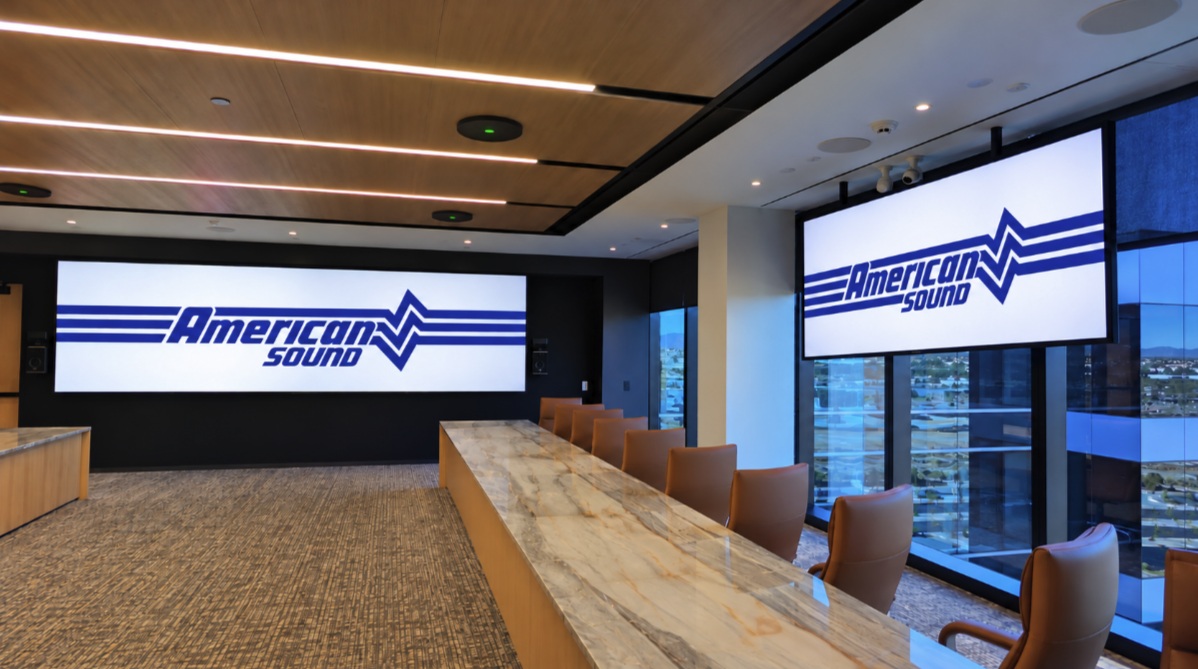
There were huddle rooms, training spaces, an executive boardroom, and a security operations center. American Sound says every room was commissioned and tested before handoff. The point of standardization was not identical furniture or identical screens. It was reducing the number of new instructions an employee needed when moving between rooms.
That is a useful buying principle. Standardize the interaction, then select equipment around the space. A small room and a divisible training suite have different acoustic and visual demands; their users should not need separate mental instruction manuals.
A shop window becomes a service ticket
The argument for managed service becomes clearer when the rooms turn into hundreds of retail locations. In a company-published case study covering an unnamed apparel brand’s US and Canadian stores, displays had limited centralized visibility and problems could linger. Maintenance also had to respect store hours.
American Sound connected Utelogy monitoring to ServiceNow and built custom logic linking alerts to the correct assets, locations, and workflows. Deployment happened remotely during approved change windows. The company reports that approximately 85% of incidents are now resolved remotely, with average resolution time falling from weeks to under 48 hours.
Company-reported retail case study
Those results describe one engagement, rather than a universal service guarantee. They illustrate why the asset record matters: an alert becomes useful when it identifies a place, a device, and a next action. Remote work still needs permissions and reliable connectivity. A physical fault can still require a technician at the store.
Do the fiddly work before arrival
Turfway Park offers a smaller lesson with broad appeal. For the racing and entertainment property’s redevelopment, American Sound worked alongside NV5 on a Visionary AV-over-IP deployment spanning 60 endpoints. Engineer Daniel Martin described updating firmware and assigning addresses off-site, with the configuration completed in about two hours.
The $148 million associated with Turfway was the redevelopment budget for the whole property. It should not be read as the price of American Sound’s AV work. The transferable idea is preparation: put the equipment on a test network before the installation crew is trying to solve problems in a finished venue.
before arrival
whole system
ownership
There is code behind the cameras
The company’s software ambitions have a pleasingly unceremonious address: Pete’s Pizzeria, the name CTO Doug Schaefer gives its experimental R&D group. In April 2026, he described releasing an open-source connector between Utelogy and AI tools. The revealing detail is the decision to publish something other people can use.
The Utelogy MCP server runs locally and exposes operational information about rooms, assets, and alerts. Its MIT license makes the connector free; using the underlying platform requires a valid Utelogy subscription and API access. It is a concrete tool for people already operating that environment, with specific prerequisites.
Who gets heard at the table?
At Indiana University Health’s Fairbanks Hall, the problem was a boardroom with reflective surfaces and an aging AV system. American Sound’s redesign paired six tracking cameras with twelve tabletop microphones and an LED wall. Camera automation helped remote participants follow the person speaking, rather than watch a static view of an entire table.
That project makes the customer problem unusually clear. A hybrid meeting has two audiences, and the person joining remotely needs intelligible sound and useful framing. The same attention carries into the company’s education offering, which covers lecture halls, distance learning, and campus systems. Equipment choices begin with who needs to hear, see, and participate.
The test comes after opening day
American Sound’s newer projects make its priorities tangible. At Paycor’s downtown Cincinnati headquarters, work began in late August 2025, move-in followed before Christmas, and closeout came in February 2026. Ongoing support formed part of the arrangement. The company reports four tickets in the following eight months.
“Meeting rooms are where our clients feel the technology most, so that’s where we focus.”Doug Schaefer, CTO · October 2026
Its October Microsoft partner announcement emphasizes Teams meetings and rooms; September brought a Q-SYS developer partnership. Those relationships sit beside an unglamorous operating discipline: make the controls understandable, connect the devices to support, and keep the people who understand the system available. The next meeting is where that discipline gets tested.