The button says “Join”. Behind it sits a small diplomatic mission: microphones, cameras, displays, room controls, network connections and a meeting platform must agree to cooperate. The person arriving with a laptop has no interest in their negotiations. That gap between a simple expectation and a complicated installation is where AVI-SPL UK & Ireland makes its living.
The company designs, installs and supports audiovisual and unified communications systems. Its assignments can involve a familiar conference table or an interactive customer environment. The practical brief is much the same: make the technology usable, connect it to the organisation’s other systems, and give somebody responsibility for keeping it working.
It is an instructive business to examine because its most visible products explain only part of the purchase. Screens and speakers are tangible. Engineering, user training and the person answering a support call are less photogenic. Yet those services help determine whether an expensive room becomes an everyday tool or a place employees approach with a little apprehension.
The sale continues after the installer leaves
AVI-SPL’s professional services run from assessment and design through programme management, installation and training. Its managed services extend the relationship into daily operations. Customers can buy enterprise support across AV, digital signage and communications, or arrange dedicated onsite technicians. Asset inventory subscriptions track equipment and other workplace assets over their useful lives.
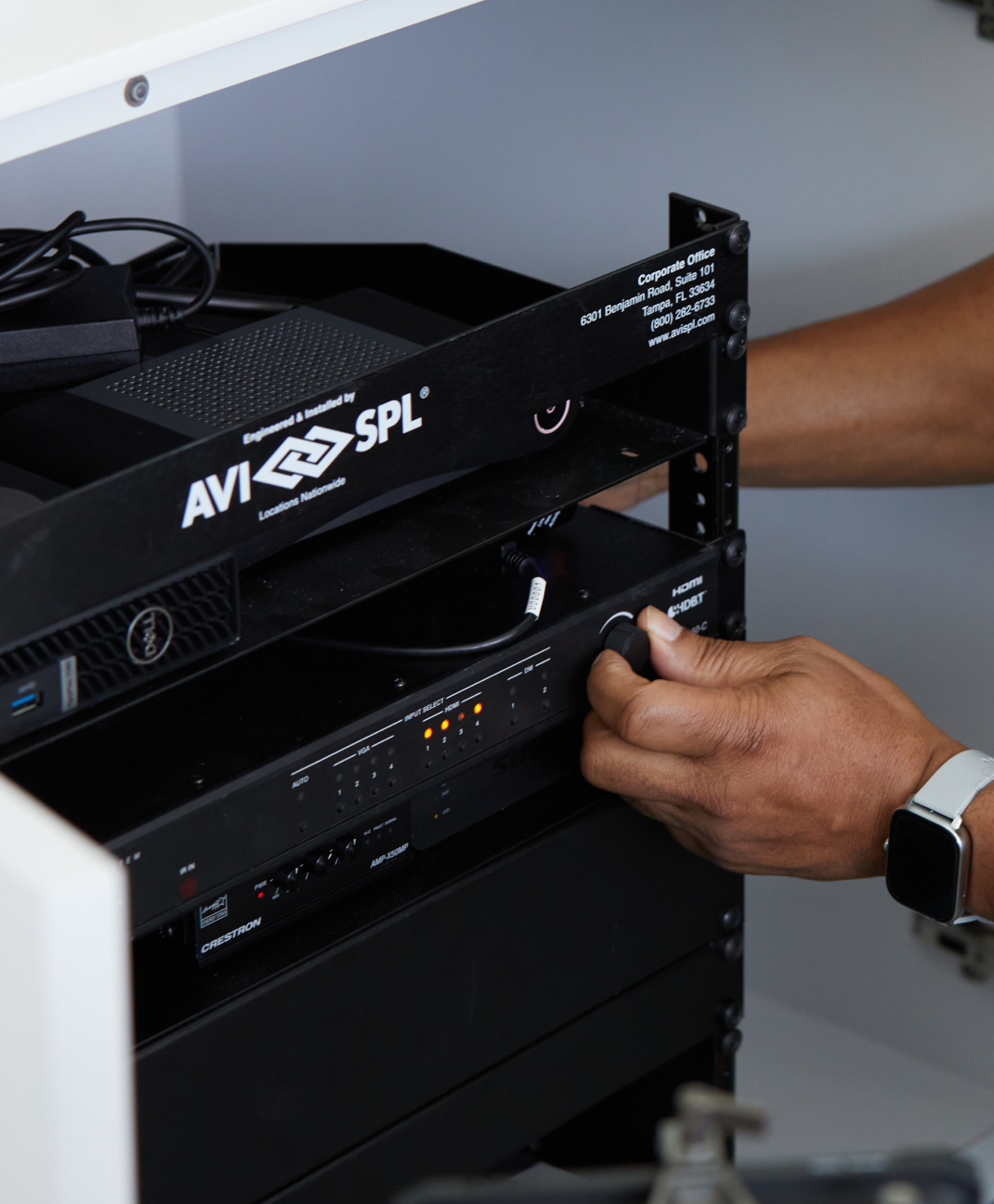
The company sits between technology manufacturers and the organisations using their products. Microsoft, Cisco, Zoom, Crestron, Logitech, HP Poly and Q-SYS appear in its partner portfolio. Those names represent different parts of a room and its connections. The integration job is to assemble a working environment, then make its operation understandable to people who have other work to do.
There is a commercial logic to that breadth. A project creates equipment and installation revenue; support and subscriptions can continue afterwards. For a customer, the attraction is a route from planning to operation through the same provider. The important procurement question becomes who takes responsibility when a problem crosses the boundaries between devices, software and the building.
€6.2 million buys a foothold in Ireland
The UK operation opened in 2013, following the incorporation of AVI-SPL Limited in November 2012. Its base is Farnborough. The global business has a longer and rather pleasingly analogue backstory: Audio Visual Innovations began in Florida in 1979 selling Kroy lettering machines. The regional operation belongs to that larger group; its own history should not be stretched backwards to fit the parent’s birthday.
Ireland became a direct part of the story in 2022 through the acquisition of Dublin AV integrator Sonics. The businesses had already collaborated on projects. Sonics brought an established engineering team and local relationships into the group, giving AVI-SPL a way to expand its Irish delivery capability through people who already knew the market.
By May 2025, reporting on the expansion put AVI-SPL’s cumulative investment in Ireland at €6.2 million and said its Irish headcount had tripled since entry. That is an investment figure covering the period since 2022. It should not be read as the construction bill for one showroom.
Investment since market entry in 2022
On May 1, 2025, the company opened its Customer Experience Centre in Tallaght. Visitors can explore a boardroom, a Microsoft Front Row room, a huddle room, a collaboration area and a town hall or training space. There is also a video wall and an open-office hot-desking area. The facility gives a purchasing conversation something useful to sit in.
The Irish customer base includes organisations in finance, professional services, technology and pharmaceuticals. Those sectors help explain the combination of local presence and international reach: a project may require engineers nearby while the customer wants a familiar approach across several countries.
A pensions conversation with a gesture-enabled mirror
Standard Life’s Edinburgh Innovation Lab shows how far the brief can travel beyond video calls. Launched in 2022, the lab was created as a place to explore ideas with clients, advisers and partners. AVI-SPL worked with experiential design firm Downstream to bring its technology together.
Visitors encounter personalised welcome content, a gesture-enabled mirror and interactive displays. A large collaboration wall allows presenters to move through material according to the conversation, while an agile studio supports work in progress. An AR/VR area gives demonstrations another format. A content management system lets lab managers tailor and schedule engagements.
The project reached the shortlist for Corporate Project of the Year at the 2023 AV Awards. More revealing than the hardware inventory is the operating idea: a room can help shape a conversation when content, layout and controls are designed together. That requires people to prepare the material and run the sessions. A wall of pixels cannot supply the agenda.
The London move that included a lesson
A separate AVI-SPL case study describes an unnamed financial institution moving into a London headquarters with a more flexible workplace. The installation included a reception video wall, but the story also gives substantial attention to training and adoption. Staff received support material intended to be accessible where and when they needed it.
The company reports positive employee feedback: people felt prepared for the move and found the equipment intuitive. This is a customer account, rather than an independently measured productivity result. Its useful detail is the sequencing. Helping people use the new environment was part of delivering the environment.
Buyers can borrow that sequence. Ask an employee who has not attended the design meetings to start a call, share content and find help. Watch what needs explaining. AVI-SPL also offers VR room design, with examples ranging from small meeting spaces to production suites and control rooms. That creates an earlier opportunity to involve users and explore alternatives, before a design becomes a physical commitment.
Who notices the problem before the meeting?
Symphony is AVI-SPL’s software answer to managing a mixed collection of meeting technology. It brings together information from connected devices and manufacturer management tools, including performance and room-usage data. Integrations include Microsoft Exchange or Office 365 and ServiceNow. Automated workflows can detect issues and create tickets.
The distinction matters to an IT team responsible for many rooms. An installed device, a working device and a useful meeting experience are different things to observe. Bringing information together can help the team decide what requires attention. The dashboard still needs a defined response: somebody must own the ticket and have the authority to act.
- 01ObserveDevice + room data
- 02RouteAlert + service ticket
- 03ActRemote + onsite help
- 04ReviewPerformance + use
In February 2026, the global Symphony business announced three subscription tiers. Standard addresses basic visibility; Premium adds connections to IT service-management deployments and manufacturer platforms; Professional adds capabilities including API access, workflows and customisable analytics. The structure separates customers by the depth of management they need. Buyers should map those capabilities against the devices and processes they actually use.
The room has a payment schedule
AVI-SPL’s Collaboration as a Service programme can bundle hardware, software licences, deployment, maintenance and managed services. Its published terms offer subscriptions of one to five years, with monthly, quarterly or annual payments. The contents depend on the customer’s technology plan and users’ needs.
That changes when the money leaves the organisation. It also changes what belongs in the comparison. An equipment quote and a bundle containing years of support answer different purchasing questions. A useful evaluation puts installation, licensing, training, support and refresh assumptions on the same page, then checks the responsibilities attached to each.
The model deserves particular scrutiny when a customer needs only a simple room, already has capable support staff, or expects its requirements to change sharply during the term. In those circumstances, the value of a broad bundle may be harder to justify. A demonstration should be followed by a close reading of scope, supported equipment and service commitments.
Europe asks for fewer handoffs
Scale is part of AVI-SPL’s pitch, but customers also need that scale to feel manageable. In December 2025, the company announced a unified European operating model under Michael Kellaway, previously its UK and Ireland managing director. It identified a specific customer demand: fewer handoffs, consistent delivery and clearer accountability across countries.
“Our customers are driving this change.”
Michael Kellaway · Managing Director, Europe · December 2025
At ISE in February 2026, AVI-SPL described a European Core Team coordinating regional priorities and complex programmes across countries. The operational test is whether common structures make engagement easier while preserving useful local knowledge. A European organisation chart alone cannot demonstrate that outcome; delivery has to do the proving.
There are credible alternatives. Kinly also offers AV integration, international deployment and managed support. AVI-SPL’s case rests on its particular combination of regional engineering, the global group, Symphony and experiential work. Prospective customers can compare those capabilities against a real project rather than assuming every room needs the full portfolio.
The parent’s reach supplies context: at the completion of 26North’s acquisition in August 2025, AVI-SPL reported more than 4,400 employees and over 70 offices worldwide. Those are global figures. The regional business is the part a UK or Irish customer encounters through project teams, service staff and places such as Tallaght.
Its next scheduled London showcase, VIBE on September 24, 2026, offers another opportunity to try the technology and meet specialists. The question worth taking along is wonderfully unglamorous: after this room opens, who keeps it useful? AVI-SPL’s business extends across the answer, from design choices to the support call long after the photographs have been taken.
Try the rooms. Meet the people.
Explore AVI-SPL UK, book a Dublin experience-centre tour, or browse virtual room designs.
Follow the UK & Ireland LinkedIn page and the group on X and Facebook. Read the European operating-model announcement, browse the company blog, or see VIBE London details.