Consider a housing agency on the morning an eligibility rule changes. The new threshold must reach the application form, the lender’s screen and the person reviewing the file. Yesterday’s application still needs an intelligible history. Somewhere inside that apparently modest administrative task lies a software business. Altair Software has made a proposition out of buying businesses like that.
- Buys to keep: Altair advertises permanent ownership and decentralized operations.
- Specialists do the work: its publicly linked brands serve housing, education, lending and treasury.
- The useful question: can the software handle your institution’s awkward exceptions?
Altair describes itself as a Constellation Software subsidiary. Its associated brands include Emphasys, Fame, Infinity, EPIC Loan Systems and SymPro. These names belong to different operating businesses, with different customers. Their common feature is a close relationship with work that has to be done correctly, repeatedly, and under rules somebody else can change.
The most interesting word is “forever”
Altair’s acquisition pitch includes the phrase hold forever
. Sellers are offered a decentralized structure and a transition that can accommodate staying with the business or moving on. For a founder whose product contains years of customer-specific knowledge, the identity of the next owner becomes part of the decision.
You can see that proposition operating in the wider Constellation network. Aquila, which publishes acquisition announcements for several Altair-linked brands, bought Fame in 2017, acquired EPIC’s assets in 2018 and acquired Infinity in 2021. The Infinity announcement explicitly promised an autonomous business unit. In 2022, Aquila grouped Infinity, EPIC and underwriting specialist Tekambi under LendSuite, while saying the companies would continue operating autonomously.
That sequence is useful because it makes the structure tangible. A business can gain a new owner, and later a shared commercial umbrella, while retaining its own products and customer relationships. It also means a buyer should investigate the particular operating company behind a product. A family connection does not establish that every system shares one database.
- 01AcquireBuy a specialist software business.
- 02RetainKeep operating knowledge close to customers.
- 03DevelopSupport the business over a longer horizon.
Four desks. Four very different problems.
Start at the housing desk. Emphasys PHA offers software for voucher programs and public housing, alongside resident portals, mobile tools, analytics and hosting. Emphasys HFA serves housing finance agencies with single-family and multifamily tools. Its single-family offering spans pre-eligibility, lender collaboration, document handling, tracking and servicing. The customer is the institution administering the program; the household feels the quality of the process.
At a school, Fame combines student information systems with admissions software, document management and financial aid services. It specifically addresses career-school markets, including cosmetology, barbering, massage and allied health. Software sits beside processing and consulting. The school can buy help doing the work as well as a system for recording it.
Company-reported figures for separate businesses. Different customer groups; no combined total.
At a municipal treasury desk, SymPro handles investment accounting, debt information and cash management. Its customers include public entities with portfolios ranging from millions to billions of dollars. Its modules can run separately or together. The attraction is practical: fewer disconnected records, less manual consolidation and a clearer view of obligations.
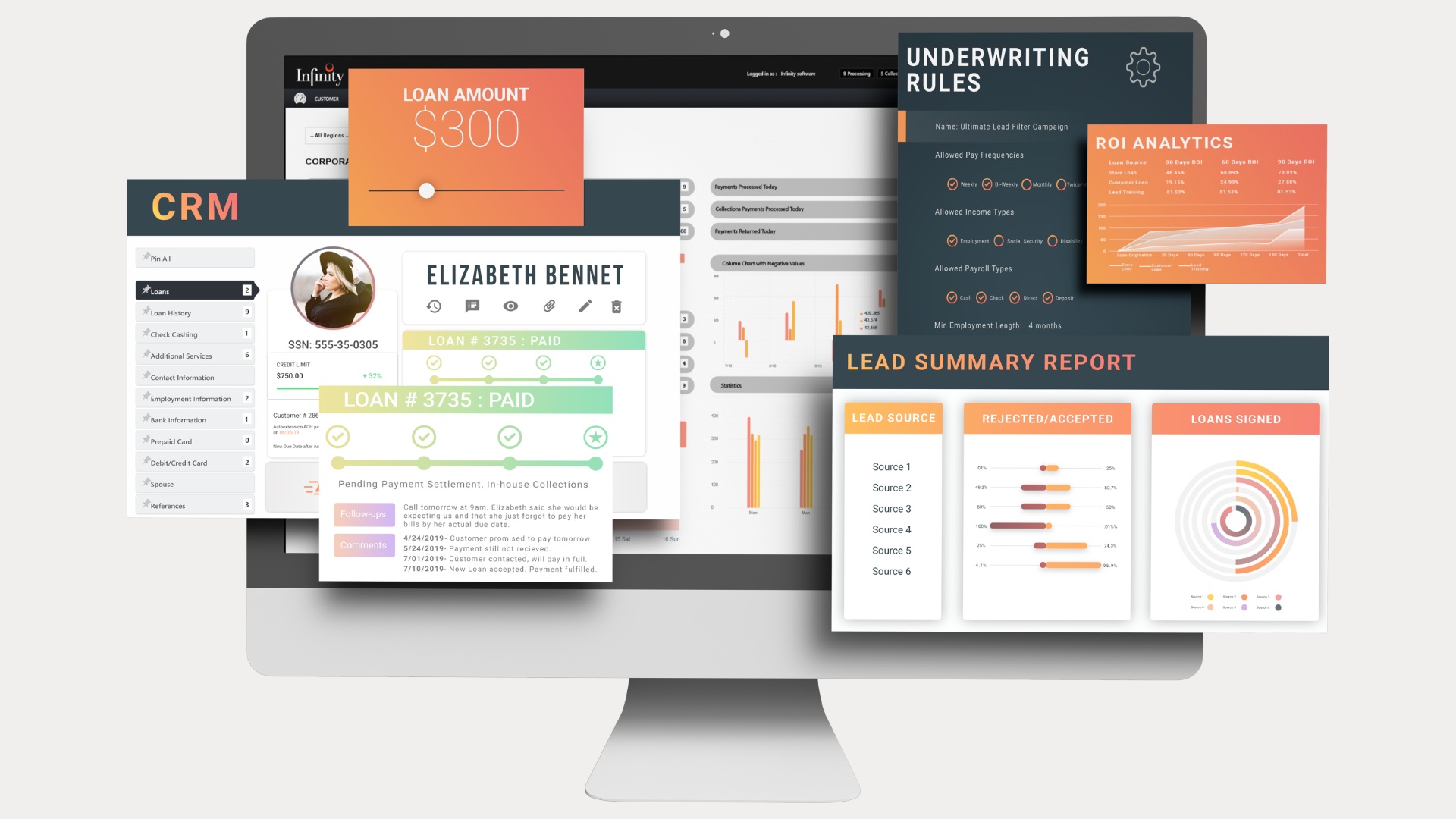
At a lender, Infinity supports the loan lifecycle for alternative-credit businesses. EPIC addresses online loan origination and management. These are institutional tools for handling lending operations. Their usefulness depends on fit with a lender’s products, processes and integrations. A polished dashboard is only the beginning of the conversation.
The price can change the day before closing
Permanent ownership still involves negotiation. Infinity’s sale was prompted by the founder’s retirement, according to his son Ryen Leyva. In a Corum-published account of Infinity’s sale to Aquila, Leyva described a major customer expressing uncertainty about renewal just before closing. The proposed price reduction was $1.8 million. He said it became $1 million with an earnout after he threatened to walk away. The customer ultimately renewed.
“It’s just people on the other line.”
Ryen Leyva, on selling Infinity to Aquila, in a Corum account
The episode supplies a concrete cost of customer concentration and a reminder to sellers: prepare records while running the business, rather than assembling them under pressure. For buyers, it suggests an equally useful test. Understand why customers stay, and what might make a large one leave.
The knowledge needs maintenance too
The operating businesses keep changing their products. In April 2026, Emphasys announced an update to Emphasys University with intelligent search, course recommendations, translation and Podcast Mode. Its explanation began with an unglamorous problem: staff join between training sessions, experienced people retire, and processing questions appear while somebody is trying to finish a file.
That is a revealing product decision. Knowledge can disappear even while the software remains installed. Training, implementation and support belong in the same purchasing conversation as features. Altair’s decentralized pitch makes sense only if specialist expertise continues reaching the people who need it.
Make the demo earn its keep
The business model combines ownership of software companies with the operating brands’ sales of software and services. Fame’s processing work, Emphasys’s hosting and training, and SymPro’s modular tools show why the commercial relationship extends beyond an initial installation. Buyers should compare the complete proposed engagement, including migration and ongoing support.
The copyable lesson is to start with a troublesome real case. Ask a housing vendor to demonstrate a changed eligibility threshold and the historical record. Ask a school vendor to follow an incomplete aid file. Ask a treasury vendor to reconcile an awkward transaction. Then assign responsibility for data conversion, training and updates.
Specialization earns its place when those details consume time or create errors. An institution with simple requirements may need less software. A team unwilling to clean its data or train staff will still have problems after buying a specialist system. The appeal of Altair’s world lies in respecting the ordinary task enough to keep improving how it gets done.
Follow the work
Explore the businesses, their products and the conversations behind them.