Alon Talmor had already reached the part of the startup story that usually earns the closing slide. His company, BlueTail, had been acquired by Salesforce. He had become chief data scientist at Data.com. The next chapter could have been another company, launched with the credentials and contacts that come with selling the first.
Instead, he went back to difficult questions. Quite literally: his doctoral work at Tel Aviv University concerned how machines reason their way toward answers. The decision gave his career an unusual middle act, with research papers where a second startup’s pitch deck might have been. It also placed him close to a problem that would eventually become a business again.
Today Talmor is founder and CEO of Mosaic AI, the enterprise software company previously called Ask-AI. Its work is concerned with technical support: the customer’s unresolved issue, the relevant information scattered across systems, the employee who needs an answer that actually helps. His route there makes a useful story about what an entrepreneur chooses to learn after an exit.
The exit that led back to a classroom
Salesforce acquired BlueTail in 2012. Talmor’s job at Data.com kept him in the business of making information useful to companies. An acquisition changes the setting, though. A small team’s decisions enter a larger organization, with the coordination and patience that requires. He has described finding that adjustment difficult; he wanted to make an impact quickly.
By 2015, he was looking toward AI and natural language processing. Jonathan Berant, returning from Stanford to Tel Aviv University, became his doctoral advisor. Talmor completed his PhD in 2020. The interval matters: he was working on question answering years before a conversational interface made that subject a familiar household activity.
The academic chapter also produced a continuing professional connection. Berant appears beside Talmor on research papers and later among Ask-AI’s team. It is a relationship that crosses an institutional boundary without needing a change of subject. The research asks how an answer can be assembled. The business asks how someone can use it.
- 2012BlueTail joins Salesforce
- 2020PhD completed
- 2021Ask-AI founded
- 2026Mosaic AI name announced
A question too large for one search
In 2018, Talmor and Berant published work on answering complex questions using the web. Their approach broke a difficult question into a sequence of simpler questions, then combined the answers. The accompanying dataset was called ComplexWebQuestions. The name makes the assignment admirably clear; academic branding occasionally does everyone a favor.
The research addressed a familiar frustration. Finding a relevant passage can leave the actual thinking unfinished. A question may require several pieces of information, collected and joined in the right order. Their model treated that joining as part of the work. On the new dataset, question decomposition improved the reported precision-at-one result from 20.8 to 27.5.
The numbers belong to that experiment, with its particular models and test conditions. The durable point is the shape of the task: a useful answer can require an organized series of smaller discoveries. Someone investigating a complicated software problem will recognize the burden, even without knowing the name of the benchmark.
CommonsenseQA followed in 2019, with Jonathan Herzig and Nicholas Lourie also on the author list. This time the problem involved background knowledge people bring to a question without being handed an explanatory document. The team used concepts from ConceptNet to help workers write multiple-choice questions that required more than a simple association.
That work puts a rather demanding version of “obvious” on the examination paper. People rely on knowledge of everyday situations while barely noticing they are doing it. Testing a machine on that knowledge requires care in how the question is constructed. Otherwise the test may reward a convenient clue and leave the intended ability unexamined.
An exam with mischievous examiners
Talmor’s coauthored oLMpics research pushed further into what language models could actually do. Published in TACL in 2020, it examined eight reasoning tasks, including operations such as comparison and composition. The researchers used controls to help distinguish capabilities present in pretrained models from abilities acquired during additional training.
One result was especially revealing: a model could compare ages within familiar human ranges and still struggle when the numbers moved outside those ranges. A success could depend on the surrounding context. The lesson for anyone assessing software is uncomfortable in a useful way. A good-looking answer tells you less than you hope about how the next answer will behave.
His work also explored ways to teach reasoning. Leap-Of-Thought, presented as a spotlight paper at NeurIPS 2020, combined knowledge already learned by a model with explicit statements supplied in language. Its experiments examined reasoning skills such as chaining and counting, including combinations of skills beyond the training distribution.
Then came a particularly playful way of finding weaknesses. For CommonsenseQA 2.0, Talmor and his collaborators turned question writing into a game. Players tried to mislead a rival AI, earning additional points for using specified phrases. Human inventiveness became part of the testing apparatus. There are worse uses for the pleasure of catching a machine out.
Common sense remained a demanding exam.
The dataset contained 14,343 yes/no questions. The human score and model results illustrate why the team made the game: passing familiar benchmarks could coexist with substantial failures on questions designed to challenge the system. For Talmor, the research record includes repeated efforts to inspect that gap rather than take an impressive demonstration at face value.
The customer attached to the question
Ask-AI was formally founded at the end of 2021. The practical assignment was to help employees get answers from company knowledge and customer communications. By October 2022, when the company announced $9 million in seed financing, its customers and design partners included businesses such as Yotpo and OwnBackup.
Inside a company, the information may already exist and still be difficult to use. It lives in messages, documents, earlier interactions and separate applications. Finding it can consume the time of both the person asking and the colleague who knows where to look. A support ticket adds a deadline and a waiting customer to the exercise.
Talmor’s approach to building the business included testing demand with design partners before undertaking a formal fundraising process. His account emphasizes listening for an existing problem. The customer should be able to describe the difficulty without first receiving a lesson in why your proposed product would be wonderful.
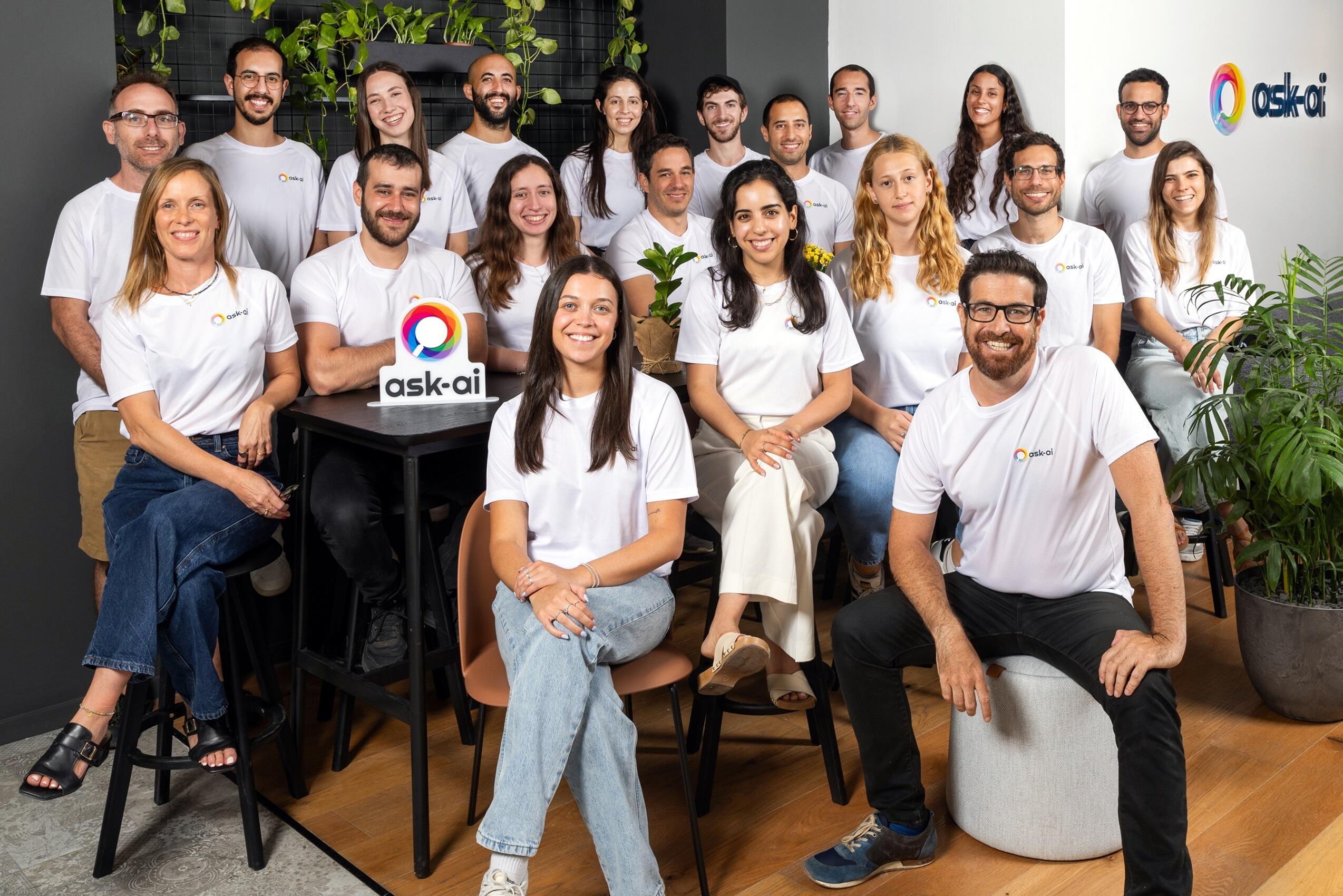
That is consistent with the description he gives himself: “I’m a little bit more conservative.” The phrase concerns financing and validation. It sits comfortably beside the less tidy story of a prospective executive deciding against joining during a fundraising process, after Talmor had already presented that person to investors.
His advice was to be candid: “Tell them exactly what happened and exactly why.” A pitch depends on a coherent account of the company. When the account changes, the relationship has to accommodate the change. His story gives the financing announcements their missing human scale: somebody still has to make the difficult call.
In January 2024, Ask-AI announced an $11 million Series A led by Leaders Fund, bringing its announced funding to $20 million at that point. It also introduced ASK, a sidekick that presented contextual information within an employee’s workflow. The company connected to more than 50 work systems, including Salesforce, Zendesk, Slack and Confluence.
The promise was practical: put relevant knowledge near the task being performed. The platform provides a browser extension for employees and in-product or help-center search for customers. Talmor was building for people who already had applications open, customers waiting and work to finish.
A correction that survives until tomorrow
On January 19, 2026, Talmor announced the Mosaic AI name. His explanation described a broader scope for B2B support, customer experience and go-to-market teams. The company’s stated direction includes finding recurring issues and turning them into product action. Resolving a case is useful; fixing a recurring problem can help the next customer too.
“Support teams were never short on answers. They were short on time to find out what was actually wrong.”
Alon Talmor
His research has continued alongside the business. A preprint coauthored with Moshe Hazoom, Gal Patel and Tom Hope, first submitted in May 2026 and revised on October 19, examines factual corrections in business AI systems. It turns corrections into compact knowledge entries, then iteratively tests and revises them so they can be retrieved and used.
The method treats the correction as something to test. It starts with a compact entry, tries the original question and paraphrased versions, examines failed retrievals and answers, then revises the entry. That sequence matters because storing knowledge and making it usable are separate pieces of work. A correction can be perfectly legible to the person who wrote it and still fail to appear when the system needs it.
The problem is almost stubbornly ordinary. Someone corrects the system today. Tomorrow, a related question arrives. Will the correction be found? The work evaluates that process with production B2B knowledge-assistance agents. It brings the research close to the accumulated instructions and exceptions on which working organizations depend.
Beyond work, Talmor lists piano playing, snowboarding, kite surfing and mountain biking among his interests. His travel preferences include nature, hiking and places away from the usual route. Those details belong to a person with several ways to spend an afternoon, even if difficult questions have repeatedly claimed his professional attention.
From BlueTail to Salesforce, through the doctorate and into Mosaic AI, the settings have changed. The latest question is precise enough to be useful: when someone takes the trouble to teach an AI the right answer, how do you make that effort last?