The equipment was sophisticated. The arrangement was faintly ridiculous. At Harvard, Alok Tayi and a colleague were performing an experiment that required one scientist to hold a glass thermometer and another to record the temperature. Between them, they had an impressive amount of training. The information still travelled through a voice and a pen.
Tayi was doing postdoctoral work with chemist George Whitesides. He knew what a laboratory could accomplish. He also knew what a connected home could accomplish. A thermostat could communicate without recruiting a second person to stand beside it. Why should the laboratory demand so much ceremony?
There is a particular sort of business idea that begins with admiration for a technology. Tayi’s began with irritation at a procedure. The distinction matters to the story of TetraScience, which he helped found in 2014. A routine had become so familiar that its absurdity needed someone to notice it again.
A summer job without a paper route
He had been noticing laboratory routines for a while. Growing up near Albany, New York, Tayi took a summer job building hardware and software to automate tests involving nanomaterials. He was about sixteen. While other teenagers acquired expertise in cash registers, he was learning how a laboratory’s physical equipment could be made to follow instructions.
His father taught business; his mother had trained as a lawyer. Tayi credits chance, including the location of the laboratory near his father’s commute, for getting him through the door. He also credits the encouragement he received there. The first experience gave him a place to try things, make mistakes, and come back.
That is a useful detail in a career whose institutional names can otherwise make the route look inevitable. Cornell followed, then Northwestern, then Harvard. On paper, those names form an orderly procession. The summer job suggests something less tidy: a young person found interesting work nearby, and the experience stayed with him.
Crystals with a memory
At Cornell, Tayi studied materials science. At Northwestern, he worked in Samuel Stupp’s group, where the alumni record places his doctoral years between 2006 and 2012. Before he became known for laboratory software, he was doing the sort of research that required a serious explanation of what the material itself could do.
In 2012, he and Alexander Shveyd were co-first authors on a Nature paper about organic materials displaying ferroelectricity at room temperature. The underlying attraction was information storage: electrical polarization could be switched between states. The work asked whether relatively simple molecular ingredients could assemble into structures with useful electrical behaviour.
The crystals had emerged from an unexpected result in Shveyd’s research. A collaboration developed across the Stoddart and Stupp groups. Tayi helped investigate the materials’ properties. Here was an early instance of a pattern that would recur in his working life: someone had something another person could use, provided they could work out the connection.
A 2015 review in Nature Chemistry, co-authored with colleagues including Takuzo Aida and Stupp, continued the subject. The publication record gives substance to the word scientist in his biography. He had pursued an academic career seriously before deciding to spend his working days building companies.
published in Nature
takes shape
launches
Three skills and a train ride
PreScouter, which he co-founded during his doctoral studies, had already introduced him to the commercial side of research. Its purpose was to help companies find emerging technologies and expertise. The question was practical: how could useful work in a university laboratory reach someone with an industrial problem to solve?
His later MIT entrepreneurship biography credited him with helping build PreScouter to serve more than four hundred customers. That experience mattered when the thermometer problem suggested another business. An invention needs engineering. It also needs someone willing to discover what a customer will pay for.
Tayi discussed connected scientific instruments with Salvatore Savo on a train ride between Boston and Cambridge. Siping Wang joined them. Their experience fitted together: Savo knew hardware, Wang knew web software, and Tayi had worked in enterprise sales. The early company could draw on three kinds of competence that the product would require.
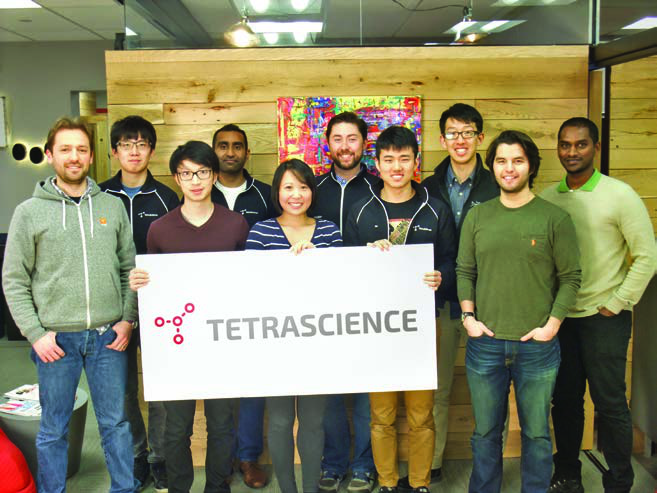
The original TetraScience Link connected instruments to a cloud service through a networked hub and adapters. That description has the pleasing lack of glamour common to useful infrastructure. The equipment remained on the bench. Its measurements could become accessible somewhere else, without another person carrying them there.
Digital Science announced a Catalyst Grant for the company in January 2015 and a subsequent investment in June 2016. The first award supported the passage from concept toward prototype. The later investment made TetraScience the first Catalyst recipient to receive follow-on funding from Digital Science.
The founders also went through Y Combinator in summer 2015. They kept their headquarters in Boston and flew to California each week for office hours and dinners. There are grander ways to describe a startup’s early development, but the weekly flight is a useful corrective. Building the company involved a considerable amount of getting to the next meeting.
The customer gets a vote
In an interview about the Internet of Things, Tayi explained that the company had started with laboratory inefficiencies and selected connectivity as a way to address them. The customer’s workflow and the business model had to fit together. Connecting an instrument, by itself, would not establish a reason to buy.
The distinction helps explain the distance between an interesting demonstration and a business. A demonstration can end when the apparatus works. The business has to keep going through installation, daily use, questions, and the next purchasing decision. A scientist’s enthusiasm for the mechanism cannot answer all those questions on the customer’s behalf.
By 2018, Tayi was writing about scientific data as the foundation for broader analysis. His article in SLAS Technology described the problem of missing centralized, machine-readable data repositories. Connected equipment could help create the collection of information that more ambitious analysis would need.
It was a progression from the thermometer to the dataset. First, capture the observation without the awkward routine. Then make it available in a form that software can use. The practical work underneath an attractive analytical result can be rather unphotogenic: records need somewhere to go, and they need to arrive in usable form.
“I want to be known as a collaborative entrepreneur.”
Alok Tayi, 2018
His account of leadership was similarly concerned with the people using the system. He wanted performance expectations to be visible and managers to understand individual strengths and weaknesses. He described customer recruitment inquiries as a particular source of pride: people who had used the product wanted to join the company behind it.
There was also a moral dimension to his thinking. In a 2015 essay, he argued that financial pressure could draw founders away from their own judgment. He wanted character and values discussed explicitly with investors, partners, and employees. The business would make demands; those demands should not quietly settle every question of conduct.
An apprenticeship inside a bigger company
His next executive chapter took him to Egnyte, where he launched and led its life sciences division. The setting changed from a young company to an established provider of content collaboration and governance software. A specialized business had to find its place within an organization that already had products and customers.
His official biography describes the unit growing to a sixty-person team and an eight-figure run rate. Those figures belong to that chapter of his career. They indicate the scale of the operation he helped build, with the ordinary obligations that come along with growth: hiring, coordinating departments, and delivering what the sales conversation promised.
His Egnyte writing concerned the movement and handling of information, including file servers, security, and compliance. These are topics unlikely to acquire a glamorous mythology. They are also topics that become very interesting when a team cannot find the right file or work confidently with the information in front of it.
A dependable Wookiee
Tayi now leads Vibe Bio as co-founder and CEO. Its current VibeOne platform applies AI to business development decisions in biopharma. The job remains concerned with turning complicated information into something a team can evaluate and use. He also co-hosts Biotech2050 with Rahul Chaturvedi, interviewing people about changes in the industry.
The podcast gives him another position in a conversation he has occupied as a researcher, seller, founder, and executive. He can ask how other people built an organization or arrived at a decision. For someone whose own work has crossed several professional boundaries, the questions are a useful part of the job.
Asked for a book recommendation, he chose Clayton Christensen’s How Will You Measure Your Life? He appreciated its attention to the uncertainty and difficult personal decisions that can sit behind a successful public career. Asked about Star Wars, he chose Yoda for perspective and Chewbacca for dependability.
It is a sensible pair for someone who has spent so much time assembling teams. One sees a little further ahead. The other can be counted on when there is work to finish. The thermometer experiment required two highly trained people to complete a routine. Tayi’s subsequent career has kept returning to how those people might put their time to better use.