A scientist held a glass thermometer. Another wrote down the temperature. Both were highly trained; neither was doing work that required years of scientific training. Recalling the scene for the Nasdaq Entrepreneurial Center, TetraScience co-founder Alok Tayi described the absurdity that helped inspire the company. The laboratory could conduct sophisticated experiments. Recording what happened still involved a person with a pen.
- The job: make incompatible laboratory data usable across instruments, teams, and software.
- The turn: a near-shutdown in 2019 forced a focus on scientific data infrastructure.
- The test: fewer manual handoffs, more reusable results, and hours returned to scientists.
That small scene contains a useful distinction. A laboratory can be excellent at producing evidence and surprisingly clumsy at moving it around. TetraScience now sells the infrastructure between those activities. Its customers include pharmaceutical companies, biotechnology organizations, and, increasingly, agricultural researchers. The work begins where an instrument’s output becomes somebody else’s input.
01The company that had to start twice
Founded in 2014 by Tayi, Salvatore Savo, and Siping “Spin” Wang, TetraScience initially pursued connected instruments and laboratory applications. It joined Y Combinator’s summer 2015 batch. The connected laboratory was an appealing idea. But collecting another stream of readings did not automatically make existing experimental results easier to combine.
By spring 2019, according to the leaders’ later account, cash was running out and customers and employees were leaving. Wang, Savo, and Patrick Grady worked through a restart. They kept the existing company structure and concentrated on a scientific data cloud, raising $1.5 million that May. The problem they chose was the fragmented data underneath the applications.
The financing eventually became substantial: an $80 million Series B in April 2021, co-led by Insight Partners and Alkeon Capital. Grady became CEO. The lesson is narrower than the familiar advice to pivot. Customers needed results to travel between systems with their meaning intact. That need gave the company a clearer job.
02The experiment needs its context
Consider a measurement. Its value depends on the sample, the instrument, the method, and the circumstances that produced it. Moving the number into a cloud database is only part of the task. Someone must preserve the connections that allow another scientist, or a model, to interpret it.
Tetra OS tackles that work through its Scientific Data Foundry, which collects and harmonizes scientific data, and a Scientific Use Case Factory that turns prepared data into repeatable workflows and applications. Tetra AI supplies agent capabilities above those foundations. Universal SDMS provides search, archiving, and data management; Tetra Workflows moves results between instruments and laboratory software.
Collect raw instrument files and retain their connection to the original experiment.
A simplified view of TetraScience’s data workflow. Select a step.Its competitive argument is scientific specificity and vendor neutrality. Generic integration software can transport files; TetraScience also models their scientific structure. It connects to electronic lab notebooks and laboratory information management systems, rather than requiring every customer to replace them. Broader informatics suites such as BIOVIA, legacy data-management systems, and internally built pipelines occupy the surrounding market.

03Count the handoffs
The persuasive examples are pleasantly unglamorous. In a published case study about an unnamed biopharma’s antibody-discovery work, researchers were discouraged from running cross-interaction chromatography assays by the manual processing involved. TetraScience says automation and integration removed 384 manual steps, saving three to four hours per run. Better plumbing changed which experiments felt practical.
3-4 hours saved per run in one published antibody-discovery customer example.
Organon offers a named example. Its quality-control deployment began at the Heist manufacturing site in Belgium, connecting scientific instruments with its laboratory information management system. The December 2025 announcement reports up to 30% less analysis time. These are deployment-specific, company-published results. They establish a mechanism to investigate, rather than a percentage every buyer should put in a budget.
Bayer expanded its deployment across pharmaceutical and crop science research in 2025. Syngenta selected Tetra OS for Crop Protection R&D in April 2026. The applications differ, but the shared difficulty is recognizable: analytical results scattered across formats, systems, and organizational boundaries.
04Send in the Sciborgs
TetraScience gives its scientist-engineers an agreeably peculiar name: Sciborgs. Their task is practical. They help customers choose use cases, organize metadata, implement workflows, and persuade people to use them. Knowing how a laboratory works matters when a technically correct integration still leaves a scientist reaching for a spreadsheet.
“Our customers are the pulse of the company.”
Spin Wang · Nasdaq Entrepreneurial Center, 2018
Portrait: company illustration

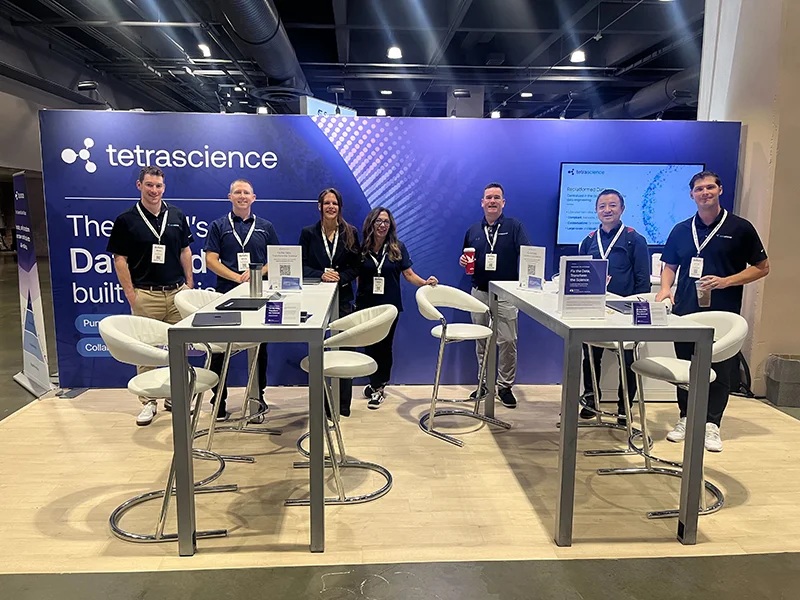
The company’s stated values include transparency, customer alignment, collaboration, and attention to craft. Its operating model makes the customer-alignment claim tangible: embed specialists close to the work. Wang’s 2026 announcement of a European headquarters in Basel explicitly tied the move to working alongside scientists in a major life-sciences cluster.
The partner network reflects the same division of labor. Microsoft contributes Azure infrastructure; NVIDIA brings accelerated computing and scientific AI capabilities. Databricks and Snowflake connect the company to enterprise data platforms. A January 2026 Thermo Fisher collaboration extends the instrument-and-informatics side. TetraScience occupies the layer where those capabilities meet experimental data.
05Buy the missing hours
The business runs on enterprise platform licensing and implementation expertise. At launch in August 2025, Tetra Workflows was included in existing platform licenses without an additional workflow charge. A buyer still has to account for connecting sources, governing metadata, validating regulated workflows, and changing daily routines.
That makes fit important. A heterogeneous instrument fleet with repeated manual transfers offers a stronger case than one isolated instrument with a simple export. Without reliable sample identifiers and scientific context, faster movement can simply spread ambiguity. A platform cannot supply experimental discipline by itself.
The work continues after deployment. September 2026 updates added ingestion-health alerts and clearer job monitoring. October’s upstream-development tools connect clone selection, culture measurements, and bioreactor data. For a reader considering similar work, the useful starting exercise is modest: follow one result, count every manual handoff, and measure the hours consumed. That is where the purchase becomes a testable proposition.