A garage is a forgiving place to start a software company. There is room for enthusiasm, a few computers and the comfortable belief that most difficulties can be solved by writing more code. Alexey Spas began there in 1998, programming with fellow students. The business they formally launched in 2000 would eventually employ more than 400 professionals. Somewhere along the way, the interesting problems stopped fitting on a screen.
Today, the Instinctools co-founder and CEO is occupied with a question that sits awkwardly beside the promises of artificial intelligence: who will make all this cleverness work together? His answers involve architecture, accountability and the economics of delivery. These are less photogenic subjects than a talking machine. They also have the advantage of remaining relevant once the demonstration ends.
From Grodno to the management problem
Spas was born and grew up in Grodno, Belarus. At the local university’s physics and engineering faculty, he enjoyed a practical education that put coding, building and testing alongside theory. Later came an MBA in Germany. The sequence matters: he encountered the work of making things before the work of directing the people who make them.
The early business developed websites and digital solutions for local customers, then built relationships with German companies. Content management and Java were among its initial specialisms. A small programming group had acquired clients, commitments and the beginnings of an international business. The garage had done its job; it could hardly be expected to supply a management structure as well.
Spas describes growth as a succession of occasions when the company’s existing practices no longer suited its size. Instinctools brought in outside consultants, invested in management education and used strategy sessions to reconsider its direction. There is an appealing lack of theatricality in that account. The founder learned to invite other people into the answer.
His early career also included software development at GrodnoOblGaz and technical team leadership at WGroup in Grodno. His technical background spans databases and web applications. That is useful context for a CEO now discussing AI: he has worked among the systems that a new generation of software is expected to understand.
The present management team makes that change visible. Alongside Spas, Instinctools lists Gunthilde Sohn as managing director for DACH, Chad West as managing director for the United States and Alexey Astakhov as vice president of engineering. Finance and human resources have their own leaders. Responsibilities that might once have crowded onto a founder’s desk now have named owners.
The company describes its delivery approach in similarly explicit terms: transparent communication, personal responsibility and clear escalation routes. Such arrangements can sound rather dry beside the romance of a garage. They become considerably more attractive when a customer needs an answer and would prefer to receive it before the next anniversary.
A chatbot goes to a conference
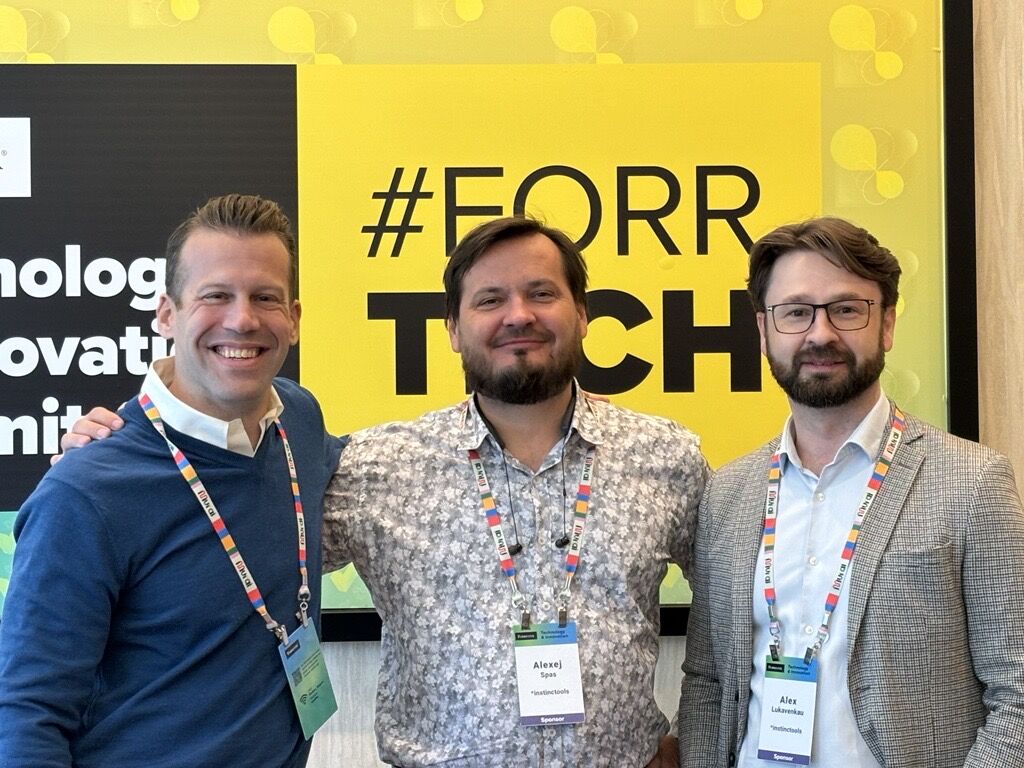
By September 2024, Spas was in Austin for the Forrester Technology & Innovation Summit. Instinctools attended as a Silver Sponsor, with Spas joined by US managing director Chad West and head of sales Alex Lukavenkau. The company brought a conversational AI product called ChadBot. A technology conference is perhaps the one social occasion where arriving with a chatbot seems entirely ordinary.
ChadBot combined a web interface, speech recognition and a server connecting its components. The team discussed enterprise automation, resilient operations and system integration. Those subjects show what Spas’s interest in AI looked like in practice: a working product accompanied by the plumbing required to make it useful.
The photograph offers a welcome interruption to the language of enterprise technology. There are colleagues standing together, conference badges in view, beneath an extravagantly yellow sign. Software businesses may sell abstraction, but they still send actual people into rooms to explain what they have built.
Clever colleagues need coordination
In his 2026 discussions of enterprise AI, Spas turns repeatedly to coordination. An agent may complete a task successfully and still contribute little to the larger process. Give several agents separate instructions, partial information and no common memory, and the organization acquires another management problem.
His concern is continuity. Work crosses departments and applications; decisions have histories; permissions differ. A system that performs well in one conversation can struggle when it must carry context into the next action. Spas argues for shared objectives, defined responsibilities and an orchestration layer that lets agents operate together predictably.
It is easy to recognize the organizational resemblance. A human team also needs to know who owns the next decision and what happened before a task arrived. In Spas’s account, the arrival of digital workers gives those familiar questions fresh technical consequences. A collection of impressive individual performances still needs someone to arrange the handoffs.
- 01Shared
context - 02Coordinated
agents - 03Governed
actions - 04Reviewed
results
A conceptual view of the operating discipline behind his AI argument.
Instinctools’ response includes GENiE, its platform for connecting enterprise agents and workflows. In May 2026, Spas identified both GENiE and AI-assisted software development as areas of investment. He framed the ambition around practical business use. The vocabulary has changed since the content-management years, but the work still involves getting information to the right place.
He applies a similar test to client relationships. Instinctools assigns a dedicated account executive aligned with the customer’s timezone and uses regular satisfaction reviews to adjust delivery. For Spas, understanding the customer’s business belongs inside the engineering engagement. Someone has to notice whether a technically completed project has delivered anything the client can use.
An experiment with a closing date
Spas’s current strategy concentrates on mid-market organizations with roughly $200 million to $2 billion in revenue. These are businesses with substantial operational complexity and limited appetite for sprawling implementation programmes. His proposed relationship ties the work to outcomes, while using AI to extend the abilities of existing teams.
He also describes a practice he calls “stop-discipline”: give an AI initiative a budget and a date by which it must demonstrate paying-customer demand. If it misses that test, end it. An experiment can be allowed to fail without being allowed to become a permanent guest.
“If it doesn’t, we wind it down.”
Alexey Spas, on AI initiatives that miss their commercial test
That rule gives the talk of adaptability a useful edge. Keeping every possibility alive consumes time and attention that could go elsewhere. There is a difference between remaining curious and maintaining an expensive museum of unfinished intentions. Spas’s account makes room for curiosity while asking it to keep its receipts.
His June 2026 writing about AI-generated code offers another version of that concern. Faster coding can shift the workload into review, testing, security and maintenance. The resulting software still has to survive contact with a company’s real systems. Producing it quickly does little to settle who understands it or who will repair it.
For a founder who began by programming, this is a revealing emphasis. He is watching the tasks around the code acquire greater weight as generation becomes easier. A release may arrive with an impressive stopwatch reading and a thoroughly unimpressed maintenance team. The bill has simply found another desk.
Still tinkering, occasionally unavailable
Spas continues to experiment personally. He has described using ChatGPT, NotebookLM and Microsoft Copilot, working with Cursor, and building small tools with Claude Code or n8n. Connecting applications through APIs remains part of his own working life. The chief executive still appears interested in what happens when one piece of software starts talking to another.
He also protects a quiet day each week for reflection and strategic thinking, alongside regular conversations with his team. That is a modest but distinctive detail in a profession fond of displaying crowded calendars. Thinking has an unfortunate reputation for looking like an empty appointment.
In April 2026, he joined Forbes Technology Council, adding another setting for professional exchange. He expressed an interest in learning through conversations with peers as well as contributing his experience. His subsequent writing has examined agent control, AI readiness and document management. These are subjects close to the ordinary friction of running a business.
Four hundred people. A three-person proposition.
On October 23, 2026, Spas published his case for AI pods: small groups of senior engineers supported by managed AI tools. Instinctools’ version centres on three professionals, with specialists joining as needed. People retain responsibility for architecture, product decisions and production approval. AI takes on portions of execution.
Company scale and delivery-unit design measure different things. The pod proposal concerns how individual engagements are staffed.
The proposal includes an initial discovery period and a bounded pilot, measured against an agreed baseline. Spas also names the conditions that can defeat it: slow customer decisions, unclear scope and restrictions on AI use. These qualifications make the idea more interesting. A delivery model needs a description of where it breaks.
There is a fitting circularity here. The student who once worked in a small programming group now leads a company large enough to propose a different way of organizing small groups. The tools are considerably more elaborate. The challenge remains recognizable: arrange people, information and responsibility so that something useful reaches the customer.
Spas’s story keeps returning to that practical test. The garage supplied a beginning. Growth demanded management. AI now demands coordination. Across those changes, his attention has moved toward the conditions that let technical work earn its place in a business. Even a very clever machine, it seems, benefits from knowing what the job is.