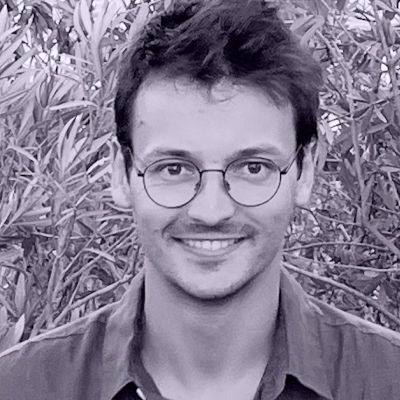
Founder • Scientist • Paris
Alexandre Pasquiou
He spent his PhD asking which artificial brain best predicts a human one. Then he built a company for the data nobody romanticizes - the rows, the columns, the catalogs that quietly run commerce.
He spent his PhD asking which artificial brain best predicts a human one. Then he built a company for the data nobody romanticizes - the rows, the columns, the catalogs that quietly run commerce.
Ask most of the AI world what counts as data and they will hand you a paragraph or a photograph. Alexandre Pasquiou hands you a spreadsheet. His startup, Neuralk-AI, is built on a stubborn observation: the data that actually decides whether a business wins or loses is not prose. It is tabular - SQL tables, CSV exports, product catalogs, transaction logs. The boring stuff. The valuable stuff.
"Data with real value for companies is data that was identified a long time ago, structured in the form of a table," he told TechCrunch when Neuralk announced its seed round in February 2025. It is the kind of line that sounds obvious until you notice that nearly every headline-grabbing model of the last few years was trained to do something else entirely.
Large language models are spectacular at conversation and search. They are far clumsier at the unglamorous prediction problems that keep a retailer alive - deduplicating a messy catalog, flagging a fraudulent order, forecasting how many units to stock. "LLMs are great for search and natural user interaction," Pasquiou has said, "but they have limitations with classic machine learning." Neuralk's bet is that those problems deserve a foundation model of their own.
"Enterprise data is tables, not paragraphs or images. Until now, no foundation model was built purposefully for it."
- NEURALK-AI MANIFESTO
Catalog cleansing. Smart deduplication and enrichment. Fraud detection. Personalized recommendations. Demand forecasting for inventory and pricing - delivered as instant predictions through an API.
His doctoral work fed people an audiobook inside an MRI scanner, then asked which language model - GloVe, LSTM, GPT-2, BERT - best predicted the brain signals that followed.
Models are "not born equal" at fitting brain data. Architecture mattered less than expected. Training mattered more. Published at ICML, 2022.
A follow-up stripped syntax or semantics out of the training text to see which brain regions cared. A scalpel made of missing words.
Find the receipts on Google Scholar and ResearchGate. The code lives on GitHub as @AlexandrePsq.
Before the cap table, there was a cap of electrodes - or rather, a magnet. Pasquiou trained as an engineer at CentraleSupelec, then went deep into computational neuroscience for a PhD at Inria, inside the MIND team at NeuroSpin, supervised by Bertrand Thirion and Christophe Pallier. His question was the kind that sounds like science fiction and reads like statistics: how well can an artificial language model predict what a living brain does while it listens?
The answer reshaped how he thinks about machine intelligence. It is not the cleverness of the architecture that wins - it is the learning. That lesson, that representations earned through training beat representations assumed by design, is the seed of everything Neuralk now builds. He had spent years measuring how machines approximate the most structured signal there is. Turning that gaze toward the structured data of commerce was less a pivot than a logical next chapter.
Along the way he did the unglamorous apprenticeship too - data science roles at delivery startup Stuart and dating app happn, plus consulting at Eternum Energy. The founder who insists "boring" tabular data is where the value hides is a man who has cleaned plenty of it himself.
The 2022 ICML paper has a title that doubles as a worldview: neural language models are not born equal to fit brain data, but training helps. In plain terms, Pasquiou and his collaborators put GloVe, an LSTM, GPT-2 and BERT head to head, then scored each by how faithfully it could predict the functional MRI time-courses of people listening to a story. The verdict was humbling for anyone who worships architecture. A model's raw design is a smaller part of the story than what, and how much, it has learned.
The follow-up work was sharper still. By selectively removing syntax or semantics from the training corpus, the team could watch which regions of the brain a stripped-down model could no longer explain - using deliberately impoverished networks as a probe for how the brain divides labor between meaning, grammar and context. It is the rare research program that treats a neural network as both subject and instrument.
That habit of mind - measure first, believe second, publish the scorecard - is precisely what shows up in Neuralk's decision to open-source TabBench. A founder who built his reputation on rigorous comparison was never going to ask the market to take a benchmark on faith.
CentraleSupelec - engineering degree.
Inria, MIND team - PhD in computational neuroscience at NeuroSpin/CEA.
Advisors - Bertrand Thirion and Christophe Pallier.
Still publishing - listed on Google Scholar, ResearchGate and arXiv.
LLMs are great for search and natural user interaction - but they have limitations with classic machine learning.
Neuralk-AI was founded in 2023 with Antoine Moissenot, an Ecole Polytechnique engineer, and set up shop at Station F in Paris - on a street, fittingly, named 5 Parvis Alan Turing. The pair recognized the same gap from two angles: AI had transformed text and images while the spreadsheets of the enterprise sat untouched. Their fix is a "verticalized tabular foundation model," starting with commerce.
The product line reads like a small constellation. Dawn is the flagship tabular foundation model, released in 2025 and reported to outperform stalwarts like XGBoost, CatBoost and even LLMs on tabular tasks. TabBench is the open-source benchmark the team shipped so the whole field could keep honest score on real enterprise workflows. Around them sit agentic workflows that analyze, clean, enrich and predict - then watch for when the model needs a tune-up.
The early customer list is a who's-who of French retail and commerce infrastructure: E.Leclerc, Auchan, the marketplace giant Mirakl, and Lucky Cart. The promise is deceptively plain - make predictive AI on structured data as simple to summon as an API call, for the eighty-odd percent of business data that has always been tabular.
A $4M seed in February 2025, led by Fly Ventures, with StemAI and Station F. The angel list is the real signal:
Neuralk's claim, on tabular tasks:
Illustrative of Neuralk's stated benchmark claims, not exact figures.
From the lab bench to the cap table, the through-line never changed: take the most structured signal you can find, and teach a machine to predict it.
Skeptics said transformer architectures would not scale to structured, tabular domains. Pasquiou's whole bet is that they were wrong - and that the proof is a benchmark anyone can run.
Data science at Stuart and happn; consulting at Eternum Energy.
Computational neuroscience at NeuroSpin/CEA - modeling how language models predict human brain activity.
Publishes "Neural Language Models are not Born Equal to Fit Brain Data, but Training Helps" at ICML.
Co-founds Neuralk-AI with Antoine Moissenot, based at Station F, Paris.
Raises $4M seed led by Fly Ventures. Ships the Dawn model and the open TabBench benchmark.
Neuralk works out of 5 Parvis Alan Turing at Station F. The address alone is a thesis statement.
Rather than hoard a benchmark, the team open-sourced TabBench so rivals could measure against them honestly.
He went from decoding the human brain to decoding the shopping cart - same math, very different stakes.
His favorite kind of data is the kind everyone calls boring: rows and columns, not chat logs.
He still publishes. The CEO title sits next to a Google Scholar page and a ResearchGate profile.
Hugging Face's Thomas Wolf and Mirakl's founders wrote personal checks - a peer vote, not just a VC one.
The stated ambition is plain and large at once: make predictive AI on structured data accessible to every data professional, and build the best tabular foundation model in the world. Less a static, expert-only project, more an autonomous workflow that cleans, enriches and predicts on its own - then tells you when it needs to learn again.
It is a Seth-Godin-sized idea wearing a spreadsheet's clothes. The flashy frontier is text and images. The valuable frontier, Pasquiou keeps insisting, is the one already sitting in every company's database - waiting for a model that was actually built for it.
Sources: TechCrunch, Ecole Polytechnique, neuralk.ai, ai-PULSE, FinovateEurope, ICML/arXiv, Google Scholar. Profile photo via ai-PULSE 2024. Benchmark bars are illustrative of Neuralk's stated claims, not exact published figures. Facts drawn from public sources; where details were unverifiable, they were omitted.